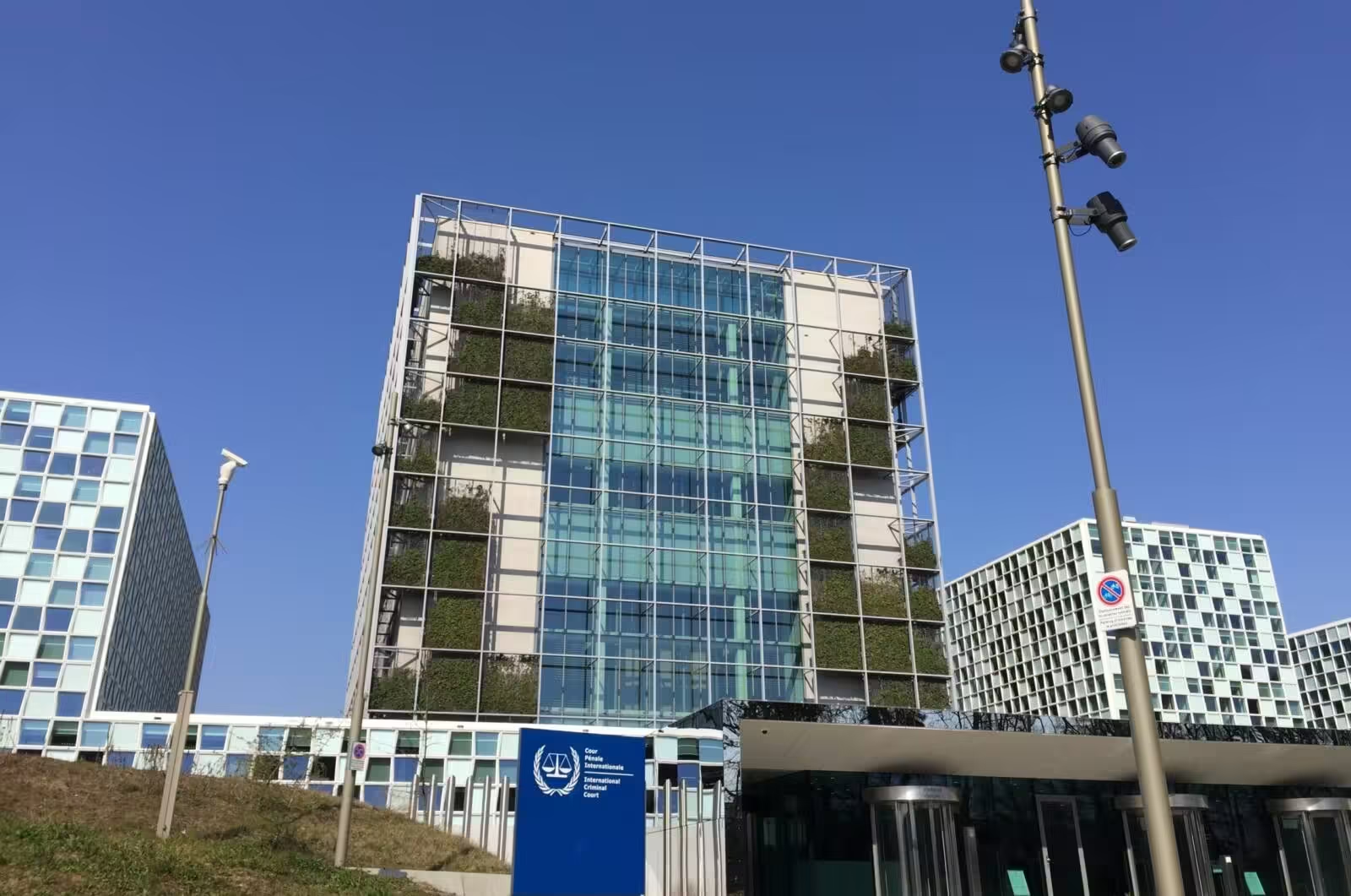

From Nuremberg to The Hague, the US championed courts that hold perpetrators of atrocities to account. In this commentary, four former war crimes ambassadors and prosecutors argue that sanctioning ICC judges abandons that legacy and invites a president to turn on judges at home.
It has been 80 years since the Nuremberg tribunal released its historic judgment, for the first time ruling that those responsible for the worst crimes known to humankind could be held individually criminally liable under international law. The United States stood at the center of those efforts—establishing the tribunal, providing a judge and a chief prosecutor, sharing evidence, and insisting that the defendants deserved due process of law, which—of course—they had cruelly denied their victims. After facing a long hiatus during the Cold War, the field of international criminal law finally enjoyed a renaissance in the 1990s, inspired by the Nuremberg precedent.
The United States was equally as instrumental in establishing the modern international criminal tribunals, including a permanent International Criminal Court. Indeed, multiple Americans—diplomats, judges, lawyers, investigators, analysts, and civil society partners—helped build the modern global architecture that adjudicates atrocity crimes, offers victims a measure of justice, and holds the world’s worst actors accountable for their international crimes. This legacy is reflected in decades of bipartisan policy; thousands of pages of treaty negotiations, briefs, and jurisprudence; the contributions of hundreds of US professionals who investigated, prosecuted, defended against, and judged allegations of international crimes; and the tireless work of nongovernmental organizations that partnered with the United States to face down the beast of impunity.
That is why the Trump administration’s decision to sanction sitting judges of the ICC—and to defend those sanctions in court against multiple legal challenges brought by the judges themselves and a coalition of NGOs—and its threats to go further and sanction the Court itself represent not only a shocking legal overreach, but also a profound moral rupture.
The Legal Failure: Sanctions Without Statutory Basis
The Executive Order outlining the sanctions relied on the International Emergency Economic Powers Act (IEEPA), a statute designed for genuine national security emergencies. Congress intended IEEPA to be used sparingly and only when the United States faces an “unusual and extraordinary threat.” In the past, sanctions under IEEPA have been issued against drug kingpins, terrorists and terrorist organizations, war criminals, and corrupt actors. The administration has claimed that ICC investigations into alleged crimes in Gaza and elsewhere constitute a comparable threat.
But this claim collapses under scrutiny.
- Whether one agrees with the ICC Prosecutor’s choices or not, the ICC is exercising a lawful judicial function authorized under the Rome Statute, a treaty ratified by over 120 United Nations member states.
- The United States is not a party to that treaty, but non-membership does not transform a judicial investigation into a national security emergency. This is especially true when one considers that the United States, even as a non-party, is entitled to challenge decisions of that body through amicus curiae (“friend of the court”) submissions to the Court, which it has done in the past.
- No evidence has ever been produced showing that the ICC judges subject to sanction, who are the nationals of US allies, posed any immediate threat to US national security interests or personnel.
- Furthermore, even as a non-party, the United States has over the years supported the work of the Court through information sharing, witness protection, offering rewards for fugitives from justice, and other tangible ways. This is the very same institution that the administration now claims poses an acute threat to the United States.
The administration’s position fails the basic administrative law test: government agency actions must be grounded in facts, not on conjecture, political preferences, or fear-mongering. Courts reviewing sanctions routinely require a rational connection between the alleged threat and the statutory authority invoked. Here, that connection is non-existent.
NGOs challenging the sanctions order have argued—correctly—that it exceeds presidential authority because it invents a threat that Congress never contemplated. The President cannot manufacture an emergency simply because he disagrees with a court’s decisions. That is not how IEEPA—or the separation of powers, for that matter—works.
In their complaintplaintiffs ask the court to declare the sanctions unlawful and bar their enforcement. They have since moved for a preliminary injunction — a court order halting the sanctions while the case proceeds. This requested relief rests on a firm foundation: the Executive Order is arbitrary, capricious, and unsupported by the administrative record and violates the Administrative Procedure Act, the statutory limits Congress placed on emergency powers, and the fundamental principle of judicial independence in the performance of judicial duties. The United States has long advanced the latter principle in its global human rights policy, criticizing foreign government officials who threaten or attempt to intimidate judges for carrying out their judicial functions.
The Moral Failure: Turning Away From America’s Proud Legacy
Even if the Executive Order were legally defensible—which it is not—it would still represent a moral failure of historic proportions.
For decades, the United States championed the idea that atrocity crimes must be met with accountability. American prosecutors led the charge at Nuremberg after World War II. American diplomats helped design the first modern international criminal tribunals focused on the former Yugoslavia and Rwanda. American military lawyers trained partners around the world in the law of armed conflict, including universal fair trial standards. The United States seconded some 22 professionals to the Office of the Prosecutor of the Yugoslavia Tribunal to carry out its statutory duties and dozens of American citizens have worked at the ICC. American NGOs documented mass atrocities, supported victims, and pushed governments—including our own—to uphold the rule of law and prevent impunity.
Sanctioning ICC judges for doing their jobs betrays this proud legacy. It signals that the United States is willing to threaten and intimidate independent judicial actors. It aligns the United States with authoritarian governments that fear international justice because they fear scrutiny of, and accountability for, their depredations. It undermines the credibility of every American diplomat who has ever urged another nation to respect human rights, uphold universal fair trial rights, or cooperate with an international court. And it sends a chilling message to victims of atrocity crimes: that the United States, once a cornerstone of global accountability, is now willing to dismantle what may be the only institution capable of delivering justice.
The Ethical Failure: Abandoning Partners Who Have Long Stood With Us
The NGOs now seeking injunctive relief are not fringe actors. They are the same organizations that have worked alongside the United States for decades—documenting war crimes, supporting survivors, and strengthening the rule of law. Their challenge to the Executive Order is not political. It is principled.
They argue that the administration’s reasoning ignores the ethical and legal obligations the United States has embraced for generations: to support independent courts, to protect judicial actors from retaliation, and to stand with those who fight impunity. By sanctioning ICC judges, the Trump administration has placed the United States on the wrong side of the enduring fight against impunity.
A Dangerous Precedent at Home
Attacking the ICC poses a domestic danger as well. If a President can sanction foreign judges for issuing lawful judicial orders with which he disagrees, what stops a President from sanctioning American judges for decisions he dislikes? What stops a President from punishing prosecutors, investigators, or grand juries for doing their jobs in the pursuit of justice? The Executive Order does not merely target the ICC—it targets the very foundation of judicial independence itself.
The federal courts reviewing the preliminary injunction motions now face a defining question: whether the President may invoke emergency powers — without evidence, without statutory grounding, and without regard for the constitutional principles that restrain executive authority. The answer must be no. The United States must not abandon its legacy as a champion of international justice. Nor can it afford to normalize executive retaliation against judicial actors. The durability of the rule of law—domestic and international—depends on it.
Stephen J. Rapp and Beth Van Schaack are former US ambassadors-at-large for war crimes issues and global criminal justice, respectively. David M. Crane, Brenda J. Hollis, and Rapp are former chief prosecutors of the Special Court for Sierra Leone. Together, they filed an amicus brief supporting the rights groups’ lawsuit against the US sanctions.
Opinions expressed in JURIST Commentary are the sole responsibility of the author and do not necessarily reflect the views of JURIST’s editors, staff, donors or the University of Pittsburgh.
Source: www.jurist.org