




Whitman faculty and students are envisioning the future of computer science—and it’s about human connection
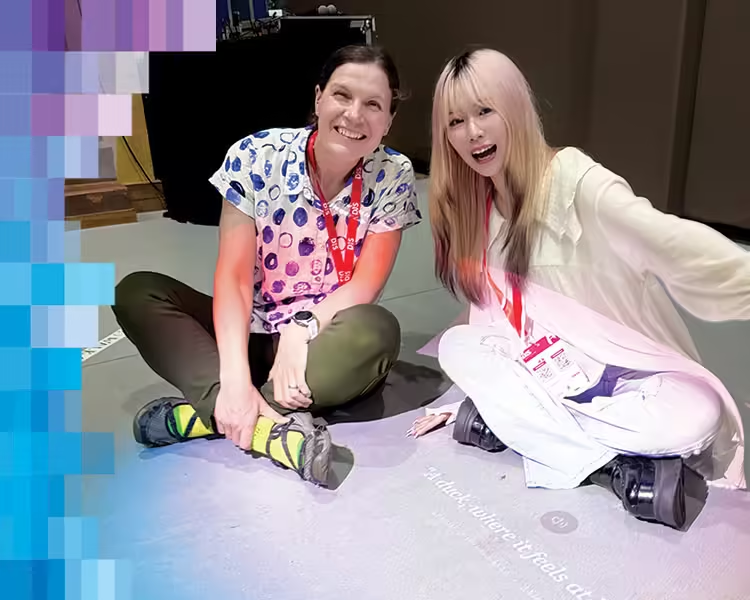
Painting with a sonic palette. Alice Chan ’27 traveled to Singapore with Assistant Professor of Computer Science Jordan Wirfs-Brock to present EchoField at the Association for Computing Machinery’s Designing Interactive Systems conference. Conference-goers were even able to add their own sounds and collaborate on a sonic map of the conference experience.
In a dark room, a vibrant colorscape spills over the floor. With each step you take, the sounds of Tokyo slowly emerge around you—a meandering patchwork of sonic memories corresponding to the swirl of colors at your feet: Ambient noise in a temple is bright white. Clattering wind is pale aqua. Pattering rain is red.
This is EchoField—an immersive, interactive audio archive developed by Alice Chan ’27 as a final project for her Computer Science course, Your Life in Sound (CS-100A), taken in her junior year. The class is taught by Assistant Professor of Computer Science Jordan Wirfs-Brock, who encourages her students to think expansively about how humans interact with sound and how creating digital audio archives can connect people more closely with their experiences.
To create EchoField, Chan uploaded brief sound clips she recorded while studying abroad in Tokyo, pairing each with a color. As she started recording sounds in her life, she realized their power to evoke emotion and memory. “When you explore, you listen to the audio and reflect on what happened back then for yourself,” she says.
Chan, a Davis United World College Scholar from Hong Kong, who is studying Japanese while designing her own major in Human-Computer Interaction, hopes to become a user-experience designer, making technology easier for people to use.
EchoField came from her desire to create an app where users could immerse themselves in—and share—the sounds of daily life. She’d learned some coding skills in past classes, but used “vibe coding,” or collaborating with an AI program to write code, to create the first version of EchoField.
“
I feel like technology has helped me build connections in many ways. I believe in its potential to create even more connection.
”

Wirfs-Brock was impressed with Chan’s concept and enthusiasm and invited her to work together to refine EchoField and submit a paper about it to conferences. They teamed up with William Bares, Associate Professor of Computer Science, who specializes in designing interactive experiences using motion tracking.
The group helped EchoField leap off the computer screen and into the physical world. Using motion-capture technology, people can now explore a projected image of the colorful archive as audio fills the air, “being in the sound instead of just listening to it,” Chan says.
In June 2026, Chan and Wirfs-Brock presented EchoField to technology researchers from around the world at the Association for Computing Machinery’s Designing Interactive Systems conference in Singapore.
Chan says Whitman has given her the opportunity to study many aspects of how humans interact with technology, including courses in Computer Science, Psychology, Human-Centered Design and Sociology. She believes that technology is important for bringing people together in a global society, where we’re often far apart.
“I feel like technology has helped me build connections in many ways,” she says. “I believe in its potential to create even more connection.”
Experience EchoField
Play with a sonic palette of sounds recorded in Walla Walla and Singapore. Try it now. Click on the library icon to start exploring sounds recorded around campus, at the Designing Interactive Systems conference and beyond.

‘They want to change the world.’ Today’s Whitman students are searching for innovative ways to harness computer science in the service of humanity, says Chair and Associate Professor of Computer Science William Bares. And the department is evolving to give them the skills to do it.
Preparing for a Collaborative Future
The values embodied in Chan’s project—human innovation, creativity and empathy—will always be an essential part of computer science, Bares says.
As Chair of Whitman’s Computer Science Department, Bares envisions an interdisciplinary future where computer scientists and experts in other fields come together, sometimes in collaboration with artificial intelligence, to discover the ideas that AI can’t come up with on its own.
“Creative ideas, entrepreneurial ideas, often come from thinking about a problem from a different perspective, being familiar with different fields,” he says.
Bares and his colleagues in the Computer Science Department are working to design a flexible curriculum that allows students to incorporate ideas from different disciplines and be more adaptable in the face of rapid changes in the computing world.
By leaning into its liberal arts mission, Whitman can help Computer Science students broaden and deepen their skills in ethics, philosophy, communication, critical thinking and human-centered design, Bares says.
Those fundamentally human skills give graduates an edge in a tech industry where traditional career paths are increasingly being reshaped by generative AI.
By providing more opportunities to create projects like EchoField, Whitman can help students build a portfolio that showcases their ability to create impactful work about meaningful topics.
“Liberal arts colleges are really positioned perfectly to engage with the future,” Bares says. “These are skills that build multiple pathways for students, so they’ve got that ability to be flexible, which is what the current market demands.”
“
Liberal arts colleges are really positioned perfectly to engage with the future.
”
—William Bares, Chair and Associate Professor of Computer Science
A Meadow of Ideas
Bares compares traditional computer science courses to a single-crop field: focused on one subject, such as data structures, without much cross-pollination.
His vision for Whitman’s Computer Science program is to make space for classes that he compares to meadows: intricate and diverse, drawing in other disciplines the way an abundant landscape attracts and energizes wildlife.
Introductory-level classes like Your Life in Sound innovate by giving students an early opportunity to be creative and imagine pathways to research and entrepreneurship beyond the traditional software developer role, Bares says.
In summer 2024, the faculty met to rewrite the department’s learning outcomes and begin reshaping course offerings and requirements. The updated curriculum emphasizes communication, collaboration and self-directed learning, as well as critical evaluation of computational technologies—considering whether technologies are efficient and ethical and thinking about the impact they have on society, communities and environments.
Bares says this work is inspired by students’ passionate interest in making the world better. “They want to do positive things for the environment, they want to help people, they want to know that what they’re learning and doing has a benefit.”
Some of the new courses and requirements have already been rolled out, and much like product testing, the department is gathering student feedback so that faculty can continue to improve their course offerings and teaching.
Bares hopes that the next iteration of the Computer Science curriculum will make room for even more courses like Your Life in Sound and innovative senior capstone projects, such as interactive data installations, independent research and startup launches.
In concert with interdisciplinary classes, Bares also dreams of creating more opportunities for students to showcase their projects to the campus community and the public—and he envisions larger, more accessible spaces for these immersive experiences on campus.
“This is the future of computer science,” Bares says. “We believe this is going to be what will excite students to want to come here, and also faculty to want to come here and be part of this.”
Meet the Computer Science Faculty

William Bares, Chair and Associate Professor
Bares’ research interweaves data visualization, graphics and intelligent user interfaces. He leads the Immersive Stories Lab, which provides spaces for students, faculty and staff members across disciplines to create projects using projection, motion capture, and virtual and augmented reality technologies. Bares has built collaborations with Whitman colleagues in fields as wide-ranging as Dance, Classics and Geology.

John Stratton, Associate Professor
Stratton studies strategies to improve computer software performance—saving time, energy and environmental resources. Recently, he’s focused on reducing the time it takes to run scientific simulations and image analyses in fields like biology. He directs the Whitman College Software Optimization Lab, or OptiLab, which hosts an online collection of his and his students’ software projects and case studies.

Eric Autry, Assistant Professor
Autry is the department’s newest member, joining the faculty in Fall 2026. He combines his expertise in mathematics, data analysis and simulation to address systemic biases in society. He was recently part of the Quantifying Gerrymandering research team at Duke University, which studied ways to quantify whether electoral maps fairly represent their populations.

Jordan Wirfs-Brock, Assistant Professor
Wirfs-Brock focuses on making data more meaningful and accessible through participatory sensory experiences like sound, vibration, touch and even taste. Her mission is to “empower people to use data as a creative material.” In 2024, she received a National Science Foundation grant to examine how people interact with sound and create tools that help them easily record and reflect on the sounds of their everyday lives.
In Their Corner

Peter, who majored in Economics, remembers when mainframe computers filled rooms the size of bank vaults.
“Through my lifetime, I’ve seen how the computer has effectively become the new way in which we process all human activity,” he says. “Studying the area is so critical in preparing young adults for what will be the way society’s organized.”
As a real estate developer in Santa Barbara, California, and former apparel industry entrepreneur, Peter has been closely observing the ways technology is shifting culture: changing the way businesses operate, the way people learn and the way humans relate to each other.
By investing in the Computer Science Department, he hopes to encourage Whitman researchers and students to embrace the changes happening in computing technology.
“Every educational institution has to adjust to societal changes, and the only way to really grow and prosper is to be able to understand those changes,” he says. “There are going to be future disciplines that will emerge and become super important, and you have to be in front of them.”
He and Naila chose to create a faculty salary endowment to ensure that the Computer Science Department has “the best possible people to attract the students and strengthen the program.”
A longtime donor who joined the Whitman Board of Trustees in 2019, Peter says he’s motivated to give back because of his own positive and enriching experiences at Whitman. He was an involved student-athlete who played varsity tennis, worked as a Resident Assistant, competed with the debate team and participated in student government. Years later, he’s still friends with many fellow Whitties.
“I hope that Whitman can continue to offer opportunities for young people, open their eyes and expand their horizons,” he says.
Investing in a Bright Future
Peter Lewis ’81 and Naila Lewis have had an impact on Whitman College that goes far beyond the Computer Science program. Their latest pledge commitment to the Employer Engagement and Immersive Learning Opportunities Endowment helped fund a new Seattle-based Director for Employer Engagement, Phil Marr, who hosted the first cohort of Whitman’s new Summer in Seattle program this summer.
Peter, who grew up in a small community in Indiana, says Whitman’s location in an agricultural area resonated with him, but he’s excited to see the college increase connections with Seattle’s urban environment and technology and career opportunities.
He says the endowment is “another great example where Whitman is seizing an opportunity and finding avenues that create more opportunity for students.”
The Lewises have also pledged to support the Whitman Annual Fund, which allows the college to make immediate investments in students’ success, such as scholarships, internships and research opportunities.
As the higher education landscape continues to evolve, “The Whitman Annual Fund is becoming more and more critical for sustainability for the college,” Peter says. “It’s part of the college’s vitality.”
Source: www.whitman.edu