


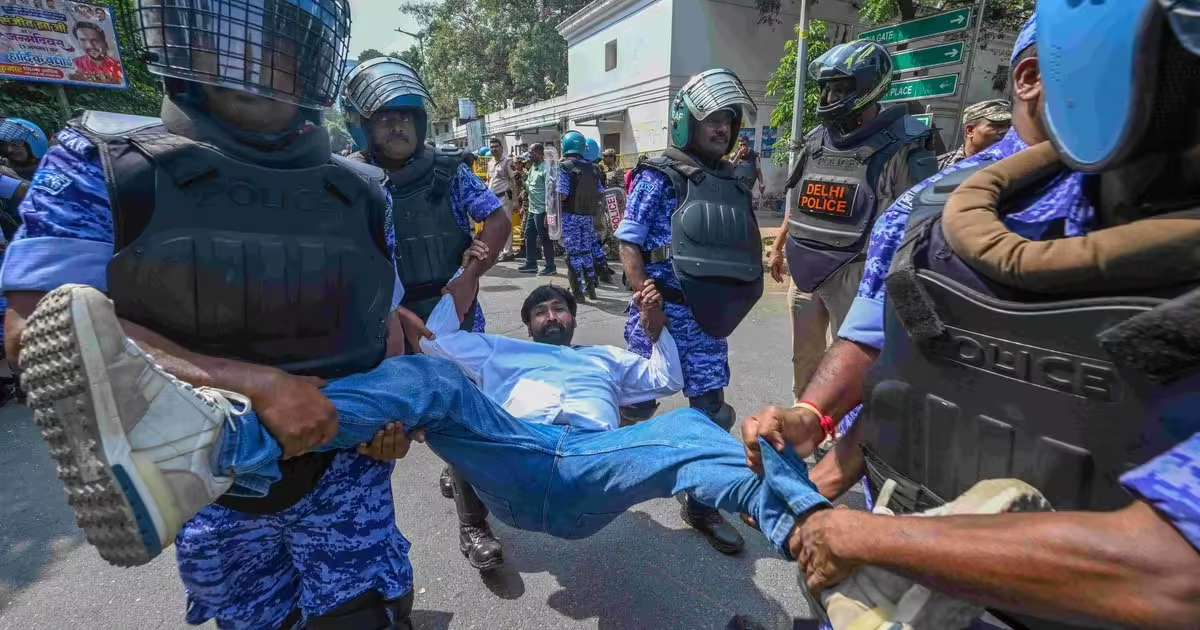

Delhi Police and paramilitary personnel detain a protesters on 10 October 2026 in New Delhi (Photo Credit: Raj K Raj/Hindustan Times via Getty Images)
India’s civic space is still rated as ‘repressed’ by the CIVICUS Monitor. The authorities persist in targeting activists, journalists, students and civil society through the misuse of draconian laws, arbitrary detention, censorship and the criminalisation of dissent. Over the past year, the Unlawful Activities (Prevention) Act (UAPA), the Foreign Contribution (Regulation) Act (FCRA), counterterrorism provisions and public order regulations have been consistently deployed to silence government critics, restrict civil society, and deter peaceful protests.
On 29th July, the country was added to the CIVICUS Monitor Watchlist due to serious decline in respect for civic space in Prime Minister Narendra Modi’s third term.
In August 2026, the UN Committee on the Elimination of Racial Discrimination (CERD) issued its findings on India. It found large-scale violations perpetrated by law enforcement officials against ethnic and ethno-religious groups, Indigenous and Tribal Peoples. These included racially motivated violence, excessive use of force, extrajudicial killings, arbitrary and prolonged detention without due process, torture, ill-treatment and sexual violence.
According to human rights groups, the national human rights institution is failing its responsibilities and should be downgraded by the Global Alliance of National Human Rights Institutions (GANHRI) accreditation body. Police still investigate police, appointments lack transparency and pluralism, civil society is sidelined, and serious violations go unaddressed.
Concerns over the state of India’s democracy have intensified amid growing criticism surrounding the independence and functioning of the Election Commission of India (ECI), headed by Chief Election Commissioner (CEC) Gyanesh Kumar. The concerns follow the nationwide Special Intensive Revision (SIR) of electoral rolls, which has resulted in around 130 million names being removed from the country’s voter lists.
Millions of people have reportedly complained that their names are missing, while opposition parties have accused the ECI of manipulating electoral rolls to benefit Modi’s Bharatiya Janata Party (BJP). The matter escalated further after an Indian Express investigation reported that Election Commissioners Sukhbir Singh Sandhu and Vivek Joshi had raised objections on at least 14 occasions over ten months to decisions concerning voter registration, deletion, restoration and access to electoral-roll data, including decisions they said had been taken without their knowledge. The revelations have prompted widespread protests and renewed demands for Kumar’s resignation.
In recent weeks, there were restrictions and a crackdown on protests in Delhi and Mumbai against electoral roll manipulation. There has also been a lack of accountability around the July 2026 CJP protests. An indigenous movement legal advisor in Arunachal Pradesh was served an FCRA notice, while an indigenous defender remains detained under a security law. Activists remain detained for a labour protest in Noida, while journalists continue to be targeted.
Peaceful Assembly
Restrictions and crackdown on protests in Delhi
The electoral controversy has triggered protests with the youth-led Cockroach Janta Party (CJP) – whose protests over irregularities in the medical entrance examinations preceded the resignation of Education Minister Dharmendra Pradhan in July 2026 – announcing nationwide demonstrations beginning on 2nd October 2026 demanding Kumar’s resignation, an independent inquiry into the SIR and restoration of pre-SIR electoral rolls.
The protest was supported by political parties and student groups, including the All India Students’ Association (AISA), the Students’ Federation of India, and the National Students’ Union of India.
Delhi: Security has been tightened in view of the protest call at Jantar Mantar on October 2. https://t.co/jOfSeNs3Vt
— IANS (@ians_india) October 1, 2026
On 2nd October 2026, police barricaded protest sites with police and paramilitary troops at multiple checkpoints and more than 1,000 security personnel deployed in and around Jantar Mantar – a prominent protest site a couple of kilometres from parliament. In Delhi, eleven metro stations were closed for entry and exit. Delhi Police earlier imposed Section 163, which bars gatherings of more than five people, the use of slogans, speechmaking and other protest activities. Police were also reportedly spotted without name tags.
On 2nd October 2026, Telecom companies were directed to suspend internet services in and around Delhi’s Jantar Mantar for 12 hours. According to reports, service providers such as Airtel, Reliance Jio and Vodafone Idea were ordered to suspend internet services from 9am to 9pm at Jantar Mantar and in areas within a 1.5 kilometre radius.
Police virtually banned protests ………………Delhi Police detains protestors near Jantar Mantar. #ElectionCommissionOfIndia https://t.co/yGy4Sgc5e6
— Kashmir News Trust༝ (@newsagencyknt) October 2, 2026
Despite these restrictions, protesters mobilised. According to reports, around 1000 were detained by the police in Delhi – including opposition leaders and members of student organisations. All India Students’ Association president Neha Bora, activist Yogendra Yadav, transparency activist Anjali Bhardwaj and senior advocate Prashant Bhushan were among the protesters detained on 3rd October 2026. Around 200 people were also placed under house arrest..
No protesters have been allowed to reach Jantar Mantar. Delhi Police is detaining people at the outer barricades and taking them away in buses, while no clear information has been provided about their destination. https://t.co/72P4U4RAcf
— India Spectator (@IndiaSpectator1) October 2, 2026
Police also registered cases against some on charges of violating orders banning mass gatherings in the centre of the capital. Cases were also registered under section 223 of the Bharatiya Nyaya Sanhita (BNS) for “disobedience to order duly promulgated by a public servant”. Some protesters were bundled into buses as they arrived.
There were also reports of unnecessary and excessive force. Videos online show people being physically dragged away from the Jantar Mantar protest site in central Delhi.
Three female journalists accused police officers of sexual harassment during the protests in the capital Delhi. The accusations by the women journalists include inappropriate touching by some police, including by an assistant commissioner of police (ACP). One journalist said that they went to a police station to file a case, but claimed the complaint was not registered immediately.
Police in Mumbai register cases against protesters
Hundreds of thousands gather at Mumbai’s Shivaji Park for CJP protest, chant ‘Gyanesh Kumar resign’
Watch: https://t.co/5JmsHnklPl— Maktoob (@MaktoobMedia) October 2, 2026
Mumbai Police denied permission for a protest by the CJP at Shivaji Park on 2nd October 2026, citing existing restrictions on gatherings at the ground, the absence of mandatory civic permission and concerns over traffic disruption.
CJP founder Abhijeet Dipke was briefly detained by Mumbai Police on 1st October after he was spotted carrying placards near the city’s Marine Drive.
On 3rd October 2026, Mumbai Police registered a case against Cockroach Janta Party (CJP) members and supporters over an allegedly unauthorised gathering at Shivaji Park during a protest demanding the resignation of Chief Election Commissioner Gyanesh Kumar.
According to police, around 400–500 people assembled near Gate No. 6 of the grounds, opposite the Meenatai Thackeray Memorial in Dadar West. The gathering took place between 4 pm and 7 pm on 2nd October, within the jurisdiction of the Shivaji Park police station.
They said protesters occupied a public road and raised slogans, creating a law-and-order situation. Loudspeakers were also installed without the necessary permission, according to police.
The case was registered under Sections 189(2) and 223 of the Bharatiya Nyaya Sanhita, along with Sections 37(1), 37(3) and 135 of the Maharashtra Police Act
Opposition leaders arrested as police break up protest
Police detain India’s leader of the opposition, Rahul Gandhi, in New Delhi as protesters demand the election chief step down over the deletion of 130 million voters from electoral rolls
https://t.co/W9KVUQul0A— TRT World (@trtworld) October 7, 2026
On 6th October 2026, police cracked down on protests by the opposition around the controversial voter roll revision. The opposition said 237 MPs from several parties took part in the march.
Police broke up a protest by opposition leader Rahul Gandhi and other MPs who were seeking the resignation of India’s top election official. Lawmakers carried placards, waved the national flag, and shouted slogans against Kumar during the march. Videos showing police forcing Gandhi on to a bus and preventing him from climbing out of the bus window
Gandhi had said earlier in the day that the opposition simply wanted to meet the election commissioners and ask questions about the voter roll revision.
On the day, security officials blocked the roads from India’s parliament to the election commission headquarters, with police barricading roads along the route between parliament and the commission’s office. Police officers, some carrying batons and wearing body cameras, reportedly outnumbered protesters along the route to the poll panel’s office.
Another mass protest in Delhi disrupted with restrictions and arrests
On a chaotic Saturday in Delhi, the police reportedly detained more than 7,000 protesters demanding the resignation of CEC Gyanesh Kumar.
Smaller protests were also held in Mumbai, Pune and Bengaluru.
Read all about it in our special newsletter.
https://t.co/ZTYcFpwujU— Scroll.in (@scroll_in) October 10, 2026
On 10th October 2026, at least 7,000 people were detained across Delhi in the latest demonstration by the Gen-Z-led Cockroach Janta Party (CJP) calling for electoral reforms.
Authorities deployed a sweeping security crackdown across Delhi with tens of thousands of security personnel deployed and roads barricaded ahead of the demonstration. Anti-riot vehicles equipped with tear gas launchers were stationed along key routes.
Several trains to and from major Delhi stations had been cancelled and dozens of metro stations were closed from the night of 9th October 2026. Bus services were suspended, and the capital’s borders sealed to buses, trucks, tractors and other large transport vehicles.
According to reports, at least 10,000 persons, including students, farmers and members of Dalit organisations, were detained across India ahead of the protest. Several student and civil society organisations alleged that police detained persons travelling to Delhi to stop them from taking part in the protest.
YouTuber Dhruv Rathee was detained by Delhi Police from his residence in Gurugram’s Sector 56 on 10th October ahead of the protest.
Police moved to break up the demonstration before it could begin, intercepting demonstrators on their way to Jantar Mantar, the designated protest site in the heart of the capital, chasing off some and detaining many others. Some were dragged away before being bundled into police vehicles and taken to temporary detention centers.
Restrictions on mobile internet and access to parts of the city added to the hurdles facing protesters. A 24-hour mobile internet shutdown was ordered in central Delhi covering a 4km radius around the protest sites. There were also reports that mobile internet was blocked at eight stadium-turned-detention centres across Delhi.
CJP प्रोटेस्ट: अभिजीत दीपके, सौरव दास और आशुतोष रांका को दिल्ली पुलिस ने किया गिरफ्तार
#AbhijeetDipke #SaurabhDas #CJP #AshutoshRanka
https://t.co/7hIx0iBEPg— NDTV India (@ndtvindia) October 11, 2026
CJP founder Abhijeet Dipke – who began the movement in May 2026 after India’s Chief Justice likened some jobless young people to “cockroaches” – was detained on 10th October 2026 after arriving at Delhi airport from Mumbai with other leaders Saurav Das and Ashutosh Ranka, who were expected to be at the forefront of the protest, were detained
Journalists were also targeted. According to reports, journalists covering protests on 10th October 2026 were put on buses and taken to locations including Chhatrasal Stadium and Chanakyapuri police station, alongside hundreds of protesters detained by the police. Reporters were filming the detentions when police personnel took them into custody, despite their displaying press cards. They also cited complaints that officers refused to acknowledge their journalistic credentials, with some allegedly remarking, “Everybody claims to be a journalist these days.” The statement further alleged that official reporting phones belonging to some of the detained journalists were taken away.
A group of lawyers were detained for nearly two hours while staging a protest outside the Supreme Court in New Delhi, demanding the resignation of the Chief Election Commissioner.
There were also reports that a group of men from right-wing organisations threatened and assaulted protesters and journalists in Connaught Place and near the MCD Civic Centre.
Amnesty International India, said: “From denying permission for a peaceful demonstration, halting all Delhi-bound trains, and sealing the city’s borders, to issuing an internet suspension order near the protest site, and pre-emptively arresting activists – India’s authorities are leaving no stone unturned in their bid to prevent this march from happening.”
A UN Human Rights Spokesperson said: “We are concerned by reports of mass detentions in India of demonstrators, protest leaders, members of civil society organisations, lawyers and journalists, before and during today’s large-scale demonstrations in Delhi. All those arbitrarily detained must be immediately and unconditionally released.”
The Supreme Court on 11th October 2026 passed an interim order directing that people peacefully assembling to protest must not be illegally detained. It directed that metro and railway services function normally, internet services remain undisturbed in accordance with law, and free movement of people and traffic be permitted in Delhi. The court also directed that lawyers must not be obstructed from discharging their professional duties.
Lack of accountability around CJP protests
There has been a lack of accountability around the crackdown on protests by the CJP that occurred in July 2026. A report by Amnesty International on 24th August 2026 found that police deployed unlawful and deadly force against peaceful protesters at the CJP march but not a single officer in Delhi has been held accountable.
Amnesty International published a new digital investigation documenting the police response to the protests. Witness testimony and video and photographic evidence verified by Amnesty International’s Evidence Lab confirm that police used weapons including pellet-firing shotguns, tear gas launchers, grenades, batons and electric shock devices against protesters between 20th and 24th July in Delhi and Siwan town in Bihar state. The weapons were deployed in a manner that breached international law and standards and domestic policing guidelines. Amnesty International also verified two instances of a police officer unlawfully using lethal force against a crowd.
Amnesty International’s Evidence Lab verified 17 videos filmed on 20th July in central Delhi across the area spanning Jantar Mantar, Sansad Marg and Connaught Place, and two videos filmed in Siwan town of Bihar state on 24th July. In videos filmed in Delhi, personnel from Delhi Police, the Rapid Action Force (RAF), and the Central Reserve Police Force (CRPF) were identified.
Association
Indigenous movement legal advisor in Arunachal Pradesh served FCRA notice
The CBI has accused lawyer and anti-dam activist Bhanu Tatak of receiving foreign funds in violation of the FCRA, prompting activists to call the case an attack on indigenous voices opposing major hydropower projects.
https://t.co/10R7HXa0Yi https://t.co/SMjj2Myhiq— Maktoob (@MaktoobMedia) September 17, 2026
Indigenous Farmers Forum (SIFF), was served a notice by the Central Bureau of Investigation, alleging she had violated the Foreign Contribution (Regulation) Act. The First Information Report alleged she received 17.6 lakh (USD 430,739) in foreign contributions without obtaining registration or prior permission under the FCRA.
The SIFF has been instrumental in consolidating opposition to an 11,000-megawatt dam project in Arunachal Pradesh while leading negotiations with the state government.
On 16th September 2026, the SIFF Youth Wing put out a statement condemning the case, calling it “harassment.” They said: “the timing and nature of this case registration appear deliberately designed to create disunity, sow doubts, and weaken the solidarity among SIFF members and the wider community.”
The FCRA has been used as a tool to silence peaceful dissent and the exercise of fundamental freedoms and obstruct independent human rights work in the country.
Continued detention of Indigenous activist
There have been calls from indigenous communities globally for the release of prominent Indigenous rights activist Pranab Doley who has been detained under the National Security Act (NSA).
As previously documented, Doley has been campaigning against conservation-related human rights abuses, and plans for a five-star Hyatt hotel near the notorious Kaziranga National Park — built on land Adivasi (Indigenous) people have rights to.
He was arrested on 13th July 2026. On 31st July 2026, a day after a local court granted Doley bail, the Assam government invoked the National Security Act (NSA) against him, stating that his activities “are prejudicial to the maintenance of public order as well as security of the state”.
Under the NSA, individuals can be held without charge or trial in administrative detention for up to 12 months on grounds of national security and maintenance of public order. This preventive detention violates various due process rights, including the presumption of innocence.
Activists remain detained for labour protest in Noida
“She talked a lot about Palestine,” recalled Srishti’s friend. “How does capitalism work? Why are politicians the way they are? These were the questions that we discussed at length.”
Anant Gupta talks to jailed artist Srishti Gupta’s friends and students.
Read Here: https://t.co/ZzOwO5qhGv— Scroll.in (@scroll_in) October 1, 2026
In Noida, artist and community organiser Srishti Gupta, 28, has spent more than five months in prison after supporting industrial workers demanding higher wages. Uttar Pradesh Police detained her on 11th April 2026. A member of the Progressive Artists’ League, Gupta also taught art to children and ran literacy classes for women in Delhi’s Shahbad Dairy neighbourhood.
“The common notion is that an artist is someone who paints. But an artist is also someone who fights for people and raises their concerns,” says Srishti Gupta’s friend. “And that’s exactly why she went to Noida and jail from there.”
https://t.co/yp31WOZgGo
@AnantGuptaAG & @priyali_dhingra report— Scroll.in (@scroll_in) October 1, 2026
Police had filed 11 cases against Gupta, and she had yet to obtain bail in two of them. A subsequent investigation by The Reporters’ Collective found that a bail order acknowledged she was absent from the site on the day of the violence, yet denied her relief on grounds including her role in organising workers and unspecified “inflammatory messages”. The investigation documented markedly different treatment of other accused, including a man granted bail whose absence from the violence was accepted as grounds for release.
The same mobilisation led to NSA detention orders against student activist Akriti Chaudhary. On 2nd September 2026, the Allahabad High Court quashed Chaudhary’s NSA detention and criticised the authorities’ conduct. On 24th September 2026, the Supreme Court clarified that this quashing remained in effect. However, she has yet to be released as the Uttar Pradesh Police have lodged 11 FIRs against her. Satyam Verma, a former journalist from Lucknow, who was also involved in the protests, remains detained under the NSA.
Umar Khalid competes six years in detention without trial
Umar Khalid, arrested on 13th September 2020, has now spent six years in custody without the trial in the larger-conspiracy case beginning. He faces charges under the draconian Unlawful Activities (Prevention) Act (UAPA), based on police allegations that organisers of protests against the Citizenship Amendment Act planned the violence.
On 30th September 2026, the Delhi High Court denied bail for the third time to Khalid and fellow activist Sharjeel Imam, stating that it could not modify an earlier Supreme Court order.
On 8th October 2026, he won the 2026 Front Line Defenders Award for Human Rights Defenders at Risk. Front Line Defenders said in a statement: “Umar Khalid is the 2026 Asia winner of the Front Line Defenders Award. To those who try to silence his work, he is seen as an “enemy of the state’’ and an “anti-national”, but to others, he is a national hero, a voice of the people, and a human rights defender.”
Ongoing violations in Kashmir
According to human rights groups, authorities continued to commit human rights violations in Indian-administered Kashmir (IAK) including their campaign of collective punishment through raids, cordon-and-search operations (CASOs) and property expropriation. Numerous Kashmiri journalists, human rights defenders, activists, and dissenters continue to be arbitrarily detained. Individuals were also arrested for their “anti-national” social media posts.
Expression
Journalist report police assault and religious targeting
“After I was mentally and physically assaulted, the police asked me my name. Yes, Khan is part of my name. I am a Muslim. And I know that it is because of this that you, the Delhi Police, beat me with lathis and slapped me. Delhi Police, you must be held accountable for this hatred, even towards a Muslim name. You have to answer for it.
The Delhi Police are displaying all this frustration and hatred because we ( me and Nafisa Khan) ask questions to the Delhi Chief Minister and India’s Home Minister.”
Shaheen Khan
Journalist— Maktoob (@MaktoobMedia) September 3, 2026
On 3rd September 2026, journalists Shaheen Khan and Nafisa Khan, associated with 4PM News Network, alleged that Delhi Police detained and assaulted them after they went to cover an event attended by Chief Minister Rekha Gupta in Saket. Shaheen alleged that officers targeted them because of their surnames and religion. A video released by their organisation showed them with bruises and welts, which the journalists attributed to police violence.
Delhi Police denied the allegations, saying the women had obstructed a designated VVIP route and refused instructions to clear it. The Press Club of India, Indian Women’s Press Corps, Delhi Union of Journalists and other media organisations condemned the alleged assault and demanded action against the officers involved.
Journalist facing criminal case over headline
On 28th August 2026, Kolkata Police registered a complaint against Anandabazar Patrika editor Ishani Dutta Roy, chief reporter Soma Mukherjee and other editorial staff over the newspaper’s description of violence at Jadavpur University as gerua gundami, or “saffron hooliganism”. The headline appeared on 21st August, following clashes between ABVP members – a nationalist student group – and left-affiliated student groups. A Hindu monk’s complaint accused the newspaper of hurting religious sentiments. The FIR invoked provisions concerning promoting enmity, outraging religious feelings and intentional insult.
At a rally that same day, West Bengal Chief Minister Suvendu Adhikari demanded an apology from the newspaper, warning that thousands of saffron-robed sadhus were ready to act and awaited his consent. Despite saying he was “not threatening the media”, he declared: “But an apology will have to be made.” He also instructed reporters not to publish the expression. These remarks intensified pressure on the newspaper alongside the criminal proceedings.
Lawyer SN Mookherjee, appearing for the #AnandabazarPatrika journalists, told the court that a petition seeking the quashing of the FIR had already been filed and sought urgent relief.
https://t.co/RXORPIi3Cm
The bench, however, said the matter should be filed in the regular course and would be heard according to the applicable procedure.— Scroll.in (@scroll_in) September 2, 2026
On 1st September 2026, men wearing saffron clothing smeared saffron paint on the newspaper’s Kolkata office. Videos showed police personnel standing nearby as the men painted the walls and shouted slogans. In a subsequent development reported on 24th September, the Calcutta High Court directed police not to take coercive action against the journalists until 15th December. The criminal case remained pending despite this protection.
Former student arrested over campus expression
On 7th August 2026, Mumbai Police arrested Abhirup Paul, a former student of the Tata Institute of Social Sciences (TISS), hours after a sessions court rejected his anticipatory bail application. The case concerned an October 2025 campus gathering commemorating former Delhi University professor G.N. Saibaba. Police alleged that participants raised slogans supporting jailed activists Umar Khalid and Sharjeel Imam and cited downloaded literature as evidence of possible Maoist links. Paul denied raising the slogans.
The sessions court also denied anticipatory bail to Kamakhya Prasad Das, another former TISS student. On 14th August, the Bombay High Court granted Das interim protection from arrest while considering his application. This was interim relief rather than a final determination of the allegations.
On 10th September, a Mumbai magistrate granted Paul bail, finding no prima facie material connecting him to Maoist or anti-national activity beyond suspicion. The court observed that possessing PDF books did not establish Maoist links and that continued detention would be unjust. Paul was required to report to police weekly until the charge sheet was filed.
Source: monitor.civicus.org