
Conventional electronics use the movement of electric charge to carry information. Spintronics uses another property of electrons—their spin—to do the same thing.
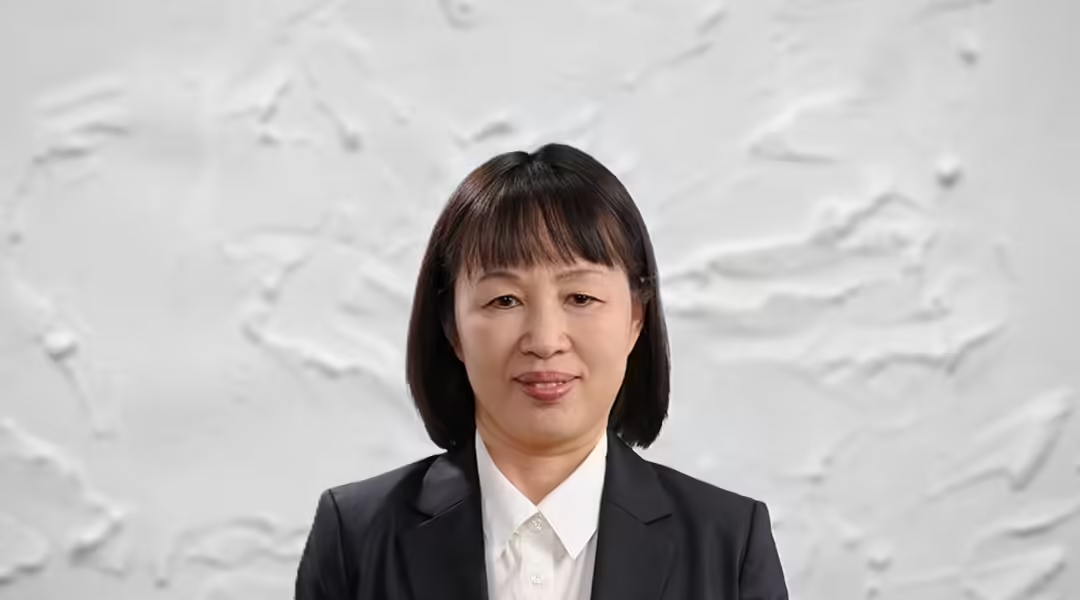
Xiuzhen Yu, director of the Electronic States Microscopy Research Team at the RIKEN Center for Emergent Matter Science in Japan, investigates the unusual ways that electron spins arrange themselves in materials. In 2010, she became the first to directly observe an individual skyrmion—a spiral-like arrangement of electron spins—with an electron microscope, a milestone that opened the door to imaging more intricate 3D spin configurations, including torons and hopfions. Understanding how these patterns form and behave could lead to next-generation devices that are smaller, faster, and more energy-efficient than today’s electronic devices.
Yu, a 2026 recipient of Wiley’s Women in Science award, explains what advanced microscopy techniques can reveal about magnetic structures and how these insights could shape future spintronic technologies.
Why is it important to study magnetic structures? How do you study them?
Investigating magnetic structures, which are closely related to the spin states of electrons, is essential for understanding the magnetic properties of materials. Such spin‑based devices promise higher efficiency, lower power consumption, and new functionalities beyond conventional electronics.
We study magnetic structures using a combination of theoretical analysis and real-space imaging techniques to visualize magnetic structures in materials. These methods allow us to determine how spins are arranged, how they interact, and how these interactions give rise to the material’s macroscopic magnetic behavior.
For someone who has never heard of a skyrmion, how would you explain what it is? What do you remember about the moment you first saw one?
A skyrmion was originally predicted theoretically as a vortex‑like spin texture in magnetic materials. Before real‑space observations were possible, a hexagonal skyrmion lattice had been identified in an alloy of manganese and silicon using small‑angle neutron diffraction. Although this technique could not directly visualize the twisted configuration, those experimental results strongly motivated me to pursue real‑space imaging of skyrmions in actual materials. Because the theoretical concept of skyrmions was already well established, explaining the observed structures was not difficult once we finally saw them.
The moment I first visualized a skyrmion was truly exciting. In 2009, using Lorentz transmission electron microscopy, I observed nanometer-scale skyrmions in the material Fe₀.₅Co₀.₅Si—known as a helimagnet because of its spiral pattern of electron spins—at an ultralow temperature of 25 K. When I applied a small magnetic field to the sample, a tiny bright dot appeared on the monitor. As I gradually increased the field, more dots emerged, and they spontaneously arranged themselves into a beautiful hexagonal lattice. It was astonishing to witness the formation of a skyrmion lattice directly.
Your team can now see magnetic structures in three dimensions. What can you see now that you could not see before?
We spent several years developing a new electron tomography method based on differential phase‑contrast microscopy. This technique allows us to map intrinsic 3D vector fields inside magnetic materials with nanometer-scale resolution. We can visualize complex 3D magnetic structures that were previously impossible to observe in real space, such as skyrmion and antiskyrmion strings, surface magnetic vortices, and other topological spin textures. These spin structures were long predicted theoretically but had never been directly imaged until now.
Which magnetic structure do you find most fascinating, and why?
Among the various topological magnetic structures we have studied, I find hopfions the most fascinating. They possess an intricate 3D spin‑linked topology that cannot be captured by 2D imaging.
Our tomography approach allows us to reconstruct these internal spin arrangements in three dimensions, revealing details that were completely inaccessible before. Seeing these complex topological textures emerge from real materials provides new insights into the fundamental physics of magnetism and opens exciting possibilities for future spintronic applications.
Your recent work showed that heat can transform skyrmions into their topologically opposite counterparts, antiskyrmions. Why is this finding important?
This finding is important because it shows that, in addition to electric current, heat flow can also drive the transformation between skyrmions and antiskyrmions. This means that the topology of magnetic textures can be controlled using very small amounts of energy.
The ability to tune skyrmion–antiskyrmion conversion through thermal stimuli opens a new pathway for manipulating topological spin structures. It suggests that future spintronic devices could operate using heat currents, potentially enabling energy‑efficient control of electron spin configurations.
What do you need to understand before skyrmions can be used in real devices? What applications do you think they could have in the future?
Before skyrmions can be used in real devices, we need to understand how well they withstand changes in temperature, defects, and other disturbances, how they move in response to external stimuli such as electric currents, magnetic fields, and heat, and how reliably they can be generated, manipulated, and erased in a controlled and energy-efficient way.
These factors determine whether skyrmions can serve as practical information carriers in real technological applications such as memory devices, where their small size and topological protection could enable high‑density, low‑power data storage. They may also play an important role in physical reservoir computing, where complex spin textures can be used for neuromorphic or brain‑inspired information processing.
What would you like to discover next?
We would like to combine time-resolved Lorentz transmission electron microscopy with microwave excitation to investigate the dynamics of topological spin textures and explore the quantum phenomena associated with them.
What challenges have you faced as a woman in science? Have you seen these challenges change during your career?
One of the challenges we continue to face is securing sufficient research funding, as well as balancing work and family life. In my experience, these challenges have not changed significantly over the course of my career.
What advice would you give to young women who want to become scientists?
My advice is not to give up on a research career when facing major life events, such as having and raising a young child. Instead, try to find ways to work more efficiently and maintain your passion for research. It can be challenging to balance family and a scientific career, but I encourage young women to stay committed to their goals and continue moving forward.
The Wiley Women in Science Awards 2026, held in March at the Institute of Physics, Chinese Academy of Sciences, brought together leading scientists and scholars to honor the outstanding contributions of nine exceptional women researchers for their impactful contributions and dedication to innovation. The establishment of the Wiley Women in Science Awards, supported by the journal Advanced Physics Researchaims to inspire the next generation of researchers and support a more inclusive and diverse research community.
Featured image thanks to Xiuzhen Yu.
Source: www.advancedsciencenews.com