


Rosalie Cufr has built a University of Toledo experience defined less by the classroom and more by what she’s done outside it in agricultural fields, in a gas chromatography lab and on a research trip to Trinidad that she calls a “cultural awakening.”
Cufr started college studying molecular biology before finding that a related discipline was where she belonged.
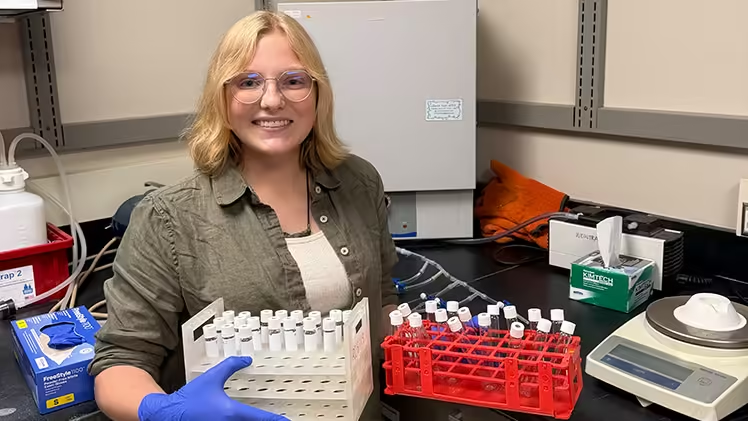
Environmental science senior Rosalie Cufr is turning her lab, field and international experiences into a path toward sustainable agriculture.
“I knew I wanted to be in a lab,” said Cufr, who switched from molecular biology to environmental science and hasn’t looked back. “I’ve loved the department and everything about it.”
Digging Into Research
Cufr found her research home with the soil ecology class taught by Dr. Mike Weintraub, a professor in the Department of Environmental Sciences. She started as an employee on the Pilot Watershed Project, monitoring agricultural fields and testing soil to determine how likely they are to contribute fertilizer runoff into local watersheds.
That fieldwork, which includes pulling soil cores with a metal auger, eventually led to a research assistant role supporting a graduate student’s thesis research. Cufr now runs soil incubations on samples from fields the lab has monitored for years, then transports them to UToledo’s Lake Erie Centerwhere she uses a gas chromatograph to measure carbon dioxide released by soil microbes, which is a key indicator of microbial activity, organic matter and overall soil health.
Because the standard protocol she inherited was designed for sandy Arizona soils, Cufr has spent months adapting it for Northwest Ohio’s dense clay soil, work that will ultimately benefit future research in Weintraub’s lab.
“It’s been a really interesting passion point,” she said.
A Cultural Awakening in Trinidad
Last summer, Cufr joined the Trinidad ecology field trip led by Dr. John Bossenbroek, chair of UToledo’s Department of Environmental Sciences. Over nine days, students tagged leatherback sea turtles, netted bats and hummingbirds, toured a cacao farm and reforestation site, and lived alongside local communities.
“It was just a cultural awakening,” Cufr said. “I talk about Trinidad all the time. It’s just part of my identity now.”
The time in the island, credited as an advanced lab, has since shaped her post-graduation plans: Cufr intends to pursue a Fulbright Scholarship to return to Trinidad and, eventually, to earn a master’s degree in agriculture with an eye toward sustainable agriculture consulting that bridges science and economics. At UToledo, she’s added minors in environmental biology and economics to support her aspirations.
Leadership Beyond the Lab
Cufr’s experiential learning extends to campus leadership as well. For nearly two years, she has been involved with the Student Green Fund, the student-directed organization that allocates student fee dollars toward sustainability projects including the recent expansion of the solar array on UToledo’s Health Science Campus.
As a committee leader for project generation, she has spent the past summer meeting with business and economics faculty to build interdisciplinary partnerships and encourage more students to bring project ideas to the fund.
Connecting the Classroom to the Career
For Cufr, coursework has provided the theory and history behind environmental policy and science, but experience is what has translated it into direction. She points to relationships built through the Pilot Watershed Project as proof that hands-on learning opens doors that can pay off for graduate school applications or future career moves.
“A lot of people are scared to get out there,” Cufr said. “You really just have to try something. And even if you’re not sure you’re going to like it, at least you can rule something in or out. You learn, you meet these new people and it makes the after-college moment less fearful.”
With a grandfather who farms in Ohio, Cufr has a deep interest in agriculture. But her time at UToledo — in the lab, in the field and abroad — has pointed her toward a broader goal: helping under-resourced farms and communities, in Trinidad or elsewhere, where she can put research into practice.
“We have the research to show smart ways farming should be done,” she said. “I want to move that research towards implementation.”
For now, that means more field and lab work, and a Fulbright application that could take her back to Trinidad. The work she’s doing today is already building toward the farms she hopes to help tomorrow.
Source: news.utoledo.edu