



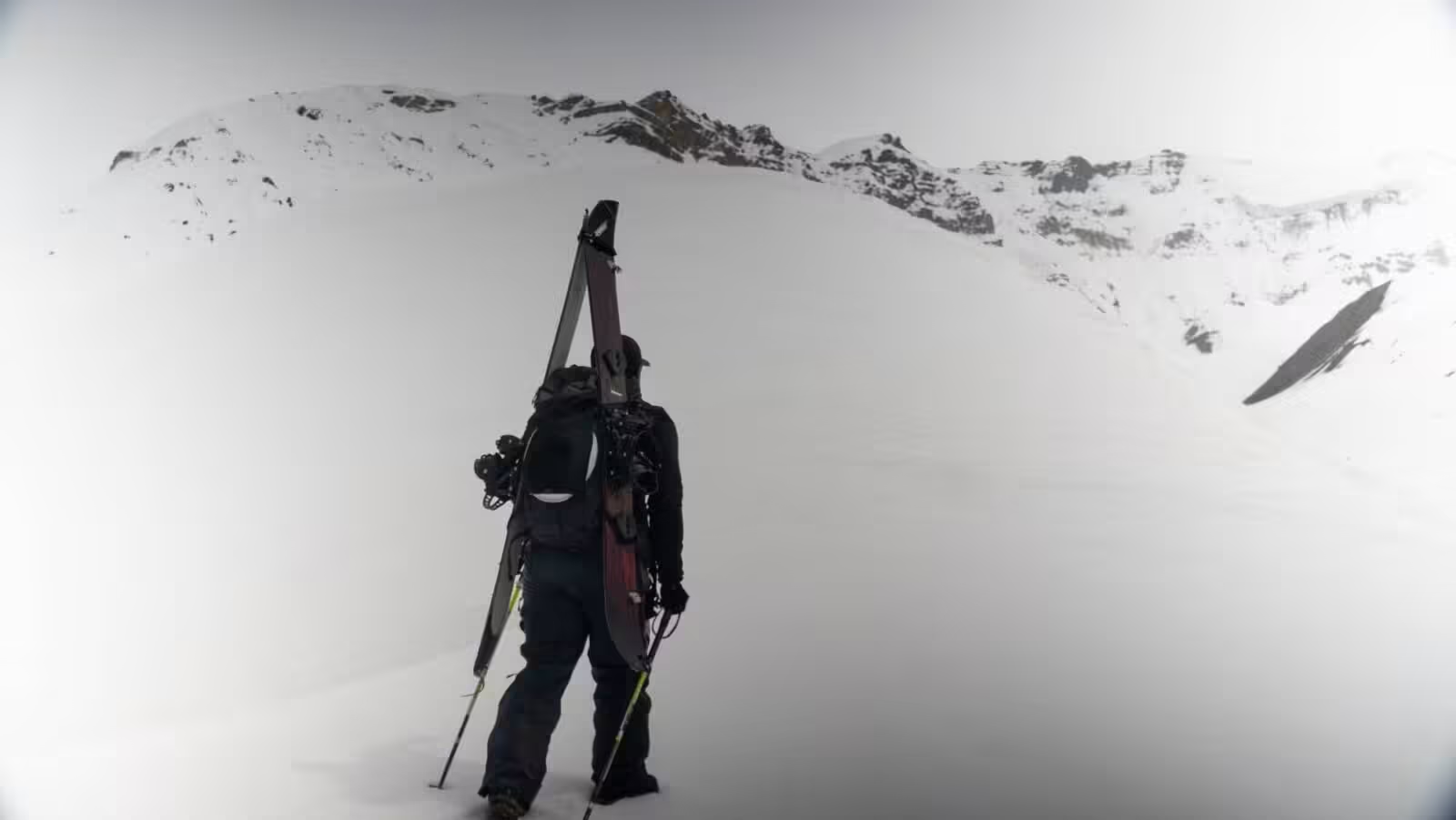


In the wet, bone-chilling wind of southern Chile, on the snowfields of the Lonquimay Volcano at Corralco Resort, Shaurya Thakur greeted me with a wide, genuine smile as we hopped on the chairlift together. He was there training with the Korean slalom snowboard team. Everyone calls him “Shaz.” He is 26 years old, turning 27 soon, with a broad, athletic frame built by hours of daily conditioning. His friendly demeanor is matched by a quiet determination that is apparent the moment he speaks of his sport. Yet despite his soft-spokenness there was an unmistakable intensity in his presence — a calm, unhurried focus that was forged far from the groomed trails of a ski resort.
Shaz hails from Kullu-Manali in the Himachal Pradesh region of India, nestled in the middle ranges of the Himalayas. He competes in Parallel Slalom and Giant Slalom on the International Ski and Snowboard Federation (FIS) circuit, splitting his time between the German national team in the winter and the Korean national team in the summer. He is working toward a singular, unprecedented goal: becoming the first Indian snowboarder in history to qualify for and compete in the Winter Olympics at the 2030 Games. “Snowboarding gave me a purpose to do something for myself — something that gives me freedom,” Shaz told me later on a video call. “When you’re on the mountain, nothing else is in your mind. You just think about the next turn, what lines you could do, where you could go. You find that peace.”
The valley where Shaz grew up sits beside a rushing river under towering peaks, a place where monsoons trigger flash floods that can sweep away homes and where a single storm season in 2023 claimed 500 lives. Mountain life there is hard, and winter sports were once a distant luxury. When Shaz was three years old, his cousins visited from Singapore and took him skiing for 10 days. But as he grew older, he wanted something different from the traditional skiers around him. In January 2019, at age 19, he acquired a secondhand snowboard in Solang, India. There were no functioning lifts or instructors. Shaz learned the basics by walking up 200-meter slopes on foot, taking 20 laps a day, and studying videos online.

On his second day riding, he took a gondola up to a zone with several feet of fresh powder without knowing how to navigate soft snow. He caught an edge 10 meters in and tumbled into the deep snowpack. It took him thirty minutes just to stand up. With the gondola closing and a single bar of cell service left on his phone, he called a friend at the base: “Just please ask this guy to stop the gondola, and help me get out of here.” He made it down safely, but the challenge only hooked him more. The very next morning, he was back on the mountain.
Long before he ever strapped into a board, a far heavier memory took root. When Shaz was 11 years old, he walked into his father’s bedroom at six o’clock on a Sunday morning before heading outside to play. His father was lying in an awkward position on the bed. Shaz brushed his teeth, came back, and noticed nothing had changed. He alerted his older brother, who assumed their father was simply resting. Sensing something was wrong, Shaz insisted his brother check again and then ran to fetch his mother. His father had suffered a fatal heart attack during the night. “I was the first one to see him on the bed,” Shaz recalled. “That is something that stuck on to me. I could still imagine it, every single detail.” For years, the suppressed trauma remained buried beneath the surface of his daily life.

As a young man, Shaz moved to Canada to study marketing at George Brown College in Toronto. Desk work sat poorly with him. He worked sales and odd jobs, feeling drained and disconnected. To escape the routine, he spent hours watching snowboarding films, mesmerized by legends like Travis Rice and Victor De Le Rue. Seeking adrenaline and a fresh start, one day he made a radical choice. He packed his belongings and drove 3,000 kilometers from Toronto to Banff in three days, arriving in Alberta without knowing a single person. To maximize his time on the slopes, Shaz took a 10 p.m. to 6 a.m. night shift at a local gas station. Fueling himself with coffee, he spent the quiet overnight hours listening to The Bomb Hole podcast, hopping across the gas station floor to practice 180s and 360s. “I used to work 10 to 6, keep myself awake drinking coffee all night, and then in the morning wake my friends up like, ‘Let’s go, let’s go to the resort.’ I changed my life around for snowboarding.”
Despite his dedication to riding, isolation and unresolved childhood grief caught up with him during a dark night in Banff. Overwhelmed by loneliness while intoxicated, Shaz attempted to end his life by cutting his wrist. His roommates returned home to find blood across the floor. One roommate, a trained nurse, stabilized him while his friends stayed by his side through the night. In the aftermath, Shaz attended the surgeries alone, keeping the incident secret from his mother in India for a month to protect her from worry. The crisis marked a profound turning point. As he recovered, he realized how deeply he missed the mountains.
Snowboarding became his emotional anchor and his therapy. As Shaz reflected in a personal letter about his journey, titled Why Snowboarding?: “At a time when I felt I had lost myself in my past and the trauma I carried, snowboarding gave me a purpose. It became my therapy. It gave me a way to express feelings I could not always put into words and helped me begin finding my way back to myself.”
“When you are in the lows of your life, snowboarding teaches you how to get up. It gave me the confidence I never had before,” Shaz told me.

When Shaz returned to India, he initially sought to pursue freestyle riding. However, India possessed no structured freestyle teams or park infrastructure. To build a legitimate professional career, he pivoted entirely to Alpine Snowboarding. The riding environment in his home region of Himachal Pradesh bears little resemblance to Western resorts. Based out of Kullu-Manali and high-altitude locations like Sethan and the Hamta Pass, local riders operate at elevations ranging from 3,000 to over 5,500 meters. Without ski lifts or splitboards, riders bootpack on foot for six hours starting at 7 a.m. just to make a single descent at 4 p.m.
The terrain is steep, raw, and fraught with severe avalanche hazards, compounded by a complete lack of rescue infrastructure. Shaz described the stark reality candidly: “When I go in India, I am fascinated with the endless possibilities. But there is one part that scares me — there is no safety over here, and no people who can rescue me if something hits the fan. Most people learn snowboarding in India by walking up six hours a day and riding down. You have to be self-sufficient.”
Equipment in the region remains extraordinarily scarce. Most gear arrives through NGO donations, secondhand sales, or basic entry-level imports from brands like Decathlon, with children’s snowboards virtually impossible to find in local ski shops. Despite these hardships, a passionate local community has emerged. While working out at a gym in Manali, Shaz met a mother who had sent her seven-year-old son to learn riding after seeing local videos online. Senior riders like 35-year-old national medalist Kamal Bai ride deep powder on rigid alpine race boards, while skilled local filmers like Pankaj Thakur aka “Panchu” push into extreme backcountry terrain carrying heavy camera packs.

Shaz recalled a harrowing evening in Sethan when a friend lost a ski on an icy pitch at dusk. With darkness falling and temperatures dropping, Shaz stayed behind with one headlight to guide her down through icy trees while sending beginners back to safety. They reached the village at 9:30 p.m. to find worried local residents organizing a search party. “It was my first time rescuing someone,” Shaz said. “I had no idea what to do, but I realized all you have to do is stay calm, keep everyone calm, and keep moving down the mountain.”
The slow development of winter sports in India carries deep historical context. As Shaz observed, Western nations have operated ski resorts for over a century, whereas India gained independence less than 80 years ago after colonial rule extracted trillions in wealth. “We were left with hunger and so many difficulties that we did not have time to think about snowboarding,” Shaz explained. “Now we are at a stage where we can focus on things like this.” Today, government-backed initiatives like the Khelo India Winter Games are expanding sports culture, while viral riding films like Nick Russell’s Papsura have inspired local youths to push their limits from 4,000-meter passes up to 6,000-meter peaks. Though other riding pockets exist in the Kashmir region, reaching them requires a grueling 10-hour drive over mountain roads from Kullu.
Shaz’s entry into international racing was met with immediate adversity. During early training in Italy, difficulty arose when his single mother fell ill in India and he needed to return home. In another instance, he dealt with conflict with trainers who told him directly that they would end his career before it started. “They told me that they’ll end my career before it even starts, right onto my face,” Shaz recalled. “That ignited the fire in me. I was like, ‘I’m not letting you do that. I’m going to show you what I can do.’”

He reached out for guidance to Shiva Keshavan, a six-time Indian Olympic luger and former fastest man in Asia, who opened doors to international training programs. German national team coach Sebastian Schwerdt loaned Shaz competitive race boards for two years when he lacked the funds to buy equipment, while Korean coach Choi Bogun became a father figure. Despite language barriers, Shaz and Coach Choi spend an hour every night in Chile reviewing training footage and gate setups using Google Translate after the younger athletes go to sleep. In a written reflection, Shaz emphasized the importance of his support system: “Mr. Shiva Keshavan — without his mentorship I could have never competed. Sebastian, my German coach, mentored me and gave me his snowboards to ride, and Choi Bogun helps me stay grounded and improve. My mother, my mentors, and my coaches have stood by me, and I feel I owe it to them to show up every single day and give my best.”
Managing an international race schedule requires relentless effort. To navigate European visa rules — which restrict non-EU citizens to 90 days within a 180-day window — Shaz alternates between winter training in Europe and summer training with the Koreans at Chilean ski resorts like Corralco. To eliminate the strain of constant travel, Shaz is planning a permanent move to Innsbruck, Austria, where he intends to launch a business to secure a long-term residency visa and fund his career. His mother, a former competitive badminton player, has taken out loans to support his dream, while Shaz assists her with her business and apple orchard during the off-season. He has traded away social lives, partying, and traditional security, placing total focus on his sport. “If it is not related to snowboarding, it’s not worth it,” he said plainly. “I don’t have any backup plans because there is only one way forward.”
Looking toward the 2030 Winter Olympics, Shaz sees his athletic career as a platform to transform Indian winter sports. Originally writing 2026 in his training diary before adjusting his timeline, he aims to become the first Indian snowboarder in Olympic history. “There is no snowboarder in India who has ever competed in the Olympics,” Shaz told me. “I want to change that and be the person who inspires the younger generation to experience the freedom of the mountains.”
Beyond his personal racing, Shaz has reached out to professional riders like Nick Russell to source secondhand youth snowboards, planning one-week training camps, avalanche safety seminars, and collaborations with local groups to introduce grooming machines and small resort infrastructure to Himachal Pradesh. In his letter, Shaz summed up his driving motivation: “I keep coming back to one thought: I want to see what happens when I put my heart, my soul, and every bit of energy I have into something I love. I want to find out how far I can go, where this journey takes me, and what kind of person I become along the way.”

Source: snowbrains.com

