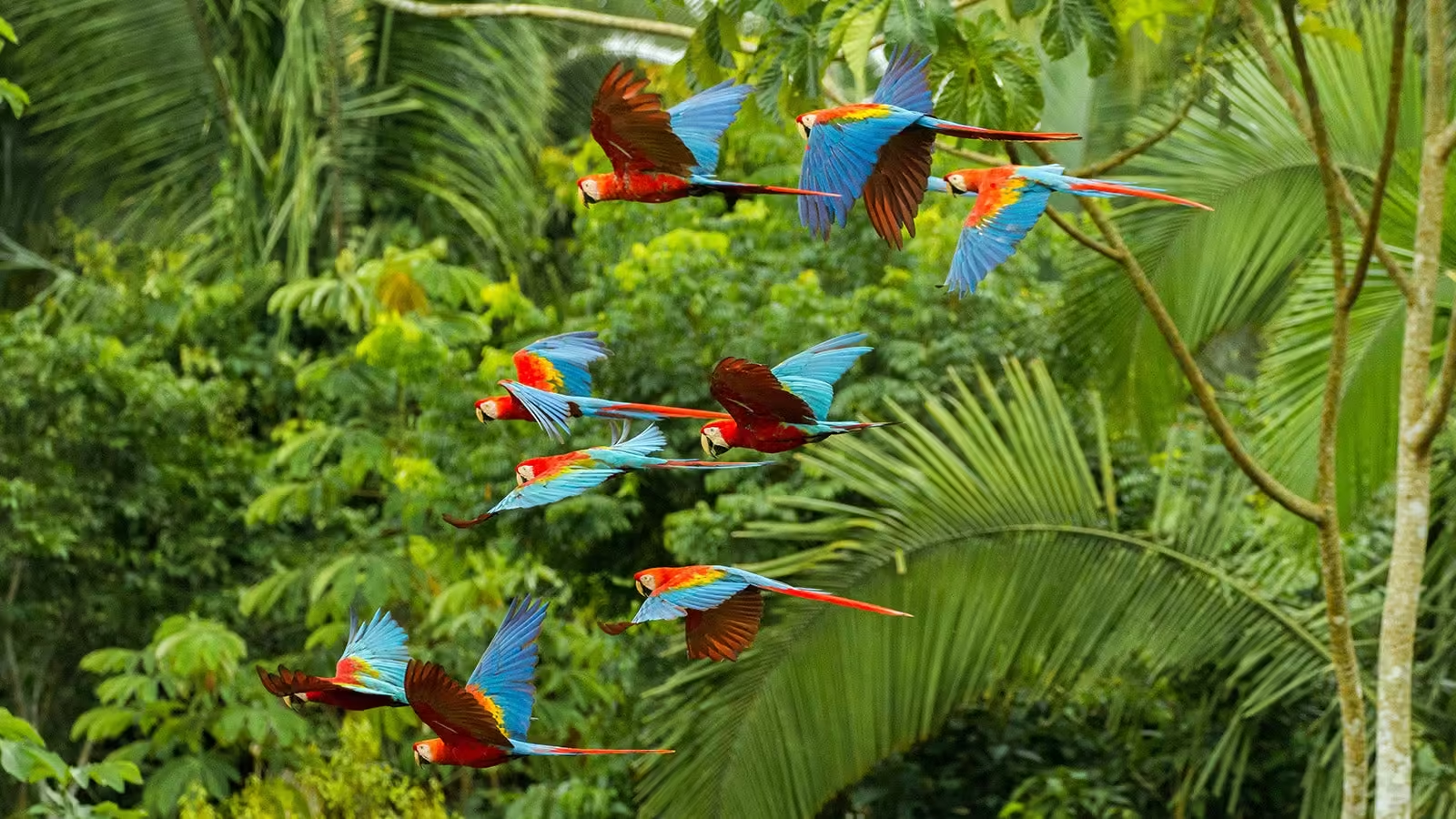

Although it covers just 16 percent of global land mass, Latin America and the Caribbean is one of the world’s most biodiverse regions, encompassing 40 percent of the world’s known species, a quarter of all forests, and the second-largest coral reef system.
While such natural capital holds tremendous value as a source of food, water, energy, and jobs, prioritizing its conservation, restoration, and sustainable use has been challenging for many countries in the region amid high sovereign debt levels, constrained national budgets, and conflicting priorities.
New and growing blended finance support from the Global Environment Facility (GEF) is helping to ease these pressures, reducing risks for potential new investors and unlocking larger flows of private capital for projects that result in positive environmental outcomes and advance international commitments.
These efforts stand to make a big difference in Latin America and the Caribbean and for countries worldwide working to meet the goals and targets of the Kunming-Montreal Global Biodiversity Framework while facing headwinds outlined in a report on the debt-biodiversity relationship on the debt-biodiversity relationship prepared for COP17 in Armenia.
One example is a new GEF-funded project, Innovative use of financial instruments for biodiversity conservation and restoration in Latin America and the Caribbean, advancing in partnership with the Inter-American Development Bank (IDB). This initiative is designed to support biodiversity conservation, restoration, and sustainable management in at least three countries in the region by enabling long-term financing, introducing incentives to meet conservation commitments, and strengthening institutional frameworks that support improved natural resources management.
The project sets up a new regional facility that will deploy debt-for-nature conversions for participating countries. Under this mechanism, a country can obtain new loans or bonds at more favorable market terms than their outstanding sovereign debt thanks to guarantees offered by IDB and GEF. It can then use this cheaper financing to repurchase their more expensive current debt, and channel the savings from reduced interest payments and principal reductions into independent Conservation Trust Funds (CTFs) dedicated to protecting ecosystems. The result is increased investment in the environment without added national debt.
“Mobilizing private sector capital for nature is critically important as we work to meet global biodiversity goals, and blended finance initiatives are central to this effort,” said GEF CEO and Chairperson Diego Mesa Puyo. “Projects like this one show how targeted GEF support can catalyze many times its value in conservation financing, helping countries meet their biodiversity commitments while managing fiscal pressures.”
This new initiative builds on a series of sovereign debt conversions completed across Latin America and the Caribbean in recent years, including in Barbados, The Bahamas, Ecuador, and Belize. It reflects the critical role that guarantees and blended finance from the GEF and its multilateral development bank partners can play in making them viable at scale.
The project includes requirements related to policies and institutional oversight to ensure that the funds raised deliver maximum environmental benefits. It includes an innovative two-step convertible feature designed to maximize donor resources, increase savings, and incentivize strong conservation performance by countries. GEF funds are first deployed as a guarantee alongside an IDB guarantee, reducing investor risk and increasing the savings generated by the debt-for-nature conversion.
Then, when conservation milestones are met, the GEF resources will be converted into performance-based grants that are transferred to independent CTFs that provide sustainable long-term financing for biodiversity conservation. There are more than 50 CTFs across Latin America and the Caribbean, most of which are expected to be part of the RedLAC network, a long-term strategic partner for both the GEF and IDB.
By channeling the debt conversion savings into CTFs rather than general government budgets, the project will help ensure that new conservation finance is additional, predictable, and insulated from the fiscal pressures that have historically undermined long-term environmental commitments.
The GEF-IDB initiative is directly aligned with multiple goals and targets of the Kunming-Montreal Global Biodiversity Framework, including those around the protection of terrestrial and marine areas, ecosystem restoration, and the resource mobilization of biodiversity finance from public and private sources.
Its potential is significant: the debt-for-nature conversions are expected to result in the improved protection or sustainable management of between 21.5 million and 37.7 million hectares of land and marine habitats. It will be supported by GEF financing of $43.8 million, which is set to leverage more than $641.3 million in guarantee co-financing, from IDB resources, prior to bond issuance, where institutional investors acting as bondholders or lenders are expected to become major financiers of the debt restructuring.
The debt-for-nature conversion facility is part of a growing portfolio of blended finance projects at the GEF, which provides financing through its multilateral trust as well as its climate adaptation and biodiversity-focused funds. As part of an increased focus on blended finance in the GEF-9 period, the use of countries’ STAR resources as credit enhancement for debt-for-nature conversions will be incentivized with additional funding from the blended finance funding window.
Source: www.thegef.org