



The experiment ended up having mixed results, according to researchers.
The question of whether the experiment was successful and could be used as a long-term model in Pennsylvania and other states cannot be easily answered, said Paula Chatterjee, a physician and health policy researcher at the University of Pennsylvania.
“Oh man, how I wish it weren’t mixed,” she said. “How I wished it were a slam dunk of like, yes, it improved finances across the board or actually, woof, we didn’t see anything. We see a mixed picture.”
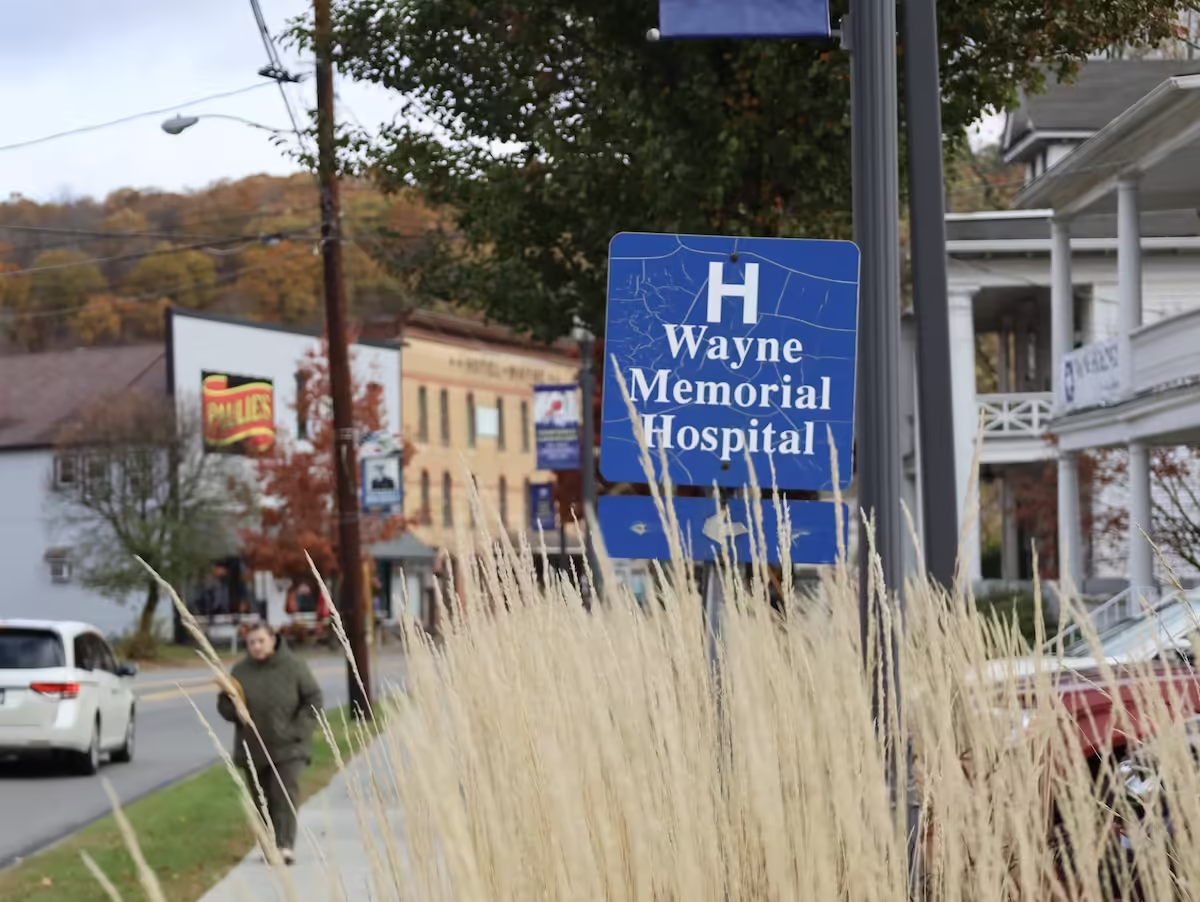
Wayne Memorial Hospital, established in 1920, is the only full service hospital across three counties in the northeastern corner of Pennsylvania. Including a network of outpatient community health centers and a long-term care facility, the health system serves over 100,000 people who live in the region.
The hospital joined the Pennsylvania Rural Health Model in 2019. Leaders were drawn to the idea of making residents healthier instead of treating them just when they get sick, said CEO James Pettinato, who has been at the hospital for more than 20 years.
There are many people in the community who live with chronic conditions like diabetes, as well as heart and lung problems, he said.
“If we better manage those patients up front, they would have a need for less hospitalizations in years to come,” he explained.
The rural health model introduced three major changes to the Honesdale community, Pettinato said.
Wayne Memorial started a program to deliver nutritious meals to adult patients who struggle with food insecurity and have diabetes, Chronic Obstructive Pulmonary Disease (COPD), or Congestive Heart Failure (CHF). Pettinato said this meant that fewer people had to go back to the hospital for complications from these conditions, and also lowered average blood sugar levels, with the caveat that the hospital offered other services during this time as well.
The hospital also changed the way it screened people in the emergency room for drug use, alcohol problems, and mental health disorders to connect them to support services.
Wayne Memorial l was also able to communicate and work more directly with insurance providers and state regulators, which allowed them to cut through some bureaucracy.
For instance, Pettinato recalled a time when a patient needed to come to the hospital just to use a medical device that’s typically only available in a hospital. But doctors said the device could be sent to the patient’s home and they could teach him how to use it there, saving him several hospital trips.
“Prior to this model, that wouldn’t have even been something we would have considered doing,” Pettinato said, explaining that when the hospital told the regulators and insurance providers that it was part of the rural health model, they understood why it would try a more “creative” discharge plan.
After more than two decades in healthcare, he added, this is the first time “we’ve been able to sit down with regulators, payers, and providers in the same room all focused on … one mission and that was to improve the overall health outcomes of our patients that we all served.”
The Pennsylvania Rural Health model ended in 2024, as scheduled. But even since then, Pettinato said the hospital and insurance providers and regulators continue to meet almost every month to discuss what the next model could look like.
About a year into the experiment, the carefully designed rural health model faced an unexpected blow: the COVID-19 pandemic changed everything.
The cost of hiring nurses and medical staff went up by three to four times, and in some cases, have not come back down to pre-pandemic levels. Medical equipment like masks and gloves became harder to come by.
The state and federal governments stepped in with funding to all hospitals, but it also meant that Wayne Memorial Hospital had to stay focused on treating sick patients, which derailed their plans for the model.
There was also an unexpected downside to being part of the Pennsylvania Rural Health Model: two other local health systems had recently cut back on services, and their patients came to Wayne Memorial Hospital.
Under the typical hospital payment model, that would have been good: more patients would have meant more people getting treated at the hospital, and more money for the hospital.
But the Pennsylvania Rural Health Model did not account for the larger number of patients.
“There was a true need for those medical services to be provided in the community so we saw actually an increase in our fee-for-service medicine and there just wasn’t a provision in the model to accommodate that,” Pettinato said. “One of the challenges in the model is you’re not necessarily paid … for the additional work.”
The hospital was able to apply to get reimbursed for the additional treatments, but it took more than a year after the hospital provided the treatments for the funds to arrive.
“It’s a long time to expend your expenses and put money out just to see if in the end you actually managed to make some of that money back,” Pettinato said.
Ultimately, the hospital was not reimbursed for the full cost of those services, and the model did not make it clear how the reimbursement process would work in cases like this.
He added that this created another big obstacle to trying a new funding model: neither the insurance providers nor the hospitals want to use complicated formulas to figure out how to pay for changing services, and “both sides feel cheated in the process.”
When the experiment ended, Wayne Memorial Hospital decided to go back to the old way of running the hospital, with the old payment system, mainly because they have more patients now than they started with.
Pettinato said they are looking for other ways to keep the food delivery program going, and that they continue to refer emergency room patients who need substance abuse and mental health services to treatment providers.
He stressed that the model did succeed in connecting the hospital to state regulators and insurance providers, so they could cut through some bureaucracy.
“From that perspective, the model hit a home run, there’s no question,” he said. “And if anything was learned through this, it’s that that part really needs to continue forward.”
The Pennsylvania Rural Health Model was so different from the usual fee-for-service model that many researchers have studied it to see if it worked or not.
When it came to whether or not it helped rural hospitals financially, “the answer is: it didn’t help them. It didn’t eliminate their losses,” said Harold Miller, a health policy expert and adjunct professor at Carnegie Mellon University. He said looking at the finances of all the hospitals that took part in the model, half of them ended up better than they started, and half of them ended up worse.
“I’d say that’s a draw,” he said.
One of the hospitals that was part of the model, Bradford Regional Medical Center, announced plans to close a little over a year after the model ended. In May 2026, the hospital stopped providing inpatient, emergency, or long term care.
Another goal of the model was to help hospitals invest in making their communities healthier, rather than just making money by treating sick patients. Donald Bourne, a medical student at the University of Pittsburgh, studied this question as his dissertation. He, too, said it was a mixed bag.
One of the studies he worked on measured whether hospitals that were part of the model were able to avoid unnecessary hospital visits, meaning visits that could have been prevented by providing better care or care in the community. He found that hospitals that joined the program early on were able to bring down these unnecessary visits, but the hospitals that joined later did not do that much differently than hospitals that did not take part in the model.
One problem is that the model, which ran for five years, did not last long enough for real change to happen, Bourne said. Moreover, the hospitals had to switch gears during the years of the pandemic, “which kind of threw hospitals for a loop and made it hard to implement some of the aspects.”
Five years might sound like a long time, Bourne said, “but when you’re talking about a huge system level transformation, that might just not be enough time for changes to occur.”
Health policy expert Harold Miller has a different explanation. He said the model could never have solved a core problem rural hospitals faced: their inability to provide enough services to the community because they couldn’t afford to.
“It actually wasn’t even designed to solve that problem because it was designed to reduce Medicare spending,” said Miller. “And it ended up being so complicated that no one could even predict exactly what was going to happen in it.”
Like Wayne Memorial’s Pettinato, he says a big problem was that the model didn’t account for what would happen if the hospitals expanded services, or served more patients. That’s a key reason some hospitals that could have joined the model chose not to, according to an article studying how hospitals decided whether to join.
The lack of clarity about reimbursements for additional treatments that facilities like Wayne Memorial provided meant the model didn’t work from the hospitals’ perspective, Miller added, and he doesn’t believe it worked from Medicare’s perspective either.
Janice Walters, CEO of the Rural Health Redesign Center, a state-funded nonprofit created to manage and run the experiment, acknowledged that the model was not able to account for how much more expensive it would be to run hospitals because of the pandemic. However, she said overall, the model brought in more money to hospitals than they would have had access to otherwise.
She explained that the global budget for each hospital was based on their revenue from the years before they joined the model. If a participating hospital introduced preventative care, treated patients in primary care settings, or introduced programs that reduced hospital admissions and emergency services, the hospital would be providing fewer emergency or inpatient services, but still get paid the global budget.
“Does it necessarily now show in the bottom lines on financial statements? No,” she said. “The increased cost (of care after the pandemic) has consumed all of the additional revenue. But absent that, if you would have stripped out all of that additional revenue, certainly our hospitals would have been in far worse shape. But because of the additional revenue coming in, they’ve been able to weather that storm a little better.”
Ultimately, she argues that insurers should pay hospitals differently to make sure the cost of providing essential services are covered, especially for rural areas, though policymakers need to decide what to include in those fixed payments. And another lesson going forward, she adds, is that any model to pay hospitals differently needs to figure out how to hold hospitals accountable without making them responsible for a lot more administrative work.
On a basic level, the model did not fully recognize “what it takes from a financial perspective to operate a rural healthcare facility,” said Dennis Scanlon, a health policy researcher and health economist at Penn State University.
He echoed Miller in saying the problem is trying to run the model in such a way that it saves money for Medicare and other insurance providers.
As an analogy, he said that a town needs to pay for a staffed fire station, with fire trucks and trained firefighters, even if there is no fire. In the same way, someone needs to pay for a hospital with modern facilities to serve rural residents, even if the people are not currently sick and don’t need treatment.
“You’re not going to have the volume of childbirths or of hip replacements or knee replacements in a rural facility, as you might have in Philadelphia or Pittsburgh or Harrisburg,” Scanlon said. “At some point, you have to kind of bite the bullet and say, ‘are we willing to invest resources to have an existing … facility … that’s going to serve smaller populations because we value those citizens.”
He said governments should accept that it is more expensive to pay for a rural hospital than an urban one, but – like providing internet access to rural areas – they should pay for it anyway because rural residents deserve healthcare just as much as their urban counterparts do.
Source: whyy.org