



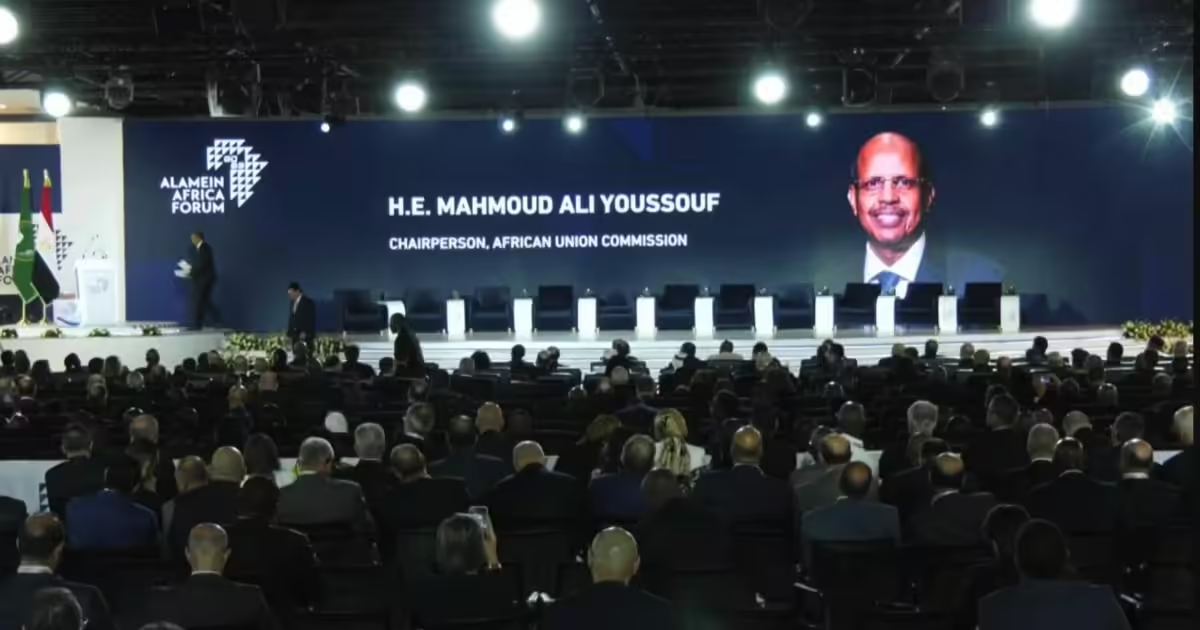

At the inaugural #Alamein Africa Forum, the Chairperson of the African Union Commission, H.E. Mahmoud Ali Youssouf, joined H.E. President Évariste Ndayishimiye, President of the Republic of Burundi and Chairperson of the African Union, H.E. President Abdel Fattah El-Sisi of Egypt, Dr George Elombi, President and Chairman of the Board of Directors of Afreximbank, Mr Aliko Dangote, President and Chief Executive of Dangote Group, and other African leaders, institutions and business leaders in a powerful call to move Africa from ambition to implementation.
H.E. Mahmoud Ali Youssouf underscored that Africa does not lack vision or ambition. What is required is the capacity to translate ambitious plans into well-prepared, financed, implemented and successful projects. The African Union has therefore brought governments and the private sector to the same table to forge the continent’s future together.
Africa possesses enormous assets: vast agricultural potential, strategic minerals essential to the global energy transition, abundant energy resources, a rapidly growing and youthful population, and a continental market anchored by the African Continental Free Trade Area (AfCFTA). Yet Africa continues to import food it can produce, medicines it can manufacture and products that could be made from its own raw materials.
The message from the Forum was clear: Africa must use its resources to create value, build industries, generate jobs and strengthen its economic resilience.
President Évariste Ndayishimiye emphasised that Africa’s paradox is that it is a resource-rich continent that remains insufficiently transformed. The priority must be to bring governments, investors and businesses together to translate national strategies and Agenda 2063 into concrete, bankable projects.
He called for a shift from diplomatic partnerships to economic partnerships, investment partnerships and, ultimately, production partnerships. He stressed that AfCFTA must become a fully functioning market, supported by trade corridors, integrated border posts, harmonised customs procedures, mutual recognition of standards, cross-border payment systems, trade finance, logistics and regional value chains.
President Ndayishimiye proposed an African Investment and Implementation Dashboard to track strategic continental projects, investments, financing, responsibilities, timelines and measurable results.
His message was simple: every commitment should lead to a project; every project should find financing; every financing should produce results; and every result should contribute to Africa’s integration and prosperity.
President Abdel Fattah El-Sisi welcomed African leaders, institutions and business representatives to New Alamein, stressing that the Forum comes at a time of profound geopolitical and economic change.
He emphasised that African countries must strengthen their capacity to shape their own future, while peace, stability, strong national institutions, respect for sovereignty, good-neighbourly relations and peaceful resolution of conflicts remain essential foundations for investment and development.
President El-Sisi highlighted the critical role of Africa’s private sector, which is a major engine of growth and employment across the continent. He called for stronger connections among African businesses, greater access to information on opportunities in neighbouring markets, and practical measures to increase intra-African trade.
The Alamein Africa Forum, he stressed, provides a platform to bridge information gaps, connect investors and businesses, promote cross-border partnerships and accelerate implementation of AfCFTA and Agenda 2063.
Dr George Elombi, President and Chairman of the Board of Directors of Afreximbank, placed the Forum in a broader context of African ownership and economic sovereignty.
He recalled that Alamein was once known principally for a major battle of the Second World War. Today, Egypt has transformed the same landscape into a place where Africans can gather to discuss and shape their own future.
He recalled Egypt’s longstanding support for Afreximbank, including hosting the Bank in Cairo since its establishment and supporting major continental trade initiatives. He stressed that African institutions created and owned by Africans must be strengthened and defended.
Afreximbank, he noted, was created by African countries in 1993 and has demonstrated its ability to respond to major economic shocks, including the COVID-19 pandemic, the Ukraine crisis and the 2026 Gulf crisis. The Bank’s interventions, he argued, demonstrate the importance of African-owned financial institutions that can act rapidly when African economies face external shocks.
Dr Elombi called on African governments to continue capitalising their institutions, honour the legal commitments underpinning them, defend the creditor status provided under their treaties and stand together in strengthening African multilateral financial institutions.
His central message was that Africa’s institutions should be judged accurately on the basis of their substance, performance, ownership and demonstrated capacity — not simply against methodologies designed for different institutional models.
He also stressed the importance of combining political diplomacy with economic diplomacy, noting that African economic instruments can help reinforce peace, stability and development.
“ This bank is your bank. Please defend it.”
Mr Aliko Dangote called for a fundamental change in the way Africa thinks about economic growth.
Africa accounts for a significant share of the world’s population and possesses enormous agricultural, mineral, energy and human resources. Yet the continent’s share of global manufacturing remains limited.
The challenge, he argued, is therefore not simply to increase GDP, but to ask what Africa is producing, who participates in that growth, how much domestic capability it creates, how many productive jobs it generates and how resilient African economies become.
Africa must transform its natural endowments into productive capabilities.
Mr Dangote stressed that AfCFTA should be understood not merely as a trade agreement, but as continental economic infrastructure capable of creating the scale necessary for investment and industrialisation.
A factory serving 30 million consumers represents one investment proposition; a factory capable of reaching hundreds of millions of African consumers represents another. Integration can therefore become an instrument of industrial policy.
He called for harmonisation of regulations, standards, payment systems, border procedures and logistics, arguing that fragmentation creates an “African scale penalty” that increases production costs and constrains investment.
Energy, he stressed, must be treated as economic infrastructure, powering industrial corridors, agricultural processing zones, mining centres, technology clusters and cities.
Africa must also move beyond exporting raw materials and focus on processing, manufacturing and value addition in order to create jobs and prosperity.
Mr Dangote emphasised that Africa needs both effective governments and a dynamic private sector: governments establish the rules, maintain stability and provide infrastructure, while entrepreneurs take risks, invest capital, innovate and create jobs.
He urged African leaders to make AfCFTA work through the free movement of people, goods and services, and called for greater African investment in Africa.
He also highlighted Dangote Group’s Vision 2030 and its commitment to expanding investment across the continent, while stressing that African development ultimately requires Africans to work together.
“Africans must work together to develop Africa.”
AUDA-NEPAD CEO Nardos Bekele-Thomas reinforced the implementation agenda, warning that Africa does not suffer from a shortage of meetings or conferences, but from a shortage of deals, action, implementation and execution.
She called for government and business to remain at the same table and for the Forum to become a permanent mechanism for turning political ambition into investment and development outcomes.
She highlighted the scale of Africa’s infrastructure financing needs and the need for private capital, blended finance, project preparation and stronger regional economic integration.
AUDA-NEPAD, she noted, is working to move major projects through preparation and structuring towards financial close, while African development finance institutions can provide capital and AUDA-NEPAD can help bring forward projects that are ready for investment.
She called for a shift from national to regional projects, greater mobilisation of African pension and sovereign wealth funds, harmonised standards and stronger economic corridors.
By the time the Forum reconvenes in 2028, she urged, Africa should be able to demonstrate projects that have moved from preparation to investor-ready status and beyond — tangible proof that the Forum delivers.
The common message emerging from Alamein is therefore unmistakable: Africa has the resources, markets, institutions, entrepreneurs, young people and capital to transform its economic future. The challenge is execution.
From Agenda 2063 to AfCFTA; from political commitments to bankable projects; from raw materials to value addition; from fragmented national markets to regional value chains; and from dependence to greater African ownership — the task is to turn potential into production, projects into investment, and investment into jobs and prosperity.
The inaugural Alamein Africa Forum is a call to build that future together.
One Africa. One continental market. African capital for African development. African solutions, African institutions and African enterprise driving Africa’s transformation.
The time for action is now.
Source: au.int