



Pope Leo XIV boarded the papal plane at Rome’s Fiumicino airport on Friday, 25 September, accompanied by journalists and his entourage, at the outset of his Apostolic Journey to France. The ITA Airways A321 took off at 7:58 a.m., Rome time, and landed at Paris Orly Airport at 9:56 a.m.
Speaking to the more than 80 journalists aboard the papal plane, the Holy Father said, “I, above all, am travelling to France, as to anywhere else in the world, as a follower of Jesus Christ wanting to proclaim peace, the peace of Christ throughout the world. It is a message which at this time, as we all know, is particularly important”.
Arriving in Paris, Pope Leo XIV met privately with French President Emmanuel Macron at the Élysée Palace. He then addressed the authorities, civil society, and diplomatic corps, mentioning his own French heritage and assuring the nation of his prayers. He recalled that France has served as a cultural, artistic, and spiritual beacon for Europe and the world for centuries. “The many brilliant French scholars who were also faithful Catholics demonstrates clearly how the sciences and the arts, literature, and philosophy can contribute to the good of humanity when they are directed toward the pursuit of beauty, goodness and truth, that the world may have life”, said the Pope, referencing the motto of his Apostolic Journey. Pointing to France’s national motto, he said liberty, equality, and fraternity “refer to universal ethical imperatives that also find in the Gospel message an inexhaustible source of inspiration and fulfillment”. Turning to France’s “rich and varied social fabric”, the Pope praised the efforts of Catholic men and women who continue to care for the welfare of the poor and underprivileged. Pope Leo XIV noted that our modern sensibilities seek to eliminate every form of suffering, saying this tendency often “brings the risk of self-delusion”.
When “science and technology are not guided by a deeper wisdom”, he said, “they can offer immediate solutions that apparently address people’s wishes and their pain, but can seriously divert them from the greater good to which they aspire”. Mutual respect and the protection of every human life is a duty borne by every person, he said, noting that it begins with conversion of heart and mind and requires selfless commitment to the good of others.
Pope Leo encouraged Christians to engage in public service guided by the light of faith, noting that authentic secularity does not exclude religion but values it as an “educational resource”.
He thanked France for its support for education and humanitarian work in the Middle East, especially an initiative to help finance over 260 schools and universities, and he recalled the ongoing effects of conflict and the scourge of war on people in the region. “We cannot remain indifferent in the face of their pain, which offends human dignity and cries out to God for justice”, he said. Pope Leo also called for nuclear weapons to be banned and for justice and right reason to prevail, since peace “is not a balance of power” but is rather built each day through dialogue and justice. In conclusion, Pope Leo XIV urged the French Republic to “remain a tireless champion of peace and multilateralism”.
“May France, faithful to its traditional values, work for a peace that is unarmed and disarming, and responsibly offer its unique contribution to that goal”, he said. “May your liberty grow in constant concern for the common good”.
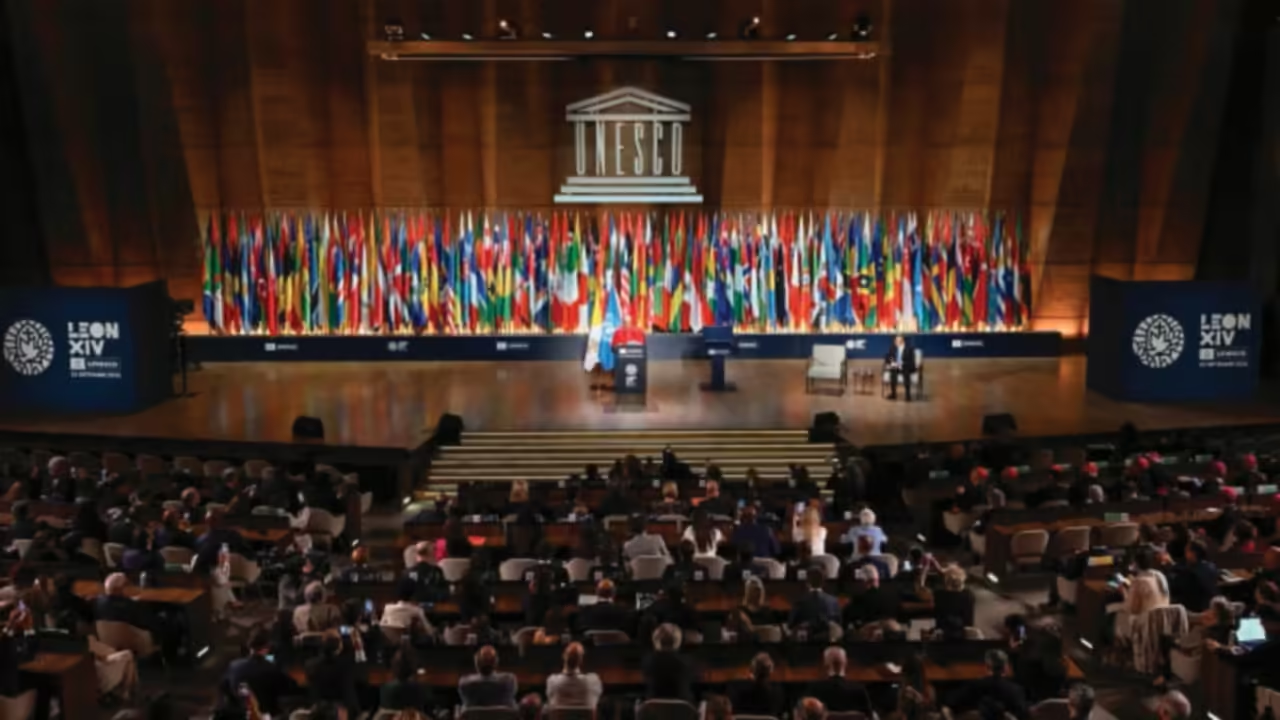
After his meeting with civil authorities, Pope Leo XIV visited the UNESCO headquarters in Paris, where he called for a renewed commitment to peace, truth and human dignity, warning that scientific and technological progress, when separated from ethics, can become an instrument of domination and destruction. Addressing representatives of Member and Observer States, international organisations, academia and civil society on Friday afternoon, the Pope described UNESCO as a place where humanity can “reflect on itself, on its history and on its future”.
The Holy See, he said, views UNESCO as a “privileged partner” in the service of the common good, particularly because authentic human development must concern “the development of each man and of the whole man”. At the heart of Pope Leo’s address was a question he said every culture and every generation must confront: “What does it mean to be human?”. He linked that question directly to education, arguing that education cannot be reduced to the acquisition of skills or material advancement. “No education can be considered complete if it fails to address the question of life’s meaning”, he said.
The Holy Father devoted particular attention to the challenges posed by technology and artificial intelligence. Artificial intelligence, he said, can process and correlate vast quantities of information, but it cannot answer questions concerning the meaning of human life, which is rooted in lived experience.
He welcomed UNESCO’s Media and Information Literacy initiative, which promotes responsible engagement with media and digital technologies, and called particular attention to children and young people. “In the digital age, their vulnerability must never become an opportunity for exploitation”, he said, highlighting that technology should support their education, relationships and freedom to think and discern.
Turning to UNESCO’s founding principles, Pope Leo recalled the words of the organisation’s 1945 Constitution: “Since wars begin in the minds of men, it is in the minds of men that the defences of peace must be constructed”. Those words, he said, are still relevant eight decades after UNESCO was founded in the aftermath of the Second World War. “Peace cannot be built by treaties alone”, the Pope maintained. Rather, genuine peace must arise from justice and from an “upright will” capable of recognising another person as “a brother or sister, a person like oneself”.
Pope Leo also addressed some of the challenges international institutions are experiencing: being increasingly expected to respond to problems that no individual State can resolve alone, while at the same time, facing questions about their effectiveness. In that context, he identified a virtue, which “seems as greatly desired as it is rarely found”: trust. “Trust that differences do not necessarily constitute a threat; trust that honest dialogue can bring about a greater good than what individuals could achieve on their own”, he said. The Holy See, he added, wishes to strengthen that trust in UNESCO and other international organisations. The Holy Father concluded by linking education, science and culture to the work of peace, describing every child born into the world as a sign of hope and every person dedicated to the search for truth as performing “an act of hope”.
In the evening, Pope Leo XIV celebrated Vespers with bishops, priests, deacons, seminarians and consecrated men and women at the Cathedral Basilica of Notre-Dame de Paris. In his homily, the Holy Father called them to missionary conversion, to cultivate an authentic love for the liturgy, and to remain close to the Lord in prayer.
Speaking from the Basilica of Notre-Dame de Paris seven years after a fire destroyed much of the church, Pope Leo said the beauty of the newly rebuilt church “speaks to our restless hearts and calls them to peace”. The reconstruction, he said, is an opportunity for encounter with all, especially those on the peripheries, who may at times seem far away, but are in some ways already near to Christ and the Church. The renewal of the Cathedral of Paris can serve as an inspiration not only for the city, but also for all cities and regions of France, which can be transformed by “a simple and welcoming missionary presence” that can harmonize cultural differences and bring healing to our divided and wounded societies.
At the same time, Pope Leo reminded those present that Notre-Dame, like all churches, is intended primarily to be a place of prayer and worship of God, especially in the celebration of the Eucharist. The Holy Father called for those charged with care of the liturgy to offer the celebrations with dignity and reverence, “even where smaller communities gather”. He also emphasized the liturgical reform of the Second Vatican Council, and exhorted clergy and religious “to cultivate an authentic love for the liturgy” and to be “witnesses and servants of the prophetic, priestly and royal vocation of the entire People of God”. He urged them to “place communion with the Successor of Peter and with the Church before [their] personal preferences, so as to foster the unity of God’s people”.
Pope Leo XIV’s first day in France came to a close in Saint-Denis, with a prayer vigil attended by some 80,000 young people from Paris and across France. The Stade de France, the country’s largest stadium, had not seen such a gathering since it opened in 1998. It was packed on Friday evening. Young people showed up in all their diversity: rural and urban, workers, students, young professionals and manual workers, united by their faith and their desire to hear the Pope’s words.
The evening began with a festive programme of testimonies, songs and artistic performances. The young people moved from celebration to Caccini’s Ave Maria, sung by Monroe and 2,500 choristers. In his welcome to the Holy Father as he arrived in the stadium, Bishop Etienne Guillet described it as the ‘stadium of all France’, highlighting the cosmopolitan, multi-ethnic and multicultural character of his diocese and of the 80,000 young people gathered there. Before the Pope, a series of tableaux revisited the lives of numerous French saints, including Thérèse of Lisieux, Charles de Foucauld, Louis and Zélie Martin, Frédéric Ozanam, Léonie Aviat, Pierre-Julien Eymard, Jean-Marie Vianney, Catherine Labouré, Bernadette Soubirous, Francis de Sales, Vincent de Paul, Louise de Marillac, John Eudes, Jean-Baptiste de La Salle, Louis-Marie Grignion de Montfort, Bernard of Clairvaux and Germaine of Pibrac. The performance ended with fireworks on the roof of the Stade and an outpouring of joy from the young people, who chanted, ‘Leo, Leo’. The Holy Father responded with smiles and waves.
Two young people then shared their testimonies. Chloé, a pharmacology student involved in work in disadvantaged neighbourhoods, asked the Pope how she could share her faith with people of other religions.
“We are all part of this spiritual journey”, Leo replied. “The fact that many are indifferent to the question of God, is indeed, a problem”, the Successor of Peter continued, “but so too is the fact that many are indifferent to the question of humanity”. He lamented that many people take no interest in those around them, despise the poor and reject those who are vulnerable and sick, “thinking that a person’s worth lies solely in what they produce”. The Bishop of Rome encouraged Chloé to persevere in her work in disadvantaged neighbourhoods: “it is there, in the concrete realities of daily life, and sometimes in the midst of difficulties, that your faith becomes a vibrant witness to hope”, he said, in a spirit of fraternity with “those who do not share our faith”. The Holy Father also mentioned, as an example, the encounters between young people from Mediterranean countries that have been organised in recent years, describing them as an encouraging sign of fraternity.
François, who comes from a rural background, is studying agronomy and is a scout leader. Keen to make a commitment, he asked how he could discern the direction of his life and give himself faithfully to it.
Firstly, the Holy Father began, it “gives me great joy to see so many of you here, driven by a desire to serve the cause of peace — a peace that helps us grow as men and women by transforming fears into hope, and complaint into responsibility”. By “committing ourselves to the service of God and others”, he explained, our wounds “find consolation and redemption”. Anxiety and uncertainty, Pope Leo continued, which can be experienced as “obstacles to your enthusiasm”, instead reveal the precariousness of plans for the future, the provisional nature of emotional relationships, the fragility of human bonds, screen fatigue and concerns about climate change and the economic and international situation. We “must pay close attention to these feelings”, Pope Leo said, and keep our hearts open to the suffering of our peers. Finally, the Holy Father addressed those “who feel called to follow Jesus” through the priesthood or consecrated life. “The Church in France needs you … do not be afraid of this call”, he said.
After the two responses, the assembly fell silent in prayer before the Holy Tunic of Argenteuil, which had been brought specially to the Stade de France for the young people. “Let us consider the two relics before us”, the Holy Father said, the tunic and the cross. The cross, “an instrument of death, becomes a sign of hope”. The Tunic, which was taken from Jesus, clothes the believer “in the white robe, washed ‘in the blood of the Lamb’”. The tunic and the cross, the Pope concluded, “represent us, as the Church born from the life of God given to the world”.
The Holy Father cited three verbs, borrowed from Saint Paul, “that appeal to our freedom: to shun, to strive and to fight” First, shun pride, vanity, violence and greed because these are feelings “that take hold of us and possess us”. Second, strive towards “righteousness, godliness, faith, love, steadfastness and gentleness”, as you “seek virtue, namely that inner strength which makes us good and true”, and as you walk towards holiness. The third, to fight, follows from the first two, but “the battle we are called to fight is that of faith, through our commitment to live according to the Gospel, as disciples of Jesus”. This is in no way a struggle against others, the Pope stressed. Such a struggle “does not use the weapons of violence, contempt or oppression. Our only weapon is that of self-giving love”. In the face of “forces that oppose our relationship with God”, and of the “powers that seek to divide individuals and peoples”, the light of the Holy Spirit enlightens and comforts. The Holy Father ended with an invitation to the thousands gathered at the Stade de France: “Let us choose together the virtues we must cultivate in order to follow the Lord”.
Source: www.osservatoreromano.va