



Editor’s note: When longtime jazz journalist and historian Paul de Barros first published “Jackson Street After Hours: The Roots of Jazz in Seattle” in 1993, he illuminated a vibrant and influential scene that had been obscured by the city’s more recent musical trends. More than 30 years later, thanks in part to the book, Seattle’s 20th-century jazz history is widely celebrated throughout the region, and the city finds itself in the midst of a jazz revival driven by a new wave of musicians, sounds and fans.
This week marks the release of an updated second edition of de Barros’ book (University of Washington Press, October 2026), an excerpt of which we share here, exploring the formative years of several greats whose careers were indelibly shaped by this place and its people.
ON FEB. 16, 1949, the Dizzy Gillespie Afro-Cuban big band, with Cuban drummer Chino Pozo, played Seattle’s Senator Ballroom. This was a Bebop Event of the first order.
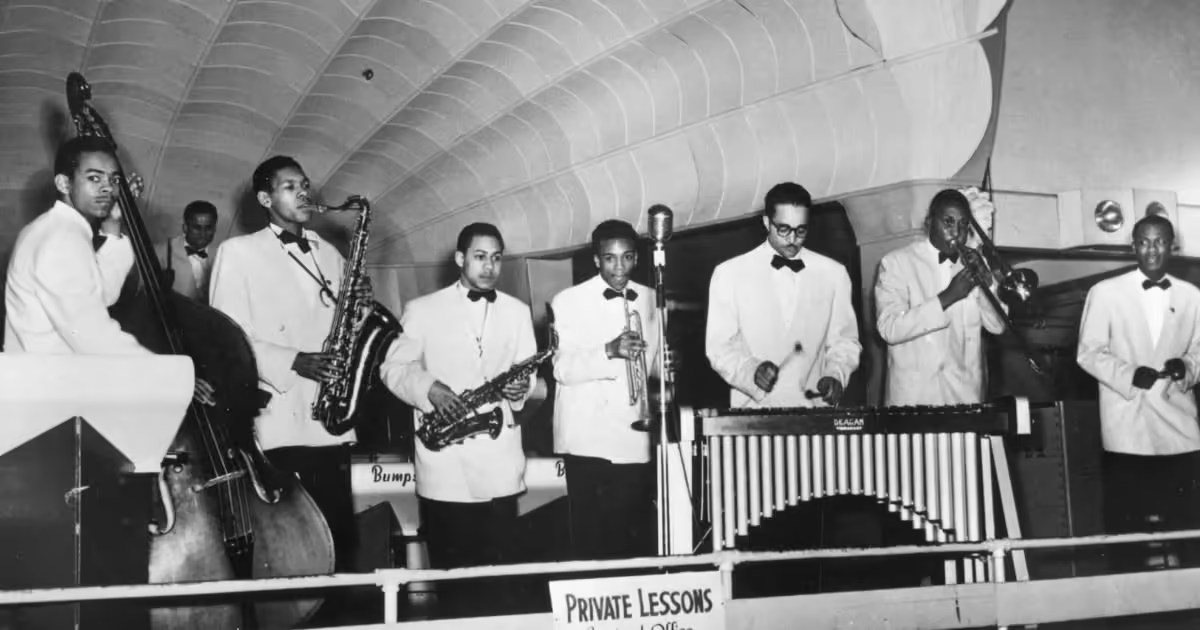
The night Dizzy’s big band played the Senator (now home of Union Arts Center), the Bumps Blackwell Junior Band had a gig. No one in the group was too happy about missing Dizzy, least of all a young trumpet player named Quincy Jones. All through the job that night, he was thinking about going up to the Washington Social Club, where he knew some of the guys from the Gillespie band would probably fall by afterward. As luck would have it, a couple of them did.
Quincy Jones belonged to the young generation of modernists who would shape the next phase of Seattle music. Just 16 when Dizzy came through town, Quincy was playing with a group of Garfield High kids originally led by tenor saxophonist Charlie Taylor before being taken under the wing of promoter Bumps Blackwell.
The Bumps Blackwell Junior Band is a legend in Seattle’s Black community. Not only did the band nurture the young Jones, it also served as the staging ground for the careers of Buddy Catlett, Billy Johnson and Tommy Adams. Because Bumps himself was a flamboyant character who also used Ernestine Anderson and occasionally Ray Charles, the band is a focal point in people’s memories of the Jackson Street scene.
The Bumps Blackwell Junior Band was started by Charlie Taylor in the fall of 1947. Taylor was the son of Evelyn Bundy, the pianist who led the Garfield Ramblers in the 1920s. When he was growing up, famous touring musicians came to his parents’ home to socialize or jam in the basement.
“We used to have their pictures all pasted around on the walls,” recalled Taylor, who earned a degree in anthropology and later ran a computer business. “They’d eat there and sign the pictures and we’d put them on the wall. Lionel Hampton bought me a set of drums.”
Taylor didn’t start playing music until he was 17. “I got a saxophone for Christmas,” he said. “I took lessons from Frank Waldron. For six months, I practiced about six hours a day. And when I couldn’t play with a mouthpiece, when it got late, then I would just play with my fingers, fingering. Then the rest of the time I would just imagine it. At the end of six months of lessons — running chord changes and reading — I quit lessons and started a band.”
When Taylor began to recruit musicians for his project, he turned first to his best friend, a kid who had just moved over from Bremerton: Quincy Jones. Jones was a handsome youngster whose spirit seems to have attracted good people and good projects from the start.
Born in Chicago in 1933, Jones moved west with his family when he was 10, to the Navy town of Bremerton, about 45 minutes by ferry from Seattle. His father had been offered a good wartime job as a carpenter in the naval shipyards.
Jones attended school in Bremerton, where he received hit-and-miss musical instruction. His first instrument was French horn, an interesting coincidence in light of Jones’ colorful use of that instrument as an arranger. He worked his way through piano, drums, and cymbals at Coontz Junior High, then played violin, tuba, baritone horn, E-flat alto horn and trombone before he finally got to trumpet, his destination instrument, at the age of 12.
He had no private instruction, save some general pointers about music handed down by Eddie Lewis, a Bremerton barber whose son, Dave, later became an important figure in the Seattle rock scene.
Just before the end of the school year in 1947, Jones’ family moved to Seattle. As soon as Quincy got to Garfield High School, he gravitated toward Charlie Taylor, who, like himself, was a natural leader.
Both Jones and Taylor played in the Garfield concert band, directed by Parker Cook, a teacher who was supportive of their extracurricular ambitions and who would answer their questions about theory, songwriting, and arranging. Jones was not an exceptional instrumentalist, but he had a fantastic ear for harmony.
“Quincy had his lesson from Frank Waldron right before I did,” said Ron Pierce. “Frank would say, ‘Quincy, play me an augmented flat nine scale here.’ He’d play it. ‘OK, play me a thirteenth scale.’ He was very impressed with Quincy. Quincy was a good student.”
Quincy agreed to join Charlie’s band. Taylor then continued recruiting, this time going to two musicians whose lineage, like his own, dated back to Seattle’s first jazz generation — alto saxophonist Oscar Holden Jr. and pianist Grace Holden; their father was Oscar Holden Sr., the veteran pianist from the 1920s. The rest of the chairs were filled by Eddie Beard, another Waldron student who Quincy said played the best tenor saxophone version of “Stardust” in town; Quincy’s stepbrother, Waymond Miller, on drums; and Billy Johnson on bass. Tommy Adams, who later became an innovative local drummer, did vocals.
“The first job we ever played was at the YMCA on 23rd and Madison, in 1947. We got seven dollars apiece,” Jones said. “We were really organized dudes. We used to have fines for drinking. If you were late, this happened, and so forth. I couldn’t believe how organized we were as kids. We were really serious about it.”
At first, Taylor’s band played Garfield noon dances and the spring talent show. As the group moved on to gigs at Fort Lawton and other outlying areas, Grace Holden bowed out, supplanted by Van Lear Douglas. Major Pigford joined on trombone. Harold Redman replaced Waymond on drums. Billy Johnson started playing bass. Sometimes they were joined by a guitar player named Booker Martin, a seaman who was older than the kids and was into playing Charlie Parker solos on guitar.
Oscar Holden Jr. was soon replaced as well, by Buddy Catlett, another student of Waldron’s who was also in the Garfield school band. Catlett was known later as a bass player, but in his youth he played alto saxophone. He was the premier instrumentalist in the Taylor group. Catlett, who like Taylor was a Seattle native, joined by serendipity when another player didn’t show up for rehearsal.
One night, Bumps Blackwell heard the band at a dance at Lake Sammamish. Blackwell had lots of connections and one of the only organized sets of written band arrangements in town. Knowing a good thing when he heard it, he offered to expand the band’s bookings if the kids would change their name to the Bumps Blackwell Junior Band and give him a percentage. Taylor and his friends agreed.
Robert A. “Bumps” Blackwell, who later pioneered the careers of Little Richard and Sam Cooke, became an influential figure in the lives of his young protégés. Born in 1918, he was a 1936 Garfield graduate who had little musical training as a youngster but adopted the airs of a conductor, dressing and acting the part. In 1939 he mounted and performed in an original musical, Ceremony in Swing. But like many swing-era bandleaders, he could barely play his putative instrument, the vibraphone.
“Everybody that was around Bumps, overall, was a better musician than Bumps was,” Ray Charles commented. “But that didn’t matter, because Bumps had the gig.”
Bumps was the kind of man who always tried to make something dramatic happen, and often did. He had tremendous energy. Father figure, promoter, manager, uncle, counselor and bandleader, he tirelessly promoted the Junior Band around the region, particularly at white society gatherings where Black leaders had not ventured before.
A whole generation of white Seattleites grew up listening to Blackwell’s various bands — at fraternity and sorority parties, for the cotillion in the exclusive walled-in neighborhood of Broadmoor, for dances in Leschi and Madison Park, at the Seattle Tennis Club, and at fancy resorts out of town.
“Bumps Blackwell could talk his way into anything,” remembered trumpet player Floyd Standifer, who arrived on the scene in the late 1940s. “Sometimes he talked his way out the other side, but he really was a showman. He had an inventive mind. This guy would never take no for an answer on anything.”
In addition to the Junior Band, Bumps led a Senior Band and a group called the Big Band that combined personnel from each. Blackwell would send different combinations of musicians out on four or five gigs in one night, all under the Blackwell aegis, then drive around town to check up on them, like a booking agent.
The Charlie Taylor band thrived under Blackwell’s sponsorship. Blackwell coached the youngsters to be total entertainers. They not only played, they danced, they sang, they did routines — they could put on a whole floor show.
The band’s first gig under Bumps’ baton was at the Civic Auditorium, playing opposite no less a figure than Cab Calloway. The band wore white jackets with no lapels. The date went over so well, Blackwell approached Lemuel Honeysuckle to reopen the Savoy Ballroom, which had been converted into a skating rink. Honeysuckle complied, and the Junior Band played there every Sunday. Blackwell also got the Junior Band gigs at county fairs in Yakima and Puyallup, at the Pacific National Exhibition in Vancouver, B.C., at nearby resorts on Shadow Lake and Angle Lake — even a regular weekend engagement at Island Lake Resort, near Bremerton.
After the Bumps Blackwell Junior Band had been together less than a year, an odd turn of events brought together many of the area’s young white and Black jazz musicians in an unlikely setting that is still a source of amused pride for all concerned. The armed forces were segregated during the 1940s, but times were changing.
The Washington National Guard decided to form a unit including Black men. Charlie Taylor got wind of this through a friend of his mother’s and went to visit Bumps. Thus was formed, in October 1947, the 41st Infantry Division Band, Washington National Guard, with 56 musicians under Warrant Officer (Junior Grade) Robert A. (Bumps) Blackwell — temporary quarters, the Field Artillery Armory at Camp Murray. The band included Quincy Jones, Buddy Catlett, Major Pigford, Charlie Taylor and just about anybody else in the neighborhood who could hold a horn. Trumpeter Floyd Standifer, who was attending the University of Washington, was also recruited.
Bumps Blackwell, who died in 1982 having achieved little national recognition, cared a great deal for the young musicians he nurtured in Seattle and afforded them many opportunities. Regrettably, as some of his protégés became famous, he exaggerated the magnitude of his influence on them. It was not uncommon for him in later years to boast that he had “given Quincy Jones his start,” or led a big band with Jones, Ray Charles and Ernestine Anderson.
In fact, Blackwell’s contribution to Jones’ career was minor and he never led such a band — at least not on any but the most sporadic basis. Musically, Blackwell was neither an innovator nor even a quality bandleader. But he made his claims on Jones often enough that people came to believe them.
Even Buddy Catlett, who remained a close, lifelong friend of Quincy’s, surmised that Jones was inspired by Blackwell’s take-charge attitude and dramatic sense of leadership, a notion that surprised Jones: “No. Not at all. Not at all! I was much more influenced by Charlie [Taylor] than by Bumps. But, you know, people write whatever they want. You tell them about Frank Waldron and they put down Clark Terry. You put down Charlie Taylor, they put down Bumps Blackwell.”
If Charlie Taylor was Quincy’s personal inspiration, Ray Charles was his musical one, since it was R.C., as he was then called, who fired up Quincy’s arranging ambitions. The meeting of Jones and Charles on Jackson Street is one of the most important moments in the story of Northwest jazz. It began a lifelong musical relationship that had a lasting influence on both men. With all the millions of dollars that passed through their offices, Jones and Charles worked together without a contract.
Neither seemed to remember exactly how or when they met, but it was soon after Charles’ arrival from Tampa, Fla., in the spring of 1948. Quincy’s first recollection of Charles was at the Elks Club, where Charles was singing on the stand: “Ray seemed o-o-o-o-old. He was so mature. And he was only two years older than I was! He was 16 and I was 14.”
“Quincy tells lies!” Charles said, laughing out loud when he heard this quote repeated back to him during a Los Angeles interview:
“You know why he says that about me, though, because I had my own apartment. I had a girlfriend that stayed with me and all this kind of stuff. I had a piano. I had a hi-fi. And my old lady, we were keeping house. He was a kid in school, so I guess I did seem like an old man.
“Quincy was playing trumpet, but he really wanted to write jazz. So he asked me how to do it. He was a very enthusiastic fellow. Not only enthusiastic — you see some people that are extremely attractive, and that’s the way Quincy was with me when we were youngsters. I was very, very attracted to him. Our chemistry just clicked.
“You remember, we used to work from 1:00 till 5 in the morning and I didn’t get to sleep till 6:30. Quincy was the kind of a guy, he’d wake me up at 9. He wanted to learn how to write music. He liked things like ‘Emanon,’ with Dizzy Gillespie’s band. And it just turned out that I knew how to write music. I had been writing music since I was maybe 10, 11, 12 years old. So he would come over and I would show him things. I’d show him how to voice for saxophones, how to voice for the trombones and the trumpets, what the chord structures were, like a B-flat augmented eleventh, with an added thirteen, things like that, you know? And from that, he started to write.”
Jones echoed the story, remarkably remembering the exact same chord:
“I must have been 14 years old and I wanted to write so badly. I used to listen to Billy Eckstine’s band, “Blowing the Blues Away.” I couldn’t figure out how eight horns — four trumpets and four trombones — could play together at the same time and not play the same note. So Ray hit a B-flat-seventh in root position and a C-seventh, which is a real Dizzy Gillespie kind of sound. They always had that eight notes or seven notes [in the chord]. And bang! He just hit that thing. When I saw that, it was like that whole world just opened up. Everything from then on made sense. Just that one chord started to let me know.”
After the bang of that chord, Jones and Charles were inseparable, hanging out, comparing notes, staying up all night or playing together at the Washington Social Club. “I remember Quincy being so excited about this new thing that R.C. had shown him,” said Ernestine Anderson. “All these new changes and the new chord structure … he was just so knocked out about R.C. and his music. Ray just sort of took him under his wing.”
It’s not difficult to surmise why the relationship between these two men ran so deep. They shared a lot. They were teenagers when they met, they were both going through formative, sensitive periods in their lives, and they got their first breaks at around the same time. Both were alive to the musical possibilities exploding around them, and both were extremely ambitious. Said Charles: “We’re very opposite in our styles, and yet we are very together in our feelings.”
Jones’ growing arranging skills attracted the attention of a young music teacher at Seattle University, Gus Mankertz, who recruited the young trumpet player for a progressive, seventeen-piece “jazz workshop” band.
Mankertz was an oboist who had studied jazz and composition at the College of Puget Sound (later renamed the University of Puget Sound). For his workshop band he raided the Jackson Street clubs and Garfield High School, bringing in Quincy, Buddy Catlett, Tommy Adams, Floyd Standifer, tenor saxophonist Rollo Strand, and trumpeter Don Smith. The workshop band was ultramodern, performing the hippest new bebop arrangements by Stan Kenton, Woody Herman and Dizzy Gillespie.
While playing for Mankertz during his senior year in high school, Quincy composed his first major piece, “The Four Winds Suite.” On May 9, 1950, a month before Jones graduated from high school, the suite was performed by the workshop band.
Besides learning to arrange, the other consuming passion for Jones at this time was to leave town with a name band. “Ernestine was our idol,” he recalled. “She was out with Johnny Otis and those bands before anybody. Everybody was in awe of anybody that had gone on the road with a professional band.”
As it turned out, the arranging skills Ray Charles passed on to Jones would be Quincy’s ticket out of town, though not quite as fast as he had hoped. The story of how Quincy left Seattle with Lionel Hampton after auditioning backstage has been told and retold — and embellished — but what really happened is known by only a few.
Hamp was in town. The year was 1950. As usual, Quincy had found a way backstage at the Palomar. He introduced himself, sat down at the piano, and played an excerpt from “The Four Winds Suite.” Hampton was knocked out. He invited Jones into the band on the spot. However, Hamp failed to clear his invitation with the band’s business manager — his wife, Gladys. Jones recounted:
“I was dying to leave home. I just wanted to go. I didn’t want to finish school or anything. So when Hamp said, ‘You’re with the band,’ I didn’t want to take a chance! I just got on the bus. I had one of those little bebop things, the little leather cases. I was ready to go. I was gone. I wasn’t even going to ask anybody. I didn’t even want anybody to notice I was there, so they’d just leave town and I’d be with them. Then Gladys got on the bus and she said, ‘No. Get that kid back to school. Get him off the bus.’ I was so hurt.”
For the time being, Jones had to settle for a scholarship to Seattle University, where he continued to play for Mankertz. He became a local celebrity. An article in the school newspaper — “Quincy Jones, Musical Prodigy, Studies at Seattle University” — captured the intellectually cool, button-down-collar image the young Jones had picked up hanging out with touring professionals.
When asked his plans for the future, he replied, “I would like to study at Westlake Music College in Hollywood, and later to write serious studies for the movies — mood music, they call it … I appreciate the good in all classes of music, from boogie on up to the classics. However, at present I have a leaning toward popular dance music.”
Jones spent only one semester at Seattle University. In the spring of 1951, having sent his “Four Winds Suite” ahead as an audition manuscript, he left Seattle for Boston, to attend the Berklee College of Music, then known as Schillinger House. “I liked Seattle University, because Gus Mankertz had this band there,” remarked Jones. “But it was just a little bit square, that’s all. I just really wanted to get out of town. I wanted to get away from home and get back to Boston so I knew I’d be close to Bird and Miles. And get me to New York. That’s all I cared about. I knew I would never be home again. Never.”
Jones had been in Boston but a few months when Lionel Hampton came through town. Janet Thurlow, the hip singer from Seattle, was with the group. She reminded Hamp he had once unsuccessfully tried to hire Quincy in Seattle. Hamp renewed the invitation. Jones needed little prodding to drop out of classes and jump on the band. This time — with Gladys’ blessing — Quincy was allowed to stay.
As the new kid on the block, Jones at first met with resentment from older band members. But his unique arranging talents soon won over the skeptics. By May he was recording with the band. The following fall, his name was on the marquee of the Trianon Ballroom, with Hampton’s and Thurlow’s.
The Charlie Taylor/Bumps Blackwell Junior Band lasted fewer than three years, but Jones had intense affection for the days he spent with it.
“It was one of the magic times in my life,” he said. “We were finding out what makes sounds work and listening. Everybody was always trying to pick up new tunes and just learning and growing. All we cared about was getting better.”
Source: www.yakimaherald.com