




Twenty years ago, a pucca Lucknawi gentleman was talking about life in the old days. His family was Muslim, but they had many Hindu friends who would come for family celebrations. Since many of them would not eat otherwise, brahmins would be hired to cook and serve them in a separate shamiana.In other words, you could be close friends and yet be respectful of cultural distances. It was a gracious expression of tolerance and liberality, but it made me uncomfortable: is it necessarily okay to indulge the abhorrent prejudices of your guests? If brahmins refuse food served by lower castes, should they stay home?I was reminded of that slightly troubling discussion by the recent controversy about whether it was appropriate to serve our Brics visitors a (pretty wonderful) fully vegetarian meal. As a regular menu-planner, I was not troubled by the fact that it was not representative of what most Indians eat. Menus must have an internal balance — the paneer lababdar, all cream and cashews might go better with a lighter dal (like the thakkali bele saaru they served with it) than a hearty mah di dal. And in any case, we have so much to showcase, even sticking to vegetarian dishes, that we could have fed them for a month without running out of interesting offerings.What bothered me is what our visitors made of it. When I plan a meal, I think hard about what my guests will enjoy. I might want to surprise them a little, intrigue them a bit, even throw in a soupçon of culinary education, but my main goal is that they go home happy and well-fed. I don’t know this for a fact, but I strongly suspect that for most invitees, vegetarian food is something that one eats as penance or when on a strict diet. This is perhaps why the Chinese president stayed away. Maybe some of the others sneaked out for a secret midnight snack after the gala dinner!This is what made me think of that Lucknow conversation. Whereas my acquaintance was willing to accommodate his guests’ preferences, the decision in Delhi was to give primacy to “ours”. Even if the goal was to persuade our guests that our vegetarian food was as subtle and wonderful as anything the non-vegetarian world has to offer — which I fully accept — there could still have been some choice; the meal could have started, as it often does in fancy restaurants, with a short speech about the special vegetarian dishes that were being served. Or did someone actually intend to hint at “our” disapproval of our guests’ food habits? Atithi devo bhava, but only if they eat the right foods.Food is now so political everywhere in India, that it is hard to rule this out. Just the other day, a certain Bageshwar baba created a small crisis in West Bengal politics by advising Bengalis to go vegetarian for Durga Puja. Even the CM decided that this was too much, and had himself filmed eating an enormous piece of fish. A few days later, a child in a Mumbai school had to pay a fine for bringing green methi (!!!) for lunch, which apparently “hurt the sentiments” of the Jain kids.I can only speculate about what happened in Delhi, but I can imagine that even without any directive from up top, the person choosing the menu would be in a bit of a quandary. She/he might want a menu that everyone enjoys, but would the inclusion of say, a kosha mangsho, be seen as insufficiently respectful of the preferences of our strictly vegetarian top leadership? Indeed, if there was something like that on the menu, optional of course, would the committed vegetarians on the guest list feel compelled to protest that this is not their Indian tradition? And on the other hand, if they try to be understanding and choose not to protest, would they be considered insufficiently committed to the cause of building a Hindu nation? Would there be a scandal in the right-wing press? Would heads roll?Food may be particularly salient in India, perhaps thanks to the strong connection between ritual purity and diet in Hindu religious practice, but the challenge of navigating identity markers is everywhere now. Not just whether a Hindu should eat meat (the first-order identity marker), but also whether a Hindu should serve meat (second-order marker), and even whether a Hindu should be friends with someone who serves meat to others (a third-order marker). Every one of these is now a signal that someone else might be reading, interpreting and potentially reacting to, and therefore every one of us needs to go through an intellectual double or triple take every time we decide on little things that used to be automatic. As it is for a Muslim woman who does or doesn’t cover her head, or has to decide whether to associate with others who do or don’t. Or for a BJP supporter who just wants India to play Test cricket again with Pakistan, so that we can show them how much better we are. Is he guilty of ignoring the pain of all those who suffered from terrorism, or just a cricket lover who wants an exemption for his passion? And would it be okay for another BJP supporter to speak out in his defence?There is a game-theoretic argument that might help us understand how we got to these paralysing ambiguities. Imagine a world where people have diverse personal opinions that they value, but also some preference for conformity. In a world where everyone speaks their mind, there is no one public opinion to go against — if you try to be like A, you will be less like B or C — so you might as well indulge your individuality. Diversity breeds diversity.Now think of the reverse. Assume for a moment that for whatever reason, everyone else opts to keep their opinions private and pays lip service to a single collective view. Then taking a different position becomes more costly, since now you would be going against what appears to be everyone’s opinion. Maybe you will also opt to stay silent. Conformity feeds on itself.The same argument would hold if the community were polarised between, say, a left orthodoxy and a right orthodoxy. Those who are uncomfortable with both, might either stay silent or shade their public position towards whichever they are less uncomfortable with.While both conformity and diversity are potential options for this imaginary community, the presence of enforcers, people who will attack you at the slightest show of difference, tends to push us towards the former. Moreover, if you happen to be the lone dissenting view, you must worry that the enforcers will all come for you, which must be frightening. This is exactly the effect that the armies of AI-aided right-wing trolls in India aim for (as does President Trump), but there are also enforcers on the left — including those who will come after you for using the wrong pronoun or not being pure enough in your anti-capitalist views.Diversity feels worryingly fragile these days, in the sense that a small number of powerful and ruthless voices can drown the rest. One can be punished not only for deviating, but also for tolerating other suspected deviants. This is what has happened to the Republican Party in the US, where everyone either toes the full Trump line or endures the career-ending force of his fury. And even in India, while I hear a lot of grumbling (especially now), most people won’t publicly protest.Part of the problem is social media. It is easy to enforce compliance if you are quick on the keyboard, ruthless, and comfortable claiming the moral high ground (like Trump). On the other hand, I don’t want to suggest that there was once a now-lost paradise of unbridled liberality. For every Lucknawi who happily reached across religions, there were probably several who openly disdained the other. The much disparaged “woke” discourse was first and foremost an attempt to regulate the expression of naked prejudice — it is easy to forget just how bad things used to be, and still are in large chunks of the right. But it is hard not to see that it has turned into an arms race of virtue-signaling that divides the left at a time when it needs to unite, and distracts from all the daunting issues that need to be tackled.That said, calls for more honesty and openness can be treacherous, fronting some desire to be openly sexist, casteist, or racist when it suits us. But it is still worthwhile to try to be more tolerant of those with whom we mostly agree. If they have spent their life doing and saying the right things, let’s not jump to condemn them at the first sign of deviance. Let’s try to think of the best reason they might have gone that way. And allow for the possibility that it was an honest mistake. Or even that the misunderstanding might be ours.
Recipe for Black Pepper Chicken/Tofu
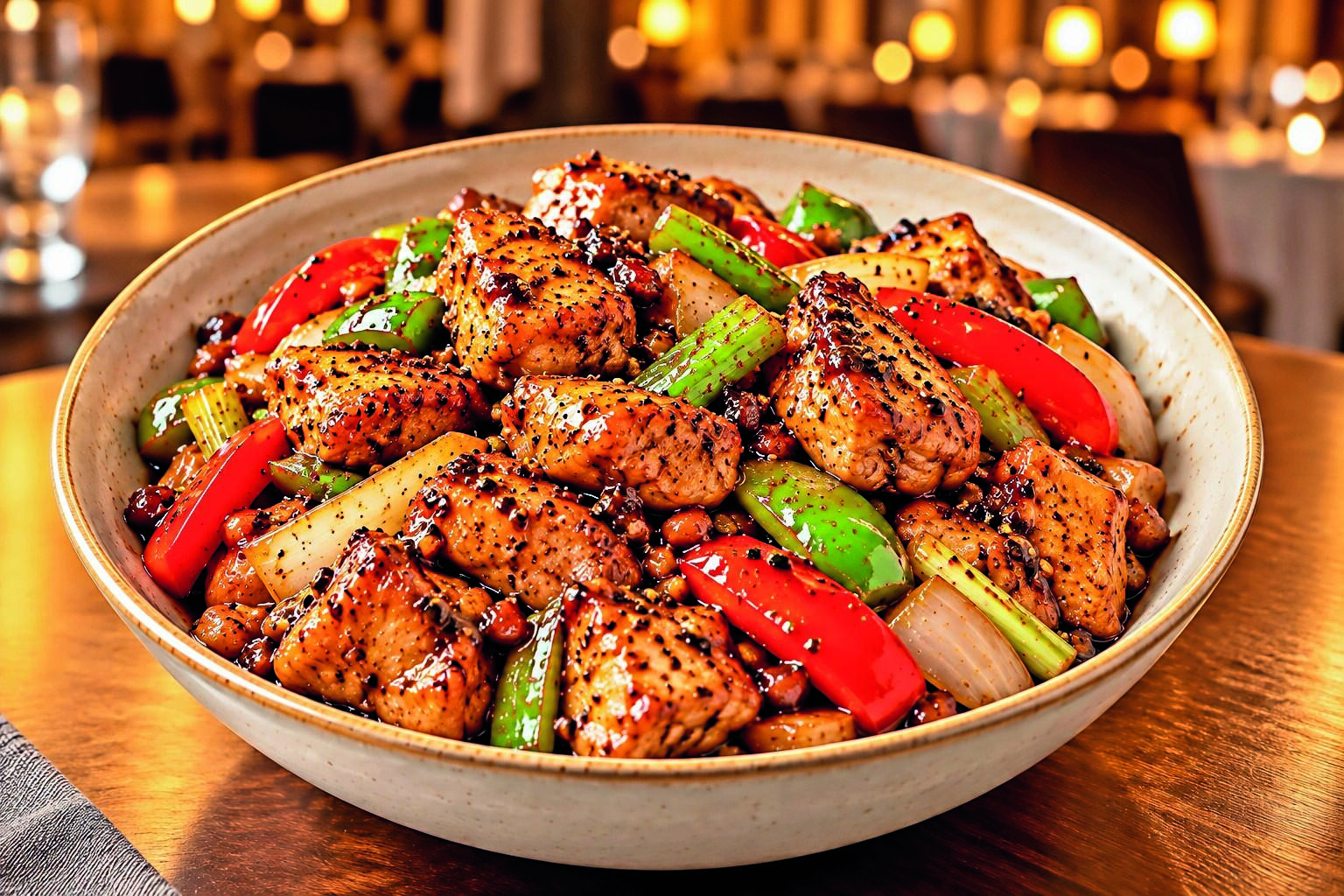
Black pepper chicken/tofu recipe
I often design menus where a small last-minute tweak turns a dish vegetarian, so that I can serve both sets of clients with little effort. This pair is mostly for President Xi, if he has vegetarian guests.Make a marinade with 4 tbs hoisin sauce, 2 tbs light soy, 2 tbs dark soy, 4 tbs chinese cooking wine, 1tbs sesame oil, 2 tsp grated ginger, and 2 tbs cornstarch, whisking till the starch is dissolved (use vegan substitutes for soy if preferred). Divide in half and marinate separately 250 gms boneless chicken thigh and 250 gms of firm tofu, both cut into bite-sized morsels, for one hour in the fridge. Heat a medium-sized pan at high heat, and when the oil is visibly hot, add the chicken, stir-fry for a minute, and then reduce heat to medium and cook for 2 minutes (check that the meat is fully cooked through). Put the chicken on a plate and rinse the pan very carefully (or use a different pan) and repeat with the tofu (it should crisp up a bit).Make a sauce with 1/2 cup vegetable stock, 1 tbs light soy, 1.5 tbs dark soy, 1 tsp sugar, 2 tsp sesame oil and 1 tbs cornstarch. Heat 2 tbs peanut oil in a wok to medium-high, and fry together ½ cup sliced onion, 1 sliced capsicum, and ½ cup sliced celery for 1 minute. Add 2 tsp minced garlic and 1 tbs coarsely crushed black pepper. Fry for 1 minute more and take off heat. Take out half the vegetables, and then add the chicken and half the sauce. Cook till the sauce thickens (1-2 minutes). Pour into a serving bowl and cover. Rinse and dry the wok (or use another one), add the vegetables and heat at medium-high and then add tofu and sauce. Cook till the sauce thickens (1-2 minutes).
Disclaimer: Views expressed above are the author’s own.
Source: timesofindia.indiatimes.com