


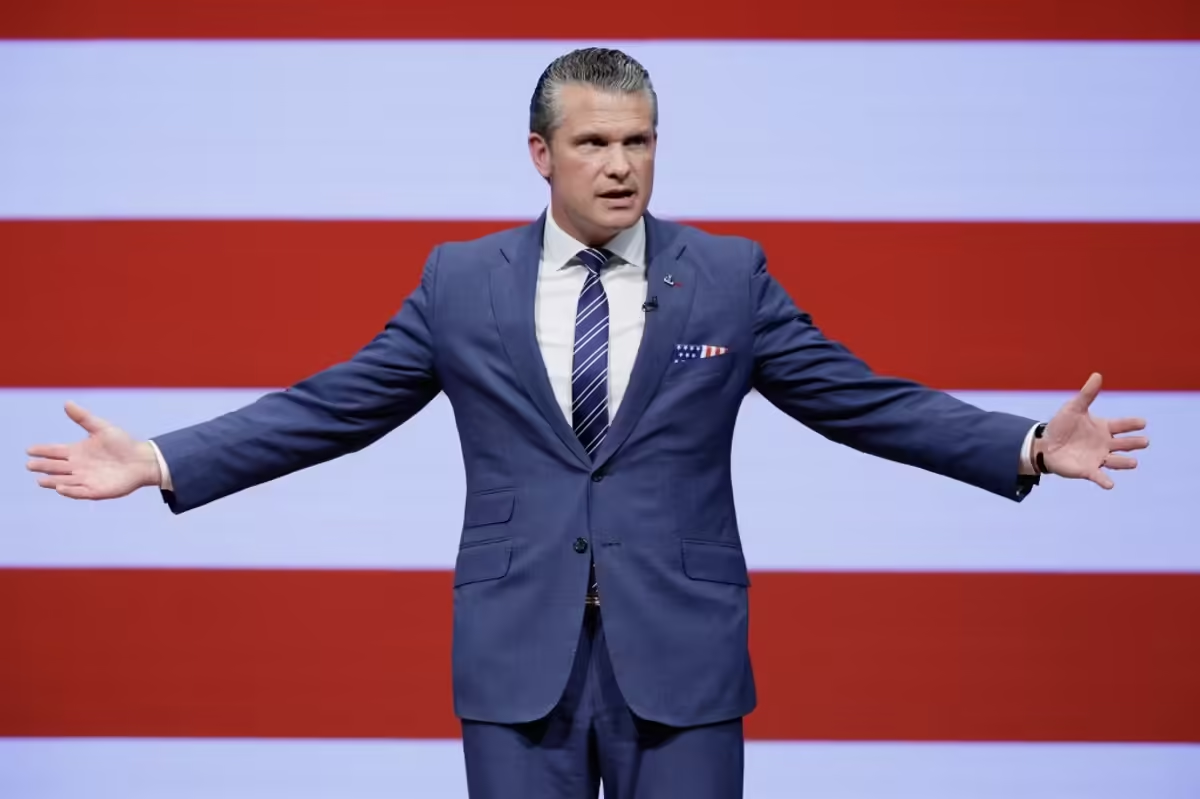

Some US military personnel and capabilities stationed in Europe could be redeployed to the Western Hemisphere or back to the American homeland, US Defense Secretary Pete Hegseth indicated on Saturday, Oct. 3.
According to The Hill, Hegseth linked the potential realignment to the administration’s demands for greater burden-sharing among European NATO allies, alongside an intensifying military campaign directed against drug cartels across Central and South America.
JOIN US ON TELEGRAM
Follow our coverage of the war on the @Kyivpost_official.
“Well, we’re definitely expanding our presence and our footprint in Central and South America with partners, and because of the bold move the president made in Venezuela,” Hegseth stated, referring to the capture of former Venezuelan leader Nicolás Maduro.
“We have a whole new suite of options economically and militarily with partnerships.”
The defense secretary highlighted expanding bilateral security cooperation with regional governments including Ecuador, Honduras, Guatemala, and Panama.
Hegseth emphasized that implementing the administration’s National Security Strategy and National Defense Strategy requires allied European nations to assume primary responsibility for conventional continental defense.
“It makes it very clear that we want more burden sharing in Europe,” Hegseth said.
“And as we do that, a lot of – some of those capabilities are going to move elsewhere, either back home to the big, beautiful base that we’re going to build that we announced a couple of days ago, or to a different posture in the Western Hemisphere as we get after these designated terrorist organizations.”
Other Topics of Interest
Merz Makes Surprise Kyiv Visit, Pledges 1,000 Drone Interceptors
The German chancellor arrived unannounced in Kyiv with business leaders, pledging rapid deliveries of interceptor systems to counter jet-powered Shahed drones.
European posture review
Hegseth’s remarks follow his “State of the Force” address, in which he invited state governors and adjutant generals across the US to submit competitive bids to host what he termed the “next great American” military base.
The prospective realignment coincides with an overarching six-month Pentagon review of US force posture across Europe.
Scheduled to conclude in December, the assessment is evaluating mechanisms to transfer conventional deterrence burdens to NATO allies while reducing the roughly 80,000 American military personnel currently deployed across the continent.
Prior contingency scenarios reported by US defense media indicated that prospective drawdowns could affect between 25,000 and 40,000 troops, primarily from long-standing garrisons in Western Europe such as Germany, Italy, and Spain.
While the US does not maintain large-scale permanent military bases in South America, the administration has progressively deployed naval and air assets to interdict regional narcotics trafficking networks, which the White House has formally designated as national security threats.
Since September 2025, US armed forces have carried out at least 70 kinetic strikes targeting suspected drug-trafficking vessels across the Caribbean Sea and the Eastern Pacific Ocean, killing 234 individuals classified by Washington as narco-terrorists.
In recent weeks, US forces expanded interdiction operations off the coast of Ecuador to target maritime “floating refueling stations,” intercepting large commercial fishing vessels and removing their crews before destroying the ships with explosives.
Allied munitions strain
The potential redeployment of American capabilities away from Europe unfolds as allied governments confront widening delivery delays for contracted US weapon systems.
Washington has notified European and Indo-Pacific partners to anticipate postponements of up to five years for key precision-strike and air defense systems, as the Pentagon prioritizes replenishing domestic stockpiles depleted during combat operations against Iran.
Operational expenditures in the Middle East have consumed more than half of the US military’s inventory of advanced Patriot interceptors – leaving fewer than 1,700 missiles in reserve – alongside a third of its Tomahawk cruise missile inventories and roughly half of its THAAD interceptors.
Source: www.kyivpost.com