




Oct. 04, 2026, 5:00 am ET
|
5 min read
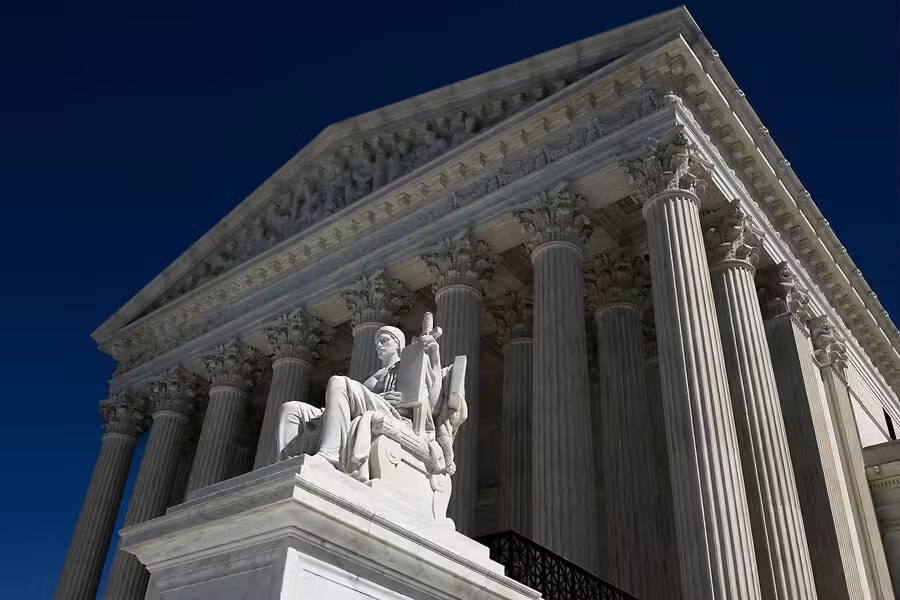
The U.S. Supreme Court begins a new term on Oct. 5. The court’s docket is still taking shape, with 30 cases accepted so far, about half the court’s usual caseload. So far, the term looks relatively quiet, particularly compared with recent years, in which cases involving Donald Trump and his policies as president have dominated the high court’s calendar.
Climate change, guns, and aspects of Mr. Trump’s immigration policies make up some of the most notable cases so far. The nine justices can still decide to add more cases to their merits docket. That’s the path in which cases undergo a deliberative process of briefings and oral arguments before the justices vote and write opinions that set precedent and guide lower courts.
Simultaneously, the court operates an “emergency docket” throughout the year, in which fast-track appeals reach the justices for decisions that are usually temporary, while litigation continues in lower courts. Those decisions can be consequential in the short term and have recently attracted headlines about mail-in voting ahead of the midterm elections and the White House ballroom. But these rulings don’t carry the long-term precedential effect of a merits decision.
Below are previews of significant merits cases to be decided this term:
Suncor Energy Inc. v. County Commissioners of Boulder County
Issues: Climate change, states’ rights
Can localities sue energy companies in state court for damages related to climate change? The Supreme Court will consider the question on the first day of its new term.
Boulder County, Colorado, which has been litigating the case since 2018, argues that it is entitled to monetary damages from Suncor stemming from the harmful effects of climate change. The company is asking the justices to overrule the Colorado Supreme Court’s decision to allow the county’s lawsuit against the company to proceed in state court.
Justice Samuel Alito, one of the court’s most conservative members, has recused himself from the case. The court could issue a 4-4 ruling, which would uphold the Colorado Supreme Court’s ruling but would not establish any precedent. The court could also rule that it doesn’t have jurisdiction to hear the case.
A variety of AR-type rifles are displayed at the Kittery Trading Post, in Kittery, Maine, Aug. 9, 2024. The Supreme Court this term will hear a case about state laws banning such assault-style firearms.
Viramontes v. Cook County
Issue: Gun rights
Can states pass laws banning assault-type rifles? Are such laws “consistent with the Nation’s historical tradition of firearm regulation”?
When the Supreme Court wrote those words in its 2022 decision in New York State Rifle & Pistol Association, Inc. v. Bruen, it created a new test for determining the constitutionality of gun regulations.
That decision caused instant chaos in the lower courts, as judges grappled with how to apply the test to a flood of lawsuits challenging gun restrictions on “history and tradition” grounds. The justices are now faced with the most high-profile successor to that case.
However the case is decided, it will affect millions of people. The AR-15 rifle, for example, is one of the most popular guns in the country, owned by an estimated 1 in 20 American adults.
Department of Homeland Security v. D.V.D.
Issue: Third-country deportations
The Trump administration last year implemented a policy expanding the use of removal of unauthorized immigrants to countries where they have no ties (known as third countries). The administration argues that federal law allows such removals. But a group of immigrants subject to the policy argues that it violates their due process rights and the United Nations Convention Against Torture, which became binding federal law in the U.S. in 1994.
The Supreme Court allowed the policy to take effect on an interim basis last year, but has not yet ruled on its lawfulness.
Rhoney v. Barbosa da Cunha
Issue: Indefinite detention of migrants
This case challenges another Trump administration immigration policy. This directive instructs immigration authorities to detain noncitizens whom they arrest indefinitely. Before the policy went into effect, noncitizens who had been in the country for long periods (years or decades) could obtain release from detention on bond or “conditional parole” because they were not considered flight risks.
District court judges have ruled that the policy is illegal in roughly 90% of all cases, according to a Politico analysis. But appeals courts have split on the issue. Judges on the U.S. Court of Appeals for the 2nd, 6th, and 11th circuits have ruled against the policy, while judges on the 5th and 8th circuits have upheld it. In this case and the D.V.D. case, the high court will play a major role in shaping the Trump administration’s immigration enforcement agenda moving forward.
* * *
There are other notable cases the court might add.
Nathan v. Alamo Heights Independent School District
Issue: Establishment of religion
In what could be the most high-profile case of the term, a group of Texas families is asking the justices to strike down a state law requiring public schools to display the Ten Commandments.
The case provides a test of the high court’s First Amendment jurisprudence in an era when the court has overwhelmingly favored the freedom of religious expression over the constitutional prohibition on government “establishment of religion.”

Students at Lehman High School in Kyle, Texas, work in a classroom in which the Ten Commandments are displayed alongside the Bill of Rights, Oct. 16, 2025.
More than 40 years ago, the Supreme Court ruled that a Kentucky law requiring the posting of the Ten Commandments in public schools was unconstitutional. Most difficult for the court, experts say, will be reconciling this case with its decision last year holding that public schools cannot “substantially interfere with the religious development” of schoolchildren over the preferences of their parents.
“The court has brought the free exercise clause to center stage and consigned the establishment clause to the wings,” says Justin Driver, a professor at Yale Law School. This case, he adds, “would be a monumental addition to the Supreme Court’s docket.”
United States v. Talbott
Issues: Military policy, transgender rights
In the first week of his second term, President Trump signed an executive order banning transgender service members from the military.
A group of active and prospective transgender service members challenged the policy, and a federal judge granted a preliminary injunction blocking it, holding that the policy likely violated the due process clause of the Fifth Amendment. An appeals court upheld the preliminary injunction.
The Trump administration argues that the policy is constitutional because the rules issued by the Defense Department apply generally to individuals with gender dysphoria (a psychological conflict between gender identity and biological sex at birth), or a history of the condition, including medical interventions. The policy does not specifically target transgender individuals as a class, the administration adds.
Source: www.csmonitor.com