



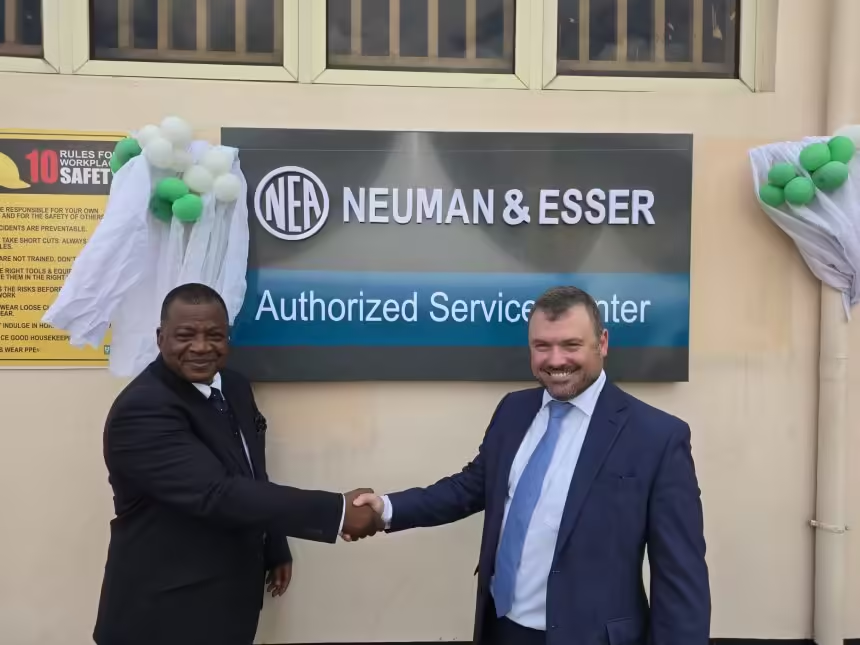

From compressor technology and refinery modernization to flare-gas recovery, hydrogen innovation and local engineering partnerships, German engineering leader NEUMAN & ESSER is helping shape a more self-reliant industrial future for Africa.
By Samuel Ouma *
For decades, Africa’s industrial development followed a familiar and costly pattern. World-class equipment arrived from overseas to power refineries, gas plants, mines and manufacturing facilities, yet whenever major maintenance, refurbishment or complex repairs became necessary, critical components were often shipped back abroad. Sophisticated machinery operated on African soil, but the expertise required to sustain it remained largely elsewhere, resulting in expensive downtime, lengthy maintenance cycles and continued dependence on foreign technical support.
That paradigm is steadily changing. Across the continent, governments are investing heavily in refining capacity, commercializing natural gas, modernizing industrial infrastructure and strengthening local content policies. The ambition is no longer confined to attracting foreign capital; it increasingly centers on developing domestic engineering capability, expanding technology transfer and ensuring African professionals possess the expertise to operate, maintain and improve the industries that will power the continent’s economic future.
Few companies illustrate that evolution more clearly than Germany’s NEUMAN & ESSER ROUP.Founded nearly two centuries ago, the company has built a global reputation for compressor solutions, process solutions, hydrogen technologies and industrial services. In Africa, however, its growing influence extends well beyond the equipment it manufactures. Increasingly, NEUMAN & ESSER is positioning itself as a long-term industrial partner, investing in engineering skills, local partnerships and knowledge transfer that strengthen industrial ecosystems long after projects have been commissioned.
Rather than treating Africa simply as another export destination, the company is helping create an environment where African engineers maintain sophisticated industrial assets locally, customers receive faster technical support and national industries retain greater value within their own economies.
That philosophy is perhaps best demonstrated in Nigeria. Earlier this year, NEUMAN & ESSER officially inaugurated an Authorized Service Center in partnership with MILAT Nigeria Limited, establishing a regional engineering hub in Port Harcourt that provides compressor maintenance, overhaul, refurbishment and engineering support for customers across West Africa. While the facility significantly reduces maintenance turnaround times for operators, its broader significance lies in the industrial model it represents: one that places local capability at the center of long-term development.
For Dr. Jiří Rius, Sales Director for Africa at NEUMAN & ESSER, the inauguration represented far more than the opening of another service facility.
“It was not only an opening ceremony; it was a real milestone for NEUMAN & ESSER, MILAT Nigeria and our esteemed customers and partners,” he says.
His remarks reflect a broader corporate strategy focused on building engineering expertise that remains embedded within African industries long after individual projects have been completed.
“This reflects NEUMAN & ESSER’s commitment to supporting local youth through training and development and represents an important milestone in our Africa development strategy,” Dr. Rus explains.
Those ambitions closely align with the priorities of governments across Africa, where local content has evolved from a regulatory requirement into a central pillar of industrial policy. Increasingly, policymakers expect international companies not merely to supply technology, but to invest in people, institutions and engineering capacity capable of sustaining industrial growth for decades.
NEUMAN & ESSER has embraced that expectation as a business philosophy rather than a compliance exercise. Instead of managing African operations from distant regional headquarters, the company has steadily expanded partnerships that bring engineering capability closer to customers. Nigerian engineers work alongside German specialists, receive continuous technical training and undertake increasingly sophisticated maintenance activities that once required equipment to be transported overseas.

The benefits extend far beyond individual facilities. Operators reduce costly downtime, maintenance becomes faster and more efficient, technical knowledge remains within local institutions and young engineers acquire internationally recognized competencies that strengthen both their careers and their countries’ industrial competitiveness.
That approach resonates strongly with the vision championed by the African Energy Chamber (AEC), which has consistently argued that Africa’s energy future depends not only on discovering new resources but on building the industrial capabilities required to maximize their value.
For the Chamber, industrial development must be measured by more than production figures. Success increasingly depends on reducing waste, improving operational efficiency, commercializing previously flared natural gas and equipping African professionals to lead the continent’s next phase of industrialization.
Those priorities became particularly evident during a visit by NJ Ayuk, Executive Chairman of the African Energy Chamber, to NEUMAN & ESSER’s headquarters in Germany.

Among the technologies that attracted his attention was the company’s integrated approach to flare-gas utilization—an area where engineering innovation intersects directly with Africa’s economic and environmental ambitions.
“They actually transform flare gas into usable energy, which I find amazing,” Ayuk observed after touring the company’s facilities.
His reaction speaks directly to one of Africa’s most persistent energy challenges. Across many oil-producing countries, associated natural gas continues to be flared because capturing, processing and commercializing it requires specialized infrastructure and commercially viable engineering solutions. Every year, billions of cubic meters of valuable gas are burned into the atmosphere while millions of Africans continue to face unreliable electricity supplies and industries struggle with inadequate energy access.
For Ayuk, that contradiction represents one of the continent’s greatest untapped economic opportunities.
“If Africa stopped flaring tomorrow,” he has argued, “the continent’s upstream emissions would decrease by half.”
The African Energy Chamber has consistently maintained that reducing emissions should not mean restricting Africa’s energy development. Instead, the organization advocates deploying better engineering, cleaner technologies and more efficient industrial systems that simultaneously improve environmental performance and generate economic value.
NEUMAN & ESSER’s engineering portfolio aligns closely with that philosophy. Working alongside German engineering partner SPG Steiner, the company delivers integrated flare-gas utilization systems capable of converting what was once considered waste into commercially valuable products.
“We offer technical consultancies to tailor the design of process and technology for utilization of this gas toward LNG, CNG, LPG or simply gas-to-power, depending on our customers’ business plans,” explains Ilya Asser, Managing Director of NEUMAN & ESSER Deutschland.
“We design, manufacture and install the complete systems directly on site. We see flare gas not as waste, but as a business opportunity.”
That distinction captures a broader transformation taking place across Africa’s energy industry. Increasingly, success is measured not simply by how much oil or gas is produced, but by how efficiently resources are utilized, how much value remains within local economies and how effectively industrial operations reduce waste while maximizing commercial returns.
The company’s engagement therefore extends well beyond compressor manufacturing. Across refineries, gas-processing facilities, mining operations and emerging hydrogen projects, NEUMAN & ESSER provides engineering design, installation, modernization, predictive maintenance, digital monitoring and long-term operational support designed to maximize equipment reliability throughout its lifecycle.
For operators managing complex industrial infrastructure, reliability has become every bit as valuable as new investment. Refineries operating below capacity because of avoidable equipment failures lose millions of dollars in potential revenue. Gas-processing facilities depend on dependable compression systems, while mining companies require uninterrupted processing technologies to maintain production targets. In each case, engineering excellence becomes not merely a technical consideration but a commercial necessity.
That reality has helped shape NEUMAN & ESSER’s growing relationship with the African Refiners and Distributors Association (ARDA), where the company has emerged as one of the downstream industry’s most consistent technical partners. As a Gold Sponsor of ARDA Week for four consecutive years, NEUMAN & ESSER has contributed expertise to discussions on refinery modernization, operational reliability, maintenance excellence and digital transformation.

According to Anibor Kragha, Executive Secretary of ARDA, investments such as the Port Harcourt Authorized Service Center represent precisely the type of partnership Africa’s downstream industry requires as refining capacity expands across the continent. By bringing world-class engineering services closer to refinery operators while strengthening local technical expertise, such facilities improve reliability, accelerate maintenance and reinforce the long-term resilience of Africa’s industrial ecosystem.
Yet the company’s African strategy extends beyond physical infrastructure. It also recognizes that compressors, digital systems and advanced process technologies are only as effective as the engineers who operate them – a philosophy that increasingly shapes NEUMAN & ESSER’s investment in technical education across the continent.
If the Port Harcourt Authorized Service Center demonstrates how NEUMAN & ESSER is localizing engineering expertise, the company’s investment in technical education reveals the philosophy underpinning its broader African strategy. Across the continent, the company has come to recognize that compressors, process systems and digital technologies are only as effective as the engineers who operate and maintain them. Building industrial resilience therefore requires investing in people with the same determination devoted to designing world-class equipment.
That conviction has found practical expression through NEUMAN & ESSER’s increasingly successful “Training on the Road” initiative, a program that takes engineering expertise directly to customers rather than requiring operators to travel overseas for specialized instruction. The approach reflects a simple but powerful idea: sustainable industrial development depends on knowledge being transferred where it is needed most.
The initiative has already benefited operators, EPC contractors and maintenance specialists in South Africa, equipping them with practical expertise in compressor technology, equipment modernization, diagnostics, operational optimization and preventive maintenance. Rather than relying solely on classroom presentations, the sessions immerse participants in real operating scenarios, allowing engineers to exchange experiences with NEUMAN & ESSER specialists while developing practical solutions to everyday industrial challenges.
The emphasis is firmly on application rather than theory. Participants learn techniques that improve equipment reliability, extend operational life, reduce maintenance costs and minimize unplanned shutdowns. Just as importantly, they gain exposure to internationally recognized engineering standards while building the confidence to solve increasingly complex technical problems within their own organizations.
Beyond South Africa, similar programs are delivered at customer facilities across Africa, through virtual platforms and at NEUMAN & ESSER’s engineering centers in Germany. Regardless of location, the objective remains consistent: strengthen local expertise so African industries become progressively less dependent on external technical support and increasingly capable of sustaining world-class industrial operations on their own.
That philosophy aligns closely with the ambitions of governments seeking to transform local content from a policy objective into a genuine driver of industrial competitiveness. Across the continent, technology transfer has become one of the defining measures of successful international partnerships, and companies capable of cultivating domestic engineering expertise are increasingly viewed as long-term development partners rather than simply equipment suppliers.
For NEUMAN & ESSER, education has become both a responsibility and a strategic investment.
“We are committed to supporting local youth through training and development,” Dr. Jiří Rus says. “Our goal is to build capabilities that remain with our customers and partners long after projects are completed.”
Those capabilities are becoming increasingly valuable as Africa’s industrial landscape grows more sophisticated. From Uganda and Côte d’Ivoire to Namibia and emerging energy markets across the continent, governments are investing heavily in infrastructure that will require dependable engineering support for decades. New oil and gas developments demand advanced compression technologies. Mining operations require highly efficient processing systems. Manufacturers are seeking greater productivity while reducing operating costs, and the emergence of hydrogen projects is opening an entirely new frontier for engineering innovation.
Rather than viewing these sectors as separate business opportunities, NEUMAN & ESSER approaches them as interconnected pillars of Africa’s industrial future. That integrated perspective is particularly evident in Namibia, where significant offshore discoveries coincide with the country’s ambition to become one of the world’s leading exporters of green hydrogen. Through the acquisition and integration of Brazilian hydrogen specialist HYTRON, NEUMAN & ESSER has expanded its expertise in PEM electrolyzers, hydrogen compression, storage and transportation technologies, positioning itself to support the development of complete hydrogen value chains.
For African countries exploring hydrogen as part of their long-term energy strategies, the company offers engineering solutions that extend from production through storage and transportation. Yet NEUMAN & ESSER does not present hydrogen as a substitute for conventional energy.
Instead, it views natural gas, refinery modernization, cleaner industrial processes and hydrogen development as complementary elements of Africa’s evolving energy mix. That balanced perspective closely mirrors the position consistently advanced by the African Energy Chamber, which argues that Africa’s energy transition must reflect the continent’s developmental priorities rather than imported policy prescriptions.
NJ Ayuk has repeatedly challenged narratives suggesting Africa must choose between economic development and environmental responsibility. The continent, he argues, contributes less than ten percent of global upstream emissions while continuing to face widespread energy poverty and inadequate industrial infrastructure.
“The perception that African energy assets are more carbon intensive than average certainly has not helped,” Ayuk has observed. “Africa produces less than ten percent of global upstream emissions.”
For the African Energy Chamber, the solution is not restricting investment but accelerating the deployment of technologies that reduce waste, improve efficiency and maximize the value of Africa’s natural resources. Companies capable of recovering flare gas, modernizing refineries, improving operational performance and supporting cleaner industrial production therefore become essential partners in the continent’s development agenda.
That is precisely where NEUMAN & ESSER’s engineering capabilities assume broader significance. By transforming flare gas into commercially valuable products, optimizing compression systems and helping operators improve equipment performance, the company demonstrates that industrial growth and environmental stewardship can reinforce rather than contradict one another. Every cubic meter of gas commercialized instead of flared creates additional economic value while reducing unnecessary emissions. Every refinery operating more efficiently strengthens regional energy security. Every engineer trained locally expands Africa’s technical capacity and reduces dependence on external expertise.
For Ilya Asser, engineering is ultimately about creating value that benefits both operators and host economies.
“We design and deliver complete solutions according to each customer’s business requirements,” he explains. “Whether the objective is LNG, CNG, LPG or gas-to-power, the goal is to convert flare gas into economic value.”
That philosophy increasingly resonates across Africa as governments pursue gas commercialization strategies designed to fuel industries, expand electricity access, strengthen manufacturing and generate new employment opportunities.
It also explains why NEUMAN & ESSER continues investing in industry platforms that extend well beyond commercial transactions. Whether participating in ARDA Week, NOG Energy Week, the African Green Industries Summit or specialized engineering workshops, the company consistently uses these forums to exchange technical knowledge, showcase innovation and deepen relationships with customers, regulators and industry associations.
Those engagements reinforce an important lesson. Industrial transformation is rarely achieved through isolated investments or individual projects. It emerges through sustained collaboration among technology providers, policymakers, local companies and engineers working toward shared objectives.
The Authorized Service Center established with MILAT Nigeria Limited illustrates precisely that principle. What began as a partnership focused on compressor maintenance has evolved into a regional engineering capability serving customers across West Africa. Nigerian engineers are now undertaking increasingly sophisticated technical work closer to their customers. Maintenance turnaround times have been reduced, operators benefit from faster and more responsive support, and more value remains within local economies rather than leaving the continent.
According to ARDA Executive Secretary Anibor Kragha, partnerships of this nature represent exactly the direction Africa’s downstream sector must continue pursuing. By expanding technical training, strengthening local partnerships and bringing world-class engineering services closer to refinery operators, facilities such as the Port Harcourt center contribute directly to the resilience and competitiveness of Africa’s industrial ecosystem. They demonstrate how international expertise can complement rather than replace domestic capability.
That philosophy naturally extends into the digital era. Industrial reliability today depends as much on intelligent data as it does on mechanical engineering, and NEUMAN & ESSER has embraced that reality through digital platforms such as NEA|XPLORE Mobile. Real-time equipment monitoring, predictive diagnostics and remote engineering support enable operators to identify potential problems before they develop into costly shutdowns.
Predictive maintenance has rapidly become a competitive necessity for industries where every hour of downtime carries significant financial consequences. By combining digital monitoring with local engineering expertise, operators improve operational efficiency, reduce maintenance costs and extend the lifespan of critical industrial assets.
It is another reminder that engineering leadership today extends well beyond hardware. For nearly two centuries, NEUMAN & ESSER has designed compressors, process systems and industrial technologies supporting some of the world’s most demanding operations. In Africa, however, its most enduring contribution may ultimately be measured less by the machinery it installs than by the engineering ecosystems it helps build.
Its partnerships with companies such as MILAT Nigeria Limited, sustained investment in technical education, support for refinery modernization, commitment to gas commercialization and expanding expertise in hydrogen technologies all reflect a consistent philosophy: industrial success is built through collaboration, knowledge transfer and long-term commitment.
That vision closely aligns with the African Energy Chamber’s advocacy for value addition, local content and practical energy solutions capable of delivering broad-based economic development. As NJ Ayuk has consistently argued, companies that combine innovation with local partnerships and long-term investment will create the skilled jobs, industrial capacity and sustainable growth that Africa requires.
For a continent determined to industrialize on its own terms, the message is becoming increasingly clear. Infrastructure remains indispensable, investment continues to matter and technology will always drive competitiveness. Yet none of those elements can realize their full potential without skilled engineers, trusted partnerships and institutions committed to building domestic expertise.
NEUMAN & ESSER’s expanding African footprint suggests that the continent’s industrial future will not simply be imported. It will be built collaboratively with African companies, sustained by African engineers and strengthened through partnerships that prioritize knowledge transfer alongside technology.

In that respect, the company’s greatest legacy may not ultimately be the compressors it manufactures or the industrial facilities it commissions. It may well be the confidence it helps instill in a new generation of African engineers—professionals equipped to maintain world-class infrastructure, solve increasingly complex industrial challenges and lead the continent’s next era of industrial transformation.
As Africa accelerates investments in refinery modernization, natural gas commercialization, advanced manufacturing and emerging hydrogen industries, the companies that will make the greatest difference are those prepared to invest not only in equipment, but in people. By combining engineering excellence with local partnerships, technology transfer and long-term capacity building, NEUMAN & ESSER is helping demonstrate that Africa’s industrial future will be defined as much by the expertise developed on the continent as by the technology brought to it. That is a legacy measured not simply in machines installed or projects completed, but in stronger institutions, more capable engineers and industrial ecosystems increasingly equipped to power Africa’s own development story for generations to come.
Source: panafricanvisions.com