



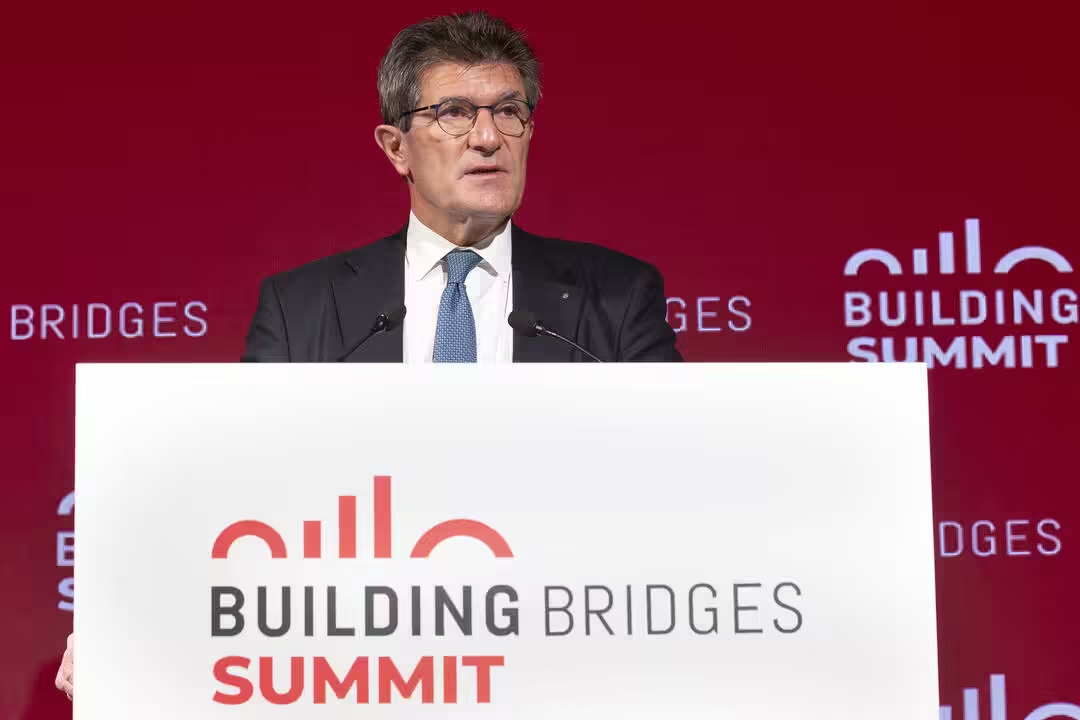

As Geneva’s annual sustainable finance summit prepares to open its doors on Tuesday, its co-founder, Swiss banker Patrick Odier, argues that sustainability must remain a long-term priority despite global conflicts, energy and security threats diverting political attention.
Since Geneva’s first Building Bridges summit in 2019, sustainable investment has been relegated to the political back seat as mounting conflicts, such as the wars in Ukraine and the Middle East, have drastically reshaped government and investor priorities. Stocks in arms and defence companies, which ESG-screened funds shunned only a few years ago, have experienced a renaissance as global military spending has soared. At the same time, the environmental, social, and governance agenda has taken a knock, not least due to the Trump administration-fuelled backlash that has prompted outflows from ESG funds. And yet, with cascading planetary crises, soaring carbon emissions, record deforestation, climate-warning-induced natural disasters and stifling heatwaves – it can no longer be business as usual.
For Patrick Odier, that makes sustainable finance far from a sideline issue. The banker, who has been the voice behind Building Bridges since its inception, says that with 2,000 to 3,000 people expected to attend this week, the topic has taken on a new urgency that can only be addressed by ensuring short-term political headwinds do not derail long-term goals. He spoke with Geneva Solutions.
Geneva Solutions: When you look back at the first edition in 2019 and compare it to today, so much has changed, in particular, the geopolitical backdrop. What did you think sustainable finance – and Building Bridges – would look like by 2026?
Patrick Odier: There are positives and negatives. Since 2019, we have moved from a local initiative to a recognised international rendezvous for sustainable finance and related issues. It has professionalised, and the number of events has doubled. Another positive is that the agenda has converged. That means it’s a bit easier to build consensus in the finance community because we have recognised the need to focus on certain mega topics rather than the cocktail of approaches we had in the past.
The downside is that things haven’t moved as fast as they should have, neither overall nor in sustainable finance. Some of the questions asked seven years ago are still the ones we are asking today. Another negative is the constant debate between short- and long-term horizons in discussions of sustainability. The short term has prevailed, probably for reasons we didn’t expect seven years ago.
In the early 2020s, the topics in the agenda at Building Bridges were centred on impact and transparency, and ESG disclosure rules and taxonomies – which have since faced considerable backlash. Today, the focus has moved to energy security, infrastructure and resilience. What does this shift tell us about the priorities and appetite for sustainable investment today?
Taxonomies and other regulatory approaches taken a few years ago were necessary to focus attention on metrics and quantifiable objectives. They helped establish a common foundation, but in some cases their complexity made implementation more challenging. That’s why there is now a growing focus on simplification and usability.
While we needed those reflections 10 years ago, today we need to tackle higher-level issues, like sovereignty over food, health, and energy. That’s why the themes we’re discussing this year at Building Bridges are more of this nature.
Take energy, which we are putting at the top of our agenda this year: recent geopolitical and energy security challenges have underscored the need to speed up the transition. Infrastructure has also become essential in parts of the world beyond those traditionally considered new frontiers, including Europe. This discussion overlaps with sustainability, because reinventing infrastructure will involve making it more productive, operationally efficient, circular, and energy-efficient.
Can investors drive that sustainable transition when political support in many countries, including major economies like the United States, is weakening?
Today, some sustainability issues have become over-politicised. At the same time, there’s been a remarkable shift in the mindset of economic actors in general, towards realising that sustainability is really about simple operational resource efficiency and resilience, while continuing to address broader environmental and social challenges. Several Asian economies that were lagging a few years ago are now leading not only the discussion but also in the transition of their societies towards more sustainable resource allocation.
If there’s one thing that we can all hope for in this whole debate, it’s that there’s a convergence between what is good for the planet, what is good for people, and what makes economic sense. Because when those interests align, we can accelerate the transition considerably.
AI seems to capture one of the central dilemmas facing sustainable finance. It’s driving huge demand for electricity and therefore investment in new energy infrastructure, but has high environmental costs – where do you draw the line between what’s sustainable and what’s not?
Energy, of course, is going to be critical to the development of these technologies. So we have a big question: how do we make sure this huge electricity consumption doesn’t trigger easy fixes by generating that electricity the wrong way? How can we create the right incentive for the supply to rise at the same pace as demand, but in the right renewable direction?
But we also have to recognise that these developments in AI would impact water even more – the supply for cooling – and that water is a critical resource that will play a huge role in the coming years for all of us. The data centres that will be created to cater for these AI energy needs use huge land surfaces, and they will have an impact in regions that are chosen carefully if we don’t want to have contradictory and perhaps completely paradoxical effects between the positive of having electricity produced correctly, and the negative impact that it creates on the environment, land use, and water in general.
At the same time, AI also offers opportunities to improve efficiency and accelerate innovation within planetary boundaries and this is a topic we have prioritised at the conference this year too.
The theme of this year’s conference is investable solutions to global challenges. Why are we still struggling to get capital to areas where there is an evident need?
Prudent capital moves at its own pace, rather than the pace we might wish to see. Our challenge is therefore to create the conditions that allow capital to move with greater confidence, speed and scale. That means you need all the ingredients in place to ensure capital allocates the way we want. One is to speak the same language. That means not only using terms like sustainability, transition, or impact correctly and consistently everywhere, and measuring them correctly, but also translating the material impact of environmental changes on economic infrastructure and industrial production facilities. That’s also why we encouraged the ISSB to open its offices in Geneva: to establish as fast as possible, global sustainable reporting standards that makes us all speak the same language and make more informed investment decisions.
A second example of where we can act to make sure capital flows more quickly is to have the right policy incentives. We need constructive dialogue between finance and policymakers to create investable conditions on the ground. This has to do with risk mitigation and ensuring that local liquidity exists before bringing in foreign capital, for example, with the proactive engagement of multilateral development banks.
In 2021, you told Geneva Solutions that sustainable investment would be the largest, most important source of future returns and portfolios. Do you still believe that?
Yes. Because sustainability will strongly impact operational efficiency in every sense. In other words, putting less energy in to get more product out. The world is going to move toward sustainability, with improved profitability or reduced risks in mind.
Companies and solutions that choose this path are likely to be among the most attractive investment opportunities of the years ahead.
What else needs to be prioritised?
Sustainability has to be de-verticalised, if I can use that rather awkward term, and become transversal to any decision and any policy we are trying to achieve.
The second point is that all this has a cost. People will always suffer much more from the short-term costs and benefit from the long-term benefits. That means that for a policy to be helpful in this respect, it would be to find a solution for who should pay the short-term costs that the average consumer cannot bear.
Success will depend on our ability to make solutions investable at scale, mobilising capital towards real-economy transformation and ensuring that the benefits and costs of the transition are shared fairly.
Source: genevasolutions.news