




Market Estimate, 2026
$17.2B
Market Forecast, 2035
$30.1B
Automotive Intercooler Market Summary
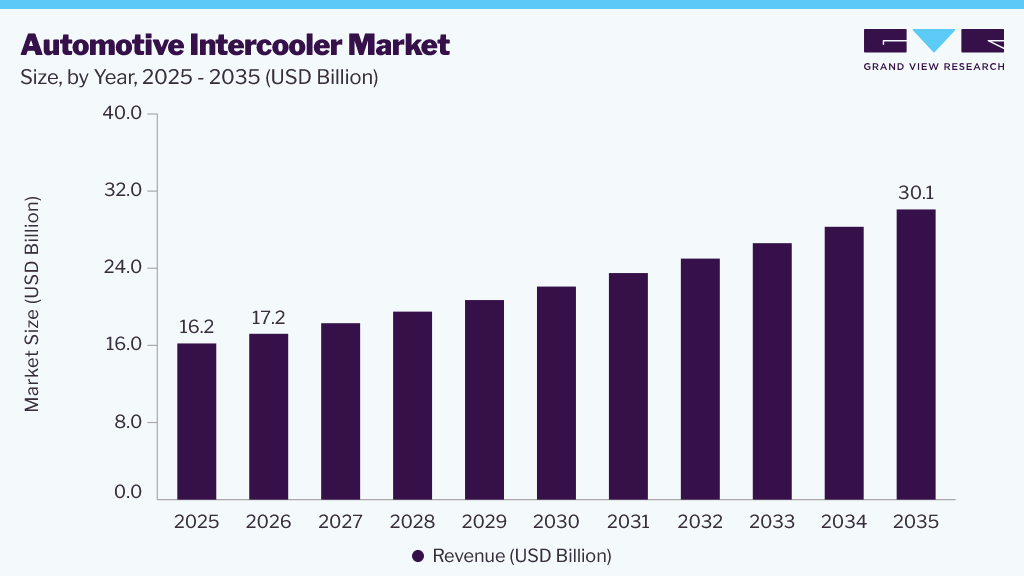
The global automotive intercooler market size was valued at USD 16.2 billion in 2025 and is projected to grow from USD 17.2 billion in 2026 to USD 30.1 billion by 2035, at a CAGR of 6.4% from 2026 to 2035. Asia Pacific dominated the market, accounting for the largest revenue share in 2025. The market is witnessing steady growth, driven by the rising adoption of turbocharged engines, engine downsizing trends, and increasing demand for improved fuel efficiency and emission compliance.
Source: Grand View Research, IR Documents, Primary Interviews, Paid Databases
Key Market Trends & Insights
- By product type: Air-to-air intercoolers segment held the largest market share in 2025.
- By engine type: Turbocharged engines segment dominated the market share in 2025.
- By vehicle type: Passenger cars led the market share in 2025.
Regional Highlights
- Largest regional market: Asia Pacific (largest revenue share, 2025)
- Fastest-growing regional market: North America (highest CAGR, 2026-2035)
Market Size & Forecast
- Market size in 2025: USD 16.2 Billion
- Estimated market size in 2026: USD 17.2 Billion
- Projected market size by 2035: USD 30.1 Billion
- CAGR (2026-2035): 6.4%
Three ways to get this report
Buy it, customize it, or ask a question.
A direct answer, usually in 1 working day
- AccessReport author, directly
- Reply timeWithin 1 working day
- No sales callDirect answer only
- FormatEmail reply
- CostFree, no cost
What the study covers
- FormatsPDF · Excel · Dashboard
- Timeline2026–2035 annual, 2025 base
- Coverage20+ countries, 5 regions
- Companies10+ key players profiled
20% free customization
- IncludeCountries, segments, points
- TailorTo your product definition
- ExtendDeeper competitor detail
- OrA fully bespoke study
- Turnaround5–10 working days
The growing adoption of turbocharged engines remains the primary driver of the automotive intercooler market. Automakers continue to downsize engines while maintaining performance through turbocharging, increasing demand for efficient charge air cooling systems. Intercoolers improve combustion efficiency by lowering intake air temperatures, resulting in higher power output, improved fuel economy, and reduced emissions. Tightening emission standards across Europe and North America are encouraging automakers to adopt advanced thermal management technologies. Similar regulatory requirements in China and India are further driving their adoption in passenger and commercial vehicles.
Despite favorable growth prospects, the market faces restraints associated with the increasing penetration of battery electric vehicles, which do not require conventional engine intercoolers. In addition, volatility in aluminum prices and the technical complexity of integrating compact cooling systems into modern vehicle architectures continue to challenge manufacturers. OEMs are also under pressure to reduce vehicle weight while maintaining thermal performance, increasing research and development costs.
The market presents significant opportunities through the development of next-generation thermal management solutions for hybrid and high-performance vehicles. Ongoing investment by leading automotive suppliers and OEMs in turbocharged internal combustion and hybrid powertrains is reinforcing demand for advanced charge air cooling technologies. Moreover, manufacturers are increasingly investing in lightweight aluminum heat exchangers, additive manufacturing technologies, and integrated thermal management systems to improve cooling efficiency while reducing vehicle weight. These innovations are expected to create long-term growth opportunities for automotive intercooler suppliers.
Analyst Perspective
The automotive intercooler market is growing due to the adoption of turbocharged and downsized engines that improve fuel efficiency and meet stringent emission standards. Rising production of turbocharged passenger and commercial vehicles, particularly in Europe and APAC, continues to support demand. Hybrid powertrains are also driving demand for advanced thermal management systems, while manufacturers focus on lightweight aluminum intercoolers and enhanced heat transfer technologies. Although growing battery electric vehicle adoption may limit long-term demand, continued production of internal combustion engine and hybrid vehicles is expected to sustain market growth during the forecast period.
Product Type Insights
The air-to-air intercoolers segment accounted for the largest share of the global automotive intercooler market in 2025 and is expected to maintain its dominant position throughout the forecast period. Air-to-air intercoolers are widely adopted across passenger cars, commercial vehicles, and performance vehicles due to their simple design, lower manufacturing cost, high reliability, and minimal maintenance requirements. These systems cool compressed air from turbochargers using ambient airflow, thereby lowering intake air temperatures, improving engine efficiency, increasing power output, and enhancing fuel economy. Their lightweight construction, cost-effectiveness, and compatibility with a wide range of turbocharged engines have made them the preferred choice for original equipment manufacturers (OEMs).
The growing production of turbocharged gasoline and diesel vehicles continues to support demand for air-to-air intercoolers. Automotive manufacturers are increasingly adopting engine downsizing strategies combined with turbocharging to meet stringent fuel efficiency and emission regulations without compromising vehicle performance. Modern air-to-air intercoolers also feature lightweight aluminum construction, improved fin geometries, and enhanced heat transfer designs that maximize cooling efficiency while reducing vehicle weight. Meanwhile, suppliers are expanding investments in broader thermal management technologies to address evolving powertrain requirements across internal combustion, hybrid, and electric vehicles.
The air-to-water intercoolers segment is expected to register the fastest CAGR during the forecast period. These intercoolers provide superior cooling efficiency, compact packaging, and faster thermal response compared to conventional air-to-air systems. They are increasingly being adopted in high-performance passenger cars, hybrid vehicles, luxury automobiles, and heavy-duty commercial vehicles where space constraints and high thermal loads require more advanced cooling solutions. As hybrid powertrains and high-output turbocharged engines continue to gain popularity, demand for air-to-water intercoolers is expected to accelerate significantly.
Engine Type Insights
The turbocharged engines segment held the largest share of the automotive intercooler market in 2025 and is also expected to record the fastest CAGR throughout the forecast period. Turbocharging has become a preferred technology for improving engine performance, while reducing fuel consumption and carbon emissions. Intercoolers play an essential role in turbocharged engines by cooling of compressed intake air before it enters the combustion chamber, resulting in higher air density, improved combustion efficiency, greater engine power, and enhanced durability.
Governments worldwide continue to implement increasingly stringent fuel economy and emission regulations, encouraging vehicle manufacturers to replace naturally aspirated engines with smaller turbocharged engines. Passenger vehicles, SUVs, light commercial vehicles, and heavy-duty trucks are all increasingly incorporating turbocharged powertrains to achieve better performance without increasing engine displacement. Although supercharged engines continue to be used in selected luxury and high-performance vehicles, their adoption remains comparatively limited because of higher mechanical losses and increasing preference for more fuel-efficient turbocharging systems.
Vehicle Type Insights
The passenger cars segment accounted for the largest share of the global automotive intercooler market in 2025. Passenger vehicle manufacturers continue to increase the adoption of turbocharged gasoline engines to improve fuel efficiency while maintaining vehicle performance. The growing popularity of compact SUVs, crossover vehicles, and premium sedans equipped with downsized turbocharged engines has significantly increased demand for advanced intercooling systems. Consumers increasingly expect better acceleration, lower fuel consumption, and reduced emissions without compromising driving performance. As a result, automotive manufacturers continue integrating advanced intercoolers with high-efficiency turbocharging technologies. Advancements in aluminum brazing techniques, lightweight heat exchangers, and compact cooling modules are enabling manufacturers to optimize vehicle packaging while improving thermal performance.
The heavy commercial vehicles (HCVs) segment is expected to witness the fastest growth during the forecast period. Commercial vehicle manufacturers are increasingly introducing highly efficient turbocharged diesel engines capable of meeting stringent emission standards while delivering higher torque, improved fuel efficiency, and lower operating costs. Growth in long-haul transportation, logistics, mining, and infrastructure development continues to increase demand for heavy-duty vehicles equipped with advanced engine cooling systems. In addition, the increasing adoption of hybrid commercial vehicles and next-generation heavy-duty powertrains is expected to further strengthen demand for high-capacity intercoolers capable of maintaining optimal intake air temperatures and engine performance under demanding operating conditions.
Sales Channel Insights
The Original Equipment Manufacturers (OEMs) segment held the largest share of the automotive intercooler market in 2025. OEMs remain the primary customers for intercooler manufacturers because intercoolers are integrated directly into vehicle powertrains during vehicle production. Automotive manufacturers continue collaborating closely with thermal management suppliers to develop lightweight, compact, and highly efficient intercooling systems that support improved engine performance, fuel efficiency, and compliance with increasingly stringent emission regulations.
The increasing production of turbocharged passenger vehicles and commercial vehicles continues to drive OEM demand. Vehicle manufacturers are also investing in integrated thermal management systems that combine intercoolers with radiators, condensers, battery cooling systems, and other cooling components, particularly for hybrid powertrains.
The aftermarket segment is projected to register the fastest CAGR throughout the forecast period. A growing global vehicle parc, increasing demand for performance upgrades, and the rising popularity of motorsports and vehicle customization are encouraging consumers to replace factory-installed intercoolers with higher-capacity aftermarket solutions. Performance enthusiasts and fleet operators increasingly seek upgraded intercoolers that improve engine efficiency, lower intake air temperatures, and enhance overall vehicle reliability. The expanding automotive repair industry and increasing average vehicle age are expected to further support aftermarket growth.
Regional Insights
Asia Pacific automotive intercooler market accounted for the largest share of the global automotive intercooler market in 2025 and is expected to maintain its leadership throughout the forecast period. The region benefits from its position as the world’s largest automotive manufacturing hub, with countries such as China, Japan, India, South Korea, and Thailand producing millions of passenger and commercial vehicles annually. Increasing adoption of turbocharged gasoline engines, rising demand for fuel-efficient vehicles, and expanding automotive exports continue to drive demand for advanced intercooling systems.
Major automotive manufacturers across the region continue investing in engine downsizing, hybrid technologies, and lightweight vehicle platforms, creating sustained demand for high-performance thermal management solutions. In addition, the presence of leading automotive component suppliers and extensive manufacturing infrastructure further strengthens regional market growth.
North America Automotive Intercooler Market Trends
North America is expected to witness the fastest growth during the forecast period. The region is experiencing increasing demand for turbocharged pickup trucks, SUVs, performance vehicles, and heavy commercial vehicles equipped with advanced engine cooling technologies. Stringent fuel economy regulations, rising production of hybrid vehicles, and continuous investments in advanced engine technologies are driving the adoption of high-efficiency intercoolers across both OEM and aftermarket channels. In addition, growing consumer preference for performance vehicles, expanding commercial transportation activities, and increasing investment in thermal management technologies are expected to support strong regional growth throughout the forecast period.
Key Automotive Intercooler Market Company Insights
The global automotive intercooler market is highly competitive, with leading manufacturers focusing on improving thermal efficiency, lightweight designs, and durability to meet the evolving requirements of turbocharged gasoline and diesel engines, as well as hybrid powertrains. Companies are investing in advanced aluminum intercoolers, optimized heat exchanger technologies, and compact cooling solutions to enhance engine performance, fuel efficiency, and emissions compliance. Strategic initiatives such as product innovation, partnerships with automotive OEMs, capacity expansions, and acquisitions continue to strengthen their competitive positions.
Key Automotive Intercooler Companies
The following key companies have been profiled for this study on the automotive intercooler market:
Recent Developments
-
In April 2026, MAHLE reported improved operating performance for the 2025 financial year, reflecting continued investment in electrification and advanced thermal management technologies. The company highlighted innovations including a thermal management module with an integrated heat pump, a range extender system for electric vehicles, and advanced thermal solutions for stationary battery storage, megawatt charging infrastructure, and data center cooling, demonstrating its broader focus on next-generation thermal management and energy-efficient technologies.
-
In July 2025, Conflux Technology announced a breakthrough in additive manufacturing by achieving gas-tight ultra-thin walls as thin as 300 microns in its 3D-printed heat exchangers. The innovation enhances thermal efficiency while maintaining structural integrity for demanding applications across aerospace, automotive, hydrogen, and advanced energy systems. The company also highlighted its ongoing R&D efforts to further reduce wall thickness using next-generation laser powder bed fusion (LPBF) technology with smaller laser spot sizes.
-
In July 2024, BorgWarner announced that it received contracts to supply its advanced EGR coolers for a major North American commercial vehicle customer. The solution features a compact floating-core architecture designed to improve durability, thermal fatigue resistance, and engine efficiency while supporting increasingly stringent emissions regulations. Although focused on EGR cooling, the development strengthens BorgWarner’s thermal management portfolio serving turbocharged commercial vehicle powertrains.
Automotive Intercooler Market Report Scope
|
Report Attribute
|
Details
|
|
Market size in 2025
|
USD 16.2 billion
|
|
Estimated market size in 2026
|
USD 17.2 billion
|
|
Projected market size by 2035
|
USD 30.1 billion
|
|
Growth rate
|
CAGR of 6.4% from 2026 to 2035
|
|
Base year for estimation
|
2025
|
|
Historical data
|
2021 – 2024
|
|
Forecast period
|
2026 – 2035
|
|
Quantitative units
|
Revenue in USD billion, and CAGR from 2026 to 2035
|
|
Report coverage
|
Revenue forecast, company ranking, competitive landscape, growth factors, and trends
|
|
Segments covered
|
Product type, engine type, vehicle type, sales channel, region
|
|
Regional Scope
|
North America; Europe; Asia Pacific; Central & South America; Middle East & Africa
|
|
Country Scope
|
U.S.; Canada; Mexico; UK; Germany; France; China; Japan; India; Australia; South Korea; Brazil; Argentina; South Africa; Saudi Arabia; UAE.
|
|
Key companies profiled
|
Dana Incorporated; MAHLE GmbH; Valeo SA; Hanon Systems; T.RAD Co., Ltd.; Modine Manufacturing Company; BorgWarner Inc.; AKG Group; Banco Products (India) Ltd.; Nissens Automotive A/S
|
|
Customization scope
|
Free report customization (equivalent to 8 analyst working days) with purchase. Addition or alteration to country, regional & segment scope.
|
|
Pricing and purchase options
|
Avail of customized purchase options to meet your exact research needs. Explore purchase options
|
Global Automotive Intercooler Market Report Segmentation
This report forecasts revenue growth at the global, regional, and country levels and provides an analysis of the latest industry trends and opportunities across each sub-segment from 2021 to 2035. For this study, Grand View Research has segmented the global automotive intercooler market report based on product type, engine type, vehicle type, sales channel, and region:
-
By Product Type Outlook (Revenue, USD Billion, 2021–2035)
-
By Engine Type Outlook (Revenue, USD Billion, 2021–2035)
-
Turbocharged Engines
-
Supercharged Engines
-
-
By Vehicle Type Outlook (Revenue, USD Billion, 2021–2035)
-
By Sales Channel Outlook (Revenue, USD Billion, 2021–2035)
-
Regional Outlook (Revenue, USD Billion, 2021 – 2035)
Frequently Asked Questions About This Report
The global automotive intercooler market size was valued at USD 16.2 billion in 2025 and is estimated at USD 17.2 billion for 2026
The global automotive intercooler market is expected to grow at a CAGR of 6.4% from 2026 to 2035, reaching USD 30.1 billion
The air-to-air intercoolers segment accounted for the largest revenue share in 2025.
Asia Pacific dominated with the largest revenue share in 2025.
Key players in the market include Dana Incorporated; MAHLE GmbH; Valeo SA; Hanon Systems; T.RAD Co., Ltd.; Modine Manufacturing Company; BorgWarner Inc.; AKG Group; Banco Products (India) Ltd.; Nissens Automotive A/S; DENSO Corporation; Marelli; and Sanden Holdings Corporation.
Source: www.grandviewresearch.com