



“I think we’re in very good shape going forward,” Thorpe said.
The NASA official overseeing all of the agency’s astrophysics missions is Shawn Domagal-Goldman. Despite the White House’s attempt to end NASA’s contribution to the LISA mission, the 2026 budget passed by Congress and subsequently signed into law by President Trump should signal to ESA that Washington supports the project.
“Something this complex is always challenging, but it’s why it’s important that we reaffirm our commitment with the funding that we have in the FY ’26 appropriations bill,” Domagal-Goldman said. “As long as we have a continuing resolution or anything at our current funding levels, we will maintain our commitment to the LISA mission.”
“I’m really happy for that because when LISA launches, it’s going to answer some of these other big questions that you can only do with a space-based gravitational wave observatory,” he said.
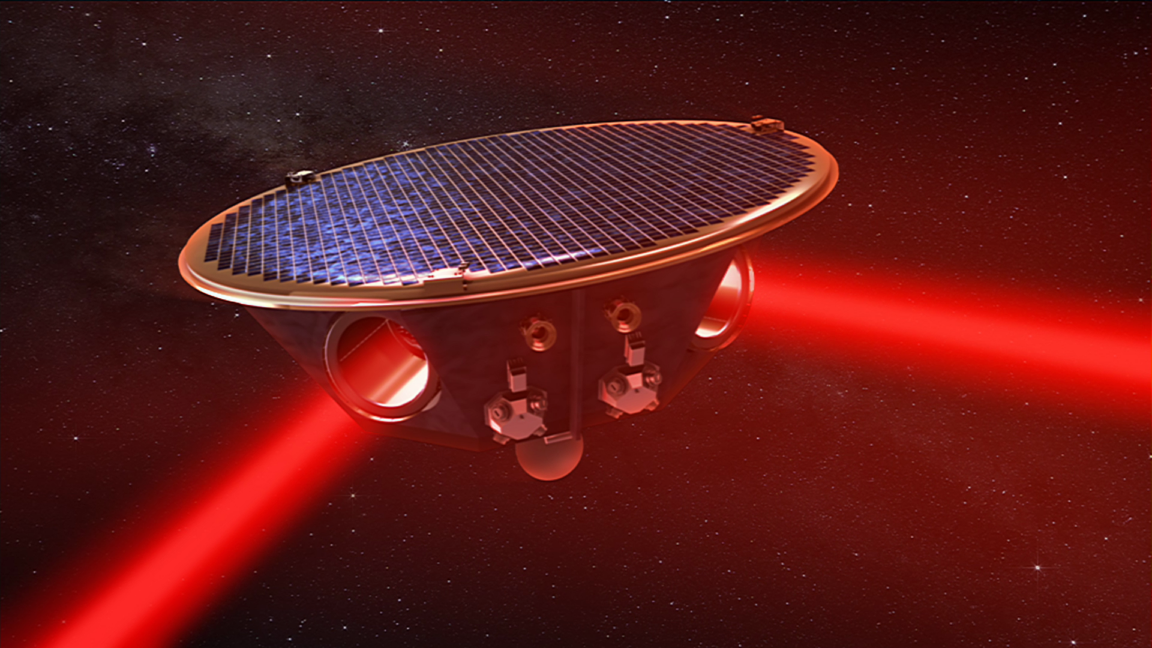
LISA’s scientific pursuits include investigating the origins of black holes and galaxy formation. It could potentially be sensitive enough to detect gravitational waves originating shortly after the Big Bang, allowing scientists to test the theories about the birth of our Universe, according to NASA.
“These are propagating disturbances in space-time,” Thorpe said of gravitational waves. “They can carry energy. They can carry momentum, and I think most interesting for astronomers, they can carry information about the systems that produce them, and we can use them to understand the Universe.”
Physicists will use detections from LISA to test Einstein’s general theory of relativity. Some of the most cataclysmic events in the cosmos, such as mergers of supermassive black holes, should produce a very specific gravitational wave signature, according to general relativity. LISA will be more sensitive to lower-frequency gravitational waves than ground-based observatories, like LIGO, corresponding to the kind of waves scientists expect to be generated by the most massive black holes.
Source: arstechnica.com