



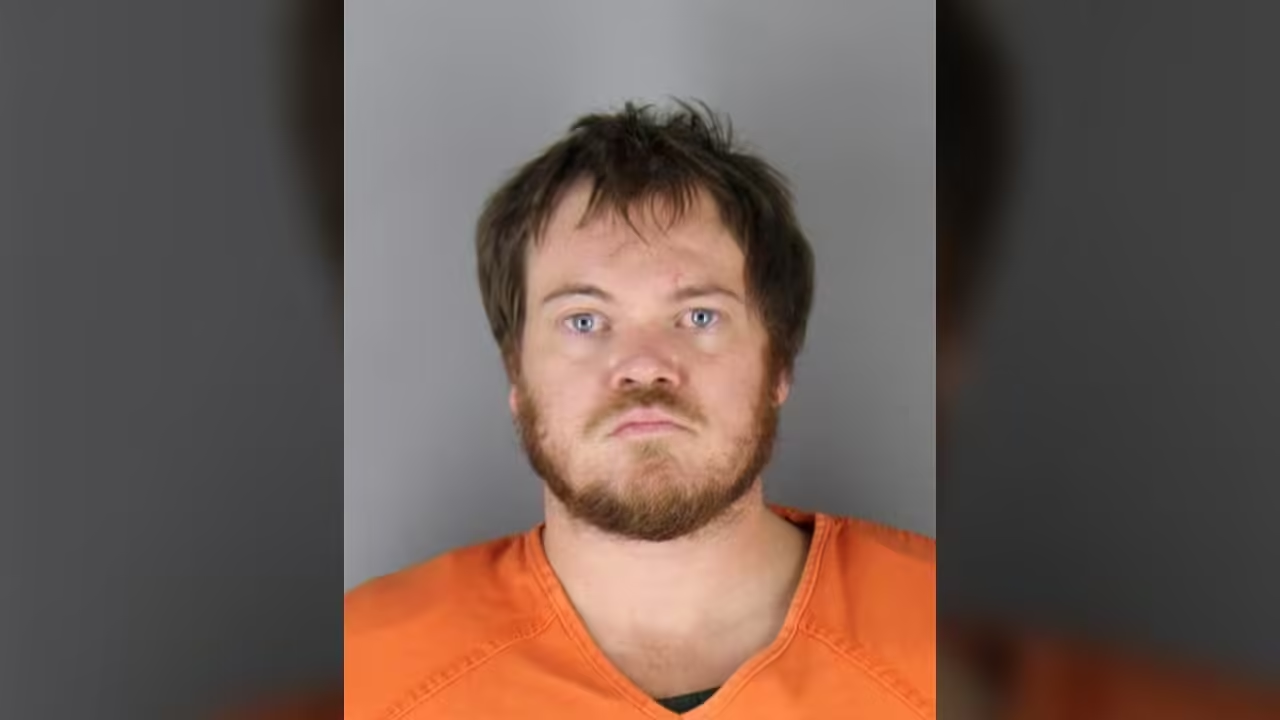

A Zimmerman man has been charged with killing a man at a mental health facility earlier this week, just a month after separate attempted murder and assault charges were filed against him in two other counties.
Now, the family of 23-year-old Bruce Hayes wants to know why he had to die in an attack at a residential mental health facility in Minneapolis earlier this week. Four others were hurt in that attack,
Derek Faulkner, 31, faces charges for that attack at a People Incorporated mental health facility in Minneapolis, as well as two earlier ones in Sherburne and Anoka counties in August and September.
Some want to know why he wasn’t already in the state’s secured mental health hospital in St. Peter. Now, he’s in the Hennepin County Jail awaiting trials in all three counties.
“This is a problem that’s been plaguing Minnesota for well over a decade,” said Richard Stanek, former Hennepin County Sheriff.
He’s spent years talking about the problems a lack of mental health care options has forced into the law enforcement community.
“The local county jails become the de facto largest mental health institution in the state of Minnesota,” he said.
Though he didn’t work any of the cases involving Faulkner, he says the story is a familiar one to him.
A struggling defendant, in this case Faulkner, who was out of jail and whose mother ended up going to a judge to get him help. The judge agreed Faulkner was legally Mentally Ill, meaning the person’s behavior could end up harming themselves or others.
That’s different from Mentally Ill & Dangerous, a legal determination that means the person has already physically hurt or tried to hurt someone else and is expected to act out the same way again.
Under state law, when a judge commits someone as Mentally Ill & Dangerous, they’re supposed to go to the state’s secured mental hospital in St. Peter.
But Stanek says it’s hard to find beds there, or anywhere else with the state.
“You’ve got to have a place to restore their competency,” Stanek said. “So they come back before the court, get cured…and get back to some sense of stability and back to their life.”
A state task force on reforming Minnesota’s Mentally Ill & Dangerous civil commitment process released a report last spring calling for a number of changes.
The recommendations included establishing a secure, state-run facility for observing patients who are undergoing the legal commitment process and helping them get stabilized before they’re committed.
The report also suggested developing community-based locked settings for individuals requiring 24-hour supervision.
“The legislators…they need to appropriate the proper funding, and then demand that the state does what it is that they’re supposed to do with the money they’ve allocated,” said Stanek.
Family questions how suspect ended up at facility
“He didn’t deserve it. Our family doesn’t deserve it, and I just want to be here to get justice for Bryce and our family,” said Tamirica Hayes, Bryce’s stepmother.
The Hayes family and their attorneys spoke publicly Friday for the first time since Bryce’s death.
“Bryce has never been mean to another person in his life, and there is nothing he could have done to deserve this,” said Kenya Taylor-Hayes, Bryce’s mother. “He is the most gentle person. He is respectful, and he wouldn’t hurt a fly, even if it landed on his food. He deserves to be remembered for those things.”
Taylor-Hayes said the family trusted Nancy Page Crisis Residence to keep their son safe while he received mental health treatment.
“The hopes were that my son was safe and protected and receiving the care that he needed while he was there,” she said.
She described the attack that killed her son as horrific.
“This was a very gory, horrific incident. This was not table talk,” Taylor-Hayes said.
The family said Bryce was attacked in his sleep with a hammer and fire extinguisher.
“This was equivalent to what you would see in the Chainsaw Massacre,” she said.
The family said Bryce, who was on the autism spectrum, had been living at the facility for about three weeks while receiving treatment for depression and anxiety.
“Just as nice as you can be. He just loved to eat. Loved his family,” said Frederick Hayes, Bryce’s father.
Family members described Bryce as a loving son, brother and former football player. After moving from Atlanta to Minnesota with his mother two years ago, they said he developed a love for the state’s parks, lakes and outdoor activities.
“Bryce loved music and he loved video games,” Taylor-Hayes said. “What he loved most about the Twin Cities in Minnesota is the parks and the lakes and just having that ability to sit outside and take in nature.”
The family said Bryce was days away from a major milestone: moving into his own home.
“Bryce was scheduled to move into his first independent housing program, which would have been a small residential home in Eagan,” Taylor-Hayes said. “He would have moved in on Wednesday.”
She said she then had to explain to what would have been her son’s new housing provider that Bryce had been killed.
“It was very sad for me when that manager there called me Wednesday morning saying that Bryce had missed his orientation on Tuesday. I had to let her know that Bryce was no longer with us and had, in fact, been murdered.”
Now, the family and their attorneys say they are looking for answers about how Derek Duane Faulkner, who was facing attempted murder and assault charges in separate cases before the attack, ended up at the facility.
“We believe [he] should not have been at that facility,” attorney Chris Stewart said.
Stewart said the family’s questions center on staffing, supervision and safety measures at the residence.
“We want answers about how this tragedy occurred,” Stewart said. “We have questions about the staffing there. How was this not prevented, and how was help not rendered earlier that could have saved such a sweet and polite young man’s life?”
The family said two representatives from People Incorporated visited Bryce in the ICU Monday while he remained on life support, though relatives said they still have significant questions about what happened inside the facility.
People Incorporated
State records show the Minnesota Department of Human Services reviewed 18 critical incident reports involving five People Incorporated facilities before issuing a correction order in February 2026. The order cited multiple late-reported incidents across those facilities, including a Dec. 25, 2025 incident at Nancy Page Crisis Residence.
DHS said the 2025 report found no issues at the time with People Incorporated’s facilities outside of a late report violation:
“The 2025 critical incident report referenced in the correction order was submitted to DHS eleven days after the incident occurred at the program. DHS did not identify any resident-safety, staffing, supervision, or operational concerns related to that incident beyond a late reporting violation. The requirement in Minn. Stat. Section 245I.13 is for critical incident reports to be submitted to DHS within ten days of learning of the incident. Information contained in the critical incident report is nonpublic under Minn. Stat. Section 13.46 subd. 3 paragraph (a).”
Following Faulkner’s alleged actions at the Nancy Page program, however, DHS says a maltreatment investigation is now ongoing
“Bryce Hayes’ death at Nancy Page is a heartbreaking tragedy. DHS remains committed to ensuring that providers deliver services in a safe environment.]
There is an open maltreatment investigation at the Nancy Page program. We are unable to provide further details while an investigation is ongoing.”
Source: kstp.com