



Two horses died at the Humboldt County Fair’s inaugural Outlaw Rodeo event this August. It’s unclear what, if anything, might have been done to prevent that tragedy, according to persons familiar with the matter.
Documents obtained by the Times-Standard suggest that there were last-minute attempts to secure additional veterinary personnel, but it’s unlikely that horses sustaining the kind of ambulatory injuries that occurred during the show’s saddle bronc event would have survived regardless of the attending veterinarian.
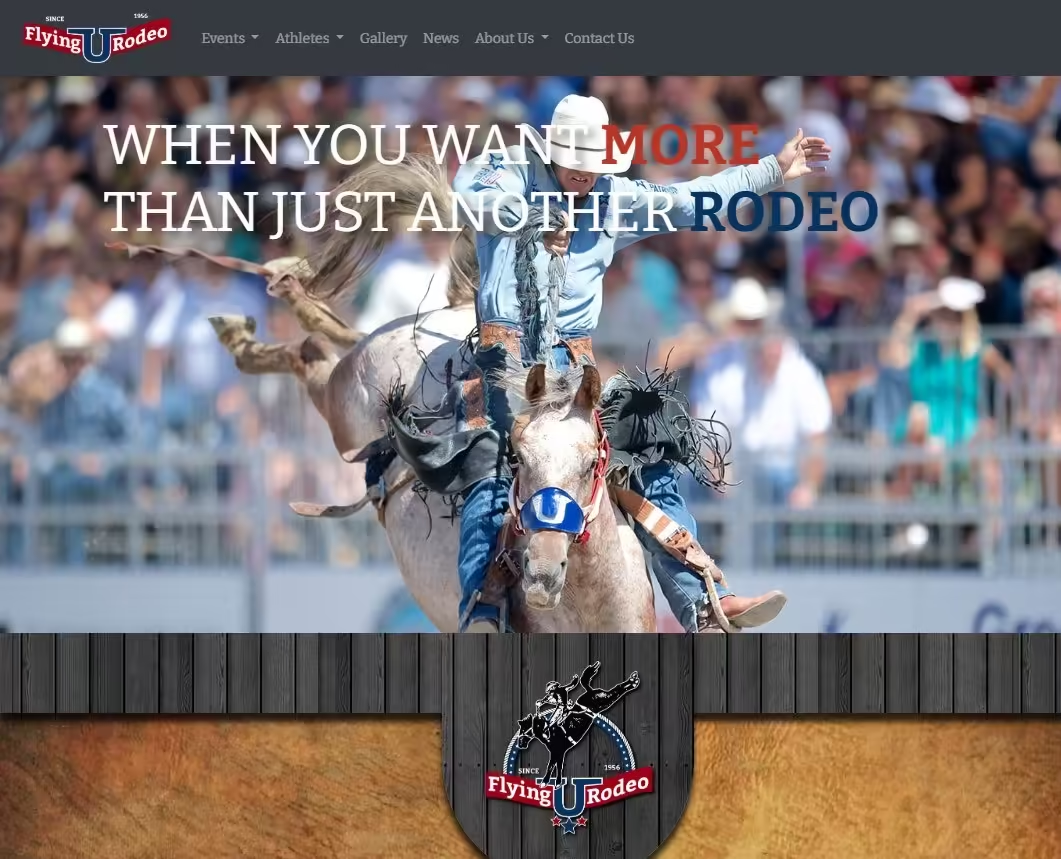
Eyewitnesses to the event took to social media with reports of agitated animals, young animals participating and poor grounds conditions, and the Times-Standard has fielded a number of tips, some laying the blame upon lax practices from Flying U Rodeo, a historically well-respected rodeo company out of Marysville, that stated: “There are numerous safeguards and provisions that are in place to ensure the safety of the human and animal athletes competing in the sport of professional rodeo.”
Some even suggested changes to modern rodeo regulations for saddle bronc events — which one caller speculated allowed riders to get dangerously high on the withers of horses — might be to blame.
Flying U Rodeo did not answer repeated calls and messages; neither did the Humboldt County Fair Association. Both organizations issued statements immediately after the incident, describing the nature of the injuries in detail.
Each horse sustained an ambulatory injury during the rodeo’s saddle bronc event. The first of those injuries is described in a report to the California Department of Consumer Affairs’ Veterinary Medical Board as an initial “saddle bronc-sustained open fracture of the left tibia — complete and comminuted” to a 6-year-old quarter horse bay mare.
The second injury was a “complete fracture of proximal left radius during saddle bronc event” to a 6-year-old sorrel quarter horse gelding, the apparent cause of which was “getting foot caught in arena fence.”
The Veterinary Medical Board declined to provide any additional documents on complaints or investigation into the incident, noting that “under the CPRA, complaint and investigatory files maintained by state licensing agencies are exempt from public disclosure.”
“Both of those were bad luck accidents, in my opinion,” attending veterinarian, Orange County-based Dr. Audrey Clifton told the Times-Standard by phone this Friday. “I cannot say that was a horrible surface; I can’t blame that at all. It was horribly unfortunate. I had a sick feeling in my stomach for days and days and weeks after, (thinking) ‘what could have been different. And I really think that Flying U (Rodeo’s representative), he did his very best to handle that situation.”
Clifton, who has been the attending veterinarian at the Humboldt County Fair’s horseracing events since her predecessor, Dr. Cook, retired, has worked as a fitness veterinarian on the horse racing circuit in Sacramento and throughout California. She told the Times-Standard that “this was literally my first rodeo and will likely be my last.”
She also said that the experience of working as an attending veterinarian at a rodeo is completely unlike a horse race — which is much more stringently regulated by state authorities and where Clifton worked with a state veterinarian and strict categories to determine the race-day condition of horses.
“Rodeo is not well-regulated; … there really is no oversight to determine ‘are these horses OK to be in today’s performance,’ ” Clifton said. “We’re relying on the stockman that brings these horses in and his history with those horses, but unlike racing, those horses, on an individual basis, are not assessed.”
Clifton noted that all of the participating horses had been presented to her by Flying U Rodeo as appropriately aged, seasoned rodeo horses, and she noted that the rodeo company appeared to comply with best practices. She also noted that the loss of those horses would likely cost the company and its ownership hundreds of thousands of dollars.
Still, she said, the experience of attending horses raised as a herd for rodeo participation was very different from the experience of working with race horses.
“I was naively asking, ‘what is the horse’s name?’ These horses don’t have names. They have brand numbers,” Clifton said.
While fatal horseracing injuries are relatively uncommon, they are not unheard of. In 2024, horses Visual Display and Arctic Fire were euthanized following injuries at the Humboldt County Fair’s horse racing event. Previous incidents in 2008 and 2003 saw horses put down at the fairgrounds as well.
Kristopher Flores treated and humanely euthanized the second of the injured horses while the first was attended to by Clifton. He is listed as the “treating veterinarian” on VMB documents.
A person familiar with the matter told the Times-Standard that the Humboldt Veterinary Medical Group, which Flores operates in Ferndale and Fortuna, was contacted by the event’s organizers just days prior to the incident and made the effort to accommodate the event’s schedule.
Flores himself responded to a series of questions posed by the Times-Standard via email. Ultimately, though, he said his involvement in the incident was limited.
“I was not the veterinarian in attendance at this event, nor was I in attendance as a spectator. I am not an equine-specific veterinarian, so I am not the most qualified to speak on the commonality of the injuries or if they are typical for rodeo horses,” Flores said. “Since I was not the veterinarian on duty, I was not made aware of any of the circumstances prior to the occurrence of the injuries.”
Flores, who works as the attending veterinarian at the Fortuna Rodeo and operates the 4-H livestock check-ins at the fair, noted that the types of ambulatory injuries each horse sustained were considered catastrophic.
“The prognosis for catastrophic injuries in horses is generally poor,” Flores said. “Even with advanced veterinary care, most horses cannot regain safe, pain-free weight-bearing. Humane euthanasia is usually recommended to prevent prolonged suffering.”
Flores said that the incident was not a common part of his practice, and didn’t speculate as to the specific cause of the injury.
“Horses with emergent catastrophic injuries are not a usual part of my practice life,” he said. “Rodeo injuries are not a usual part of my practice life. Because I was not at the event, I don’t feel qualified to add to the speculation and discourse. I don’t know why those horses broke their legs, but I know that broken legs in horses are life-threatening and almost always life-limiting. I’m glad those horses got the help they needed to end suffering.”
Robert Schaulis can be reached at 707-441-0585.
Source: www.times-standard.com