




OSIRIS-REx used Earth’s gravity to slingshot itself on a path toward the asteroid Bennu, adjusting its orbital plane. The mission team used the flyby as an opportunity to test and calibrate the spacecraft’s instrument suite.
The spacecraft got its first glimpse of Bennu in August 2018, sending back a grainy image taken at a distance of about 1.4 million miles (2.3 million kilometers).
During a slow approach to Bennu, OSIRIS-REx sent back detailed images showing the asteroid’s shape and some surface features.
The spacecraft officially arrived “at” Bennu and began operations around the asteroid.
The spacecraft entered orbit around the asteroid for the first time, setting a record for the smallest object ever orbited by a spacecraft. This was the beginning of multiple surveys and orbits of Bennu. The team used the data from these surveys to map the surface of Benni in order to find the best sample site.
After a year, the mission team selected a sample site called “Nightingale” located in a northern crater 460 feet (140 meters) wide. The crater is thought to be relatively young, and the regolith, or rocks and dust, is freshly exposed. This means the site would likely allow for a pristine sample of the asteroid, giving the team insight into Bennu’s history. One of the biggest challenges was that Bennu has an extremely rocky surface with hazardous boulders.
OSIRIS-REx performed two flyovers — one over the selected sample site, Nightingale, and one over the backup site, Osprey, to collect imagery for the spacecraft to use to target Bennu’s surface during sample collection.
During the mission’s Checkpoint rehearsal, the spacecraft practiced the first two maneuvers of the sample collection event, flying down to within 230 feet of Bennu’s surface.
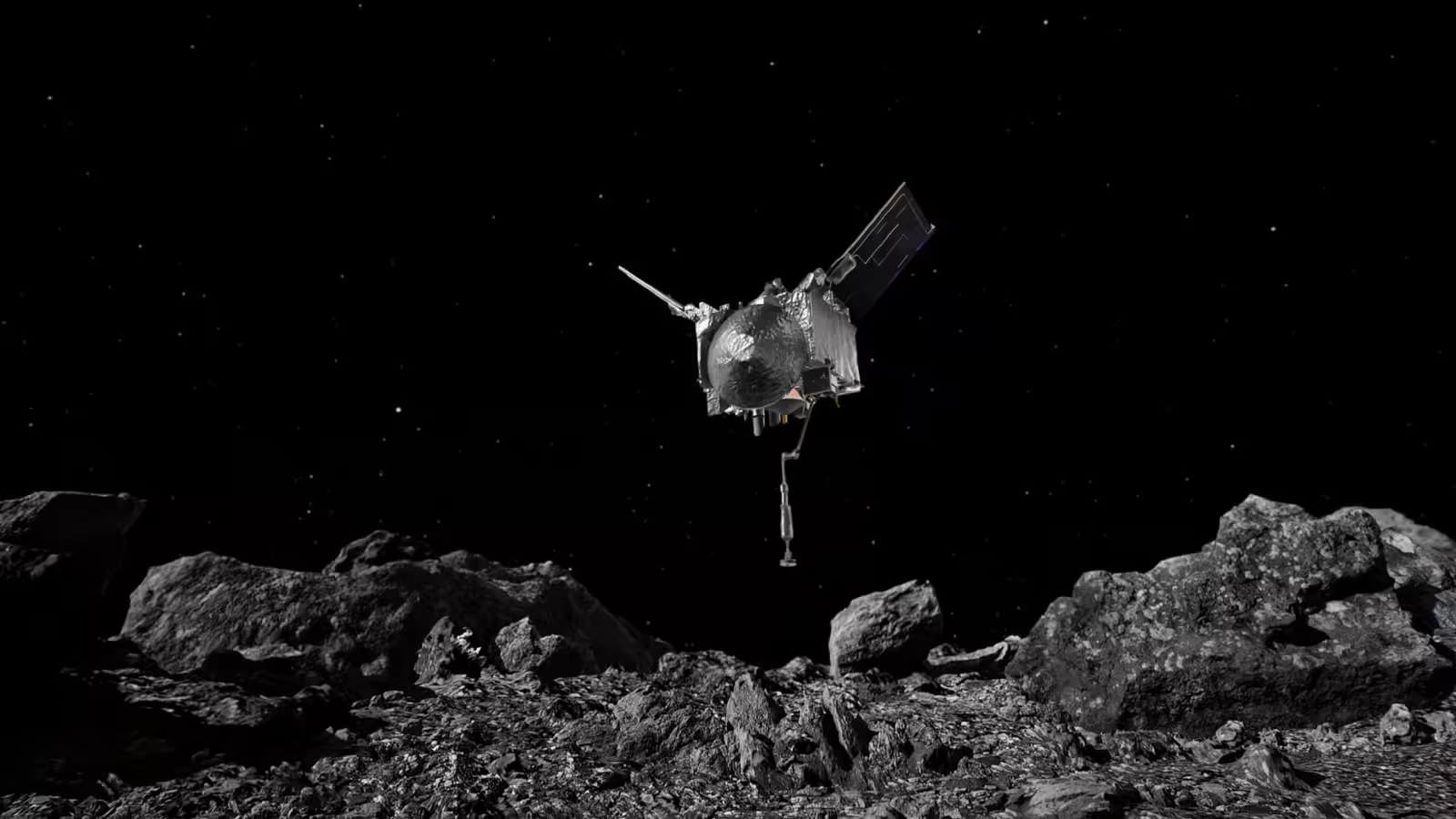
In a first for NASA, briefly touched down on Bennu to collect dust and pebbles from its surface in a maneuver known as “Touch-And-Go” or TAG.
OSIRIS-REx performed a final fly-by of Bennu and captured images of the sample site, revealing how the spacecraft changed the asteroid’s surface.
The spacecraft fired its main engines at full throttle for seven minutes – its most significant maneuver since it arrived at Bennu in 2018. This burn thrust the spacecraft away from the asteroid at 600 miles per hour (nearly 1,000 kilometers per hour), setting it on a 2.5-year cruise toward Earth.
Construction and commissioning completed for OSIRIS-REx’s cleanroom laboratory suite.
Installation of custom gloveboxes for hardware disassembly and sample processing in the OSIRIS-REx Clean Room. Full hardware disassembly rehearsal with participation from mission Sample Analysis Team.
Practice Teams rehearse sample capsule retrieval and sample extraction.
Capsule containing the asteroid Bennu sample lands.
Capsule containing the asteroid Bennu sample is disassembled and packaged to be shipped to NASA’s Johnson Space Center.
Capsule containing the asteroid Bennu sample arrives at NASA’s Johnson Space Center in Houston.
OSIRIS-REx sample canister lid is removed; curation process begins.
Quick-look analysis of the sample dust collected from the avionics deck of the sample return capsule begins.
NASA reveals the first public images of the asteroid Bennu sample on the TAGSAM (Touch-and-Go Sample Acquisition Mechanism) head.
OSIRIS-REx achieves mission sample mass requirement from just the rocks and dust found on the outside of the sampler head – 2.48 ounces (70.3 grams).
Bennu sample exhibit at the Smithsonian opens to the public.
Curation team members at NASA’s Johnson Space Center in Houston successfully removed the two fasteners from the sampler head that had prevented the remainder of OSIRIS-REx’s asteroid Bennu sample material from being accessed.
NASA announces OSIRIS-REx bulk sample mass. The spacecraft delivered 4.29 ounces (121.6 grams) of material from the asteroid Bennu when it returned to Earth; the largest asteroid sample ever collected in space and over twice the mission’s requirement.
Bennu sample exhibit opens to the public at Space Center Houston.
Bennu sample goes on display at the University of Arizona.
OSIRIS-REx asteroid Bennu sample catalog and first request opportunity announced for scientists from around the world beyond the mission.
Surprising phosphate finding in asteroid Bennu sample published in Meteoritics & Planetary Science.
Transfer of Bennu Sample to JAXA within one year of landing.
Release of a paper sharing results of early studies of asteroid Bennu samples, revealing presence of molecules that, on our planet, are key to life, as well as a history of saltwater that could have served as the “broth” for these compounds to interact and combine.
Release of three papers covering findings of sugars essential to life, a mysterious, ancient gum-like material, and presolar grains in Bennu samples.
Release of paper revealing that the porous boulders of Bennu are also riddled with extensive networks of cracksaccounting for unexpectedly high loss of heat observed from the asteroid.
Source: science.nasa.gov