
A U.S. Soldier assigned to 3rd Squadron, 2nd Cavalry Regiment uses a counter-unmanned aerial system surveillance device during Project Flytrap at Joint Multinational Readiness Center, Hohenfels Training Area, Hohenfels, Germany, June 7, 2025. The display provided ground-force Soldiers with real-time location data of nearby drones. (U.S. Army photo by Spc. Elijah Magaña)
View original

U.S. Army Pfc. Gage Green, assigned to 2d Squadron, 2d Cavalry Regiment, to fly a purpose-built, attritable system drone while participating in force-on-force training during Project Flytrap 5.0 at Pabradė Training Area, Lithuania, May 8, 2026. Project Flytrap is a counter-unmanned aerial system exercise designed to integrate emerging technologies and inform future Army requirements and doctrine. From April 27 to May 31, 2026, U.S. and Allied forces will conduct Project Flytrap as part of a series of linked exercises, including Sword 26, Saber Strike, Immediate Response, and Swift Response, which transform experimentation into capability. During Project Flytrap, Soldiers integrate counter-unmanned systems, AI-enabled command and control, and live data networks to move, decide, and fight more effectively across all domains. (U.S. Army Reserve photo by Sgt. Joseph Honce)
View original

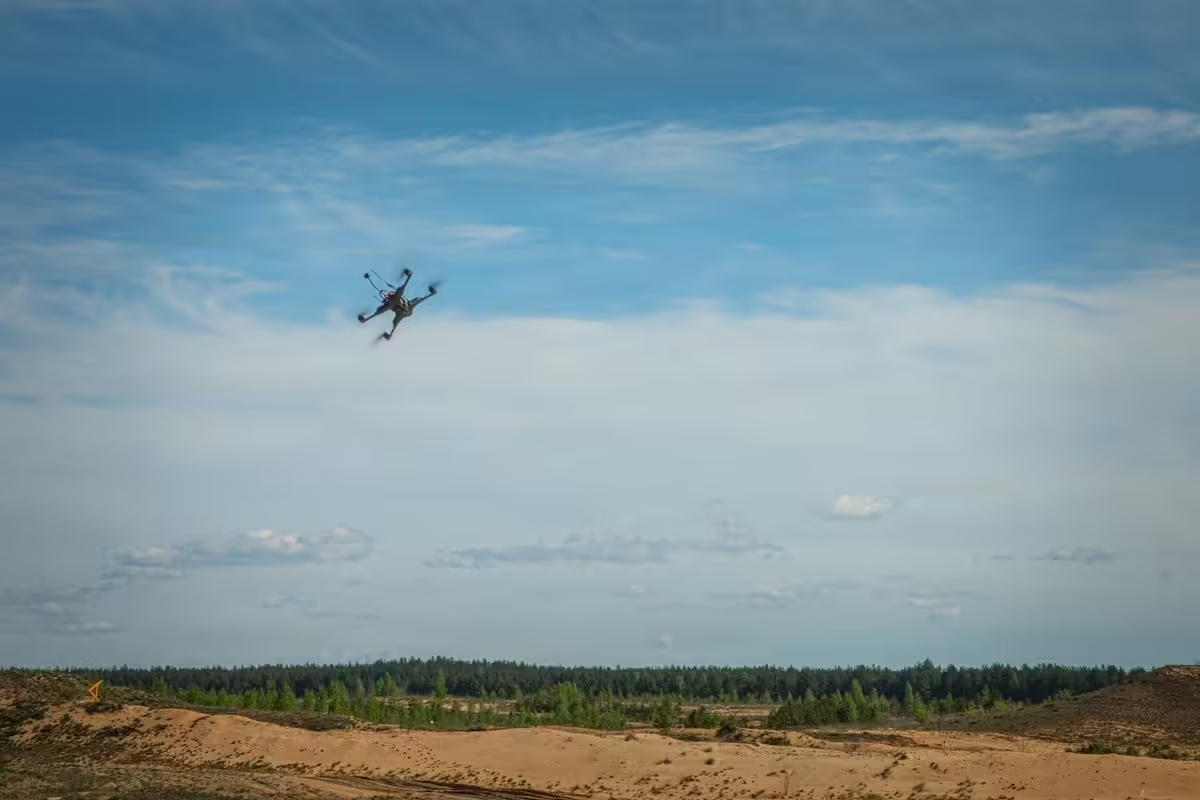
A small unmanned aerial system piloted by U.S. Army Spc. Jonathan Agurcia, an infantryman assigned to Echo Troop, 2nd Squadron, 2nd Cavalry Regiment, maneuvers over Pabradė Training Area, Lithuania, during Project Flytrap, May 15, 2026. Small unmanned aerial systems provide ground forces with an agile, low-cost platform for reconnaissance, surveillance and target acquisition in complex terrain and contested environments. From April 27 to May 31, 2026, U.S. and Allied forces will conduct Project Flytrap as part of a series of linked exercises, including Sword 26, Saber Strike, Immediate Response and Swift Response, which transform experimentation into capability. During Project Flytrap, Soldiers integrate counter-unmanned systems, AI-enabled command and control, and live data networks to move faster, decide faster, and fight more effectively across all domains. (U.S. Army photo by Sgt. Max Elliott)
View original
FORT KNOX, KY – The U.S. Army’s 2d Cavalry Regiment (2CR) is expanding Project Flytrap into a battalion level operational capability, moving from small-unit field trials into tactical employment linked to operational objectives designed to break through drone-saturated frontlines on Europe’s Eastern Flank.
The joint initiative, spearheaded by the U.S. Army Stryker regiment, alongside British military partners, develops mobile counter-unmanned aircraft systems (C-UAS) and electronic warfare capabilities and utilization. Unlike other joint strategic initiatives, Project Flytrap focuses on brigade- and battalion-level maneuver units, equipping frontline combat elements to conduct offensive maneuvers in heavily jammed and surveilled battlespaces.
Following two years of tactical evaluations informed by combat data from Ukraine and the U.S. Central Command area of responsibility, the regiment will transition in fiscal 2027 to Phase II. This phase fields multi-layered equipment suites to an entire maneuver squadron, the Regiment’s battalion equivalent, codifies individual and collective gunnery tables, and integrates unmanned aerial and ground systems into multi-domain operations breach.
Lessons from the Flank
Project Flytrap began in June 2025 during platoon situational training exercises in Hohenfels, Germany. Planners concluded that defending against small, unmanned aircraft systems demands an automated, layered defense rather than single-weapon solutions, primarily to prevent tactical leaders from suffering cognitive overload under continuous aerial surveillance.
Subsequent trials tested that doctrine under live conditions. In August 2025, platoons conducted force-on-force engagements in Poland. Troops defeated commercial and military-grade small drones using dedicated electronic warfare systems while reserving kinetic tools—such as shotguns and 5.56 mm Smartshooter optics—as 50-to-150-meter last-resort measures. The tests also exposed acute challenges in deconflicting friendly radio frequencies within congested electromagnetic spectrums.
The regiment expanded testing in May 2026 across training grounds in Poland and Lithuania. Over 90 hours of continuous live-fire and force-on-force maneuvers, troops deployed more than 50 counter-drone, unmanned aircraft, and unmanned ground vehicle systems. The primary friction point shifted from shooting down targets to data integration: commanders struggled to consolidate situational feeds into a single common operational picture across four separate battle-management networks.
Scaling to the Squadron
Phase II addresses those command gaps. Beginning in fall 2026, the regiment will conduct a command post exercise to deploy a unified network. The event will field a complete “sense-decide-act” equipment set to at least one operational squadron.
By winter 2027, the Regiment will put soldiers through counter-UAS individual weapons training exercises, progressing from single-operator tasks to platoon-level maneuvers. 2CR plans to acquire and field squadron-level unmanned ground vehicle sets and electronic warfare hardware using prize-challenge contracting mechanisms managed by the Assistant Secretary of the Army for Acquisition, Logistics and Technology (ASA-ALT).
The operational milestone culminates in spring 2027, when a squadron executes a combined multidomain obstacle breach to validate battalion-level collective proficiency across electronic warfare, drone, and counter-drone mission sets.
Adapting U.S. Army Breaching Doctrine
2CR adapts traditional Army obstacle breaching doctrine—Suppress, Obscure, Secure, Reduce, and Assault (SOSRA)—to resolve modern electronic and aerial reconnaissance screens:
- Suppress: sUAS conducting organic EW jamming and strikes against enemy observer nodes with OWA and Mortar fires.
- Obscure: Execute electromagnetic signature management, multispectral camouflage, and decoy emitters to deny targeting data.
- Secure: Active, dismounted C-UAS platforms establish a localized air superiority “umbrella” at the point of penetration.
- Reduce: UGVs and kinetic sUAS physically destroy C2 nodes and sUAS ground control stations, opening a non-transparent corridor.
- Assault: Dismounted and mounted formations rapidly flow through the EW/Spectral breach corridor to regain offensive maneuver.
Modernizing the Force
2CR leadership is framing Phase II not as technical experimentation, but as force-wide adaptation. This directly contributes to the Army’s readiness and lethality by delivering proven capabilities and tactics to the warfighter. By purchasing minimum viable hardware sets, unit leaders aim to build soldier muscle memory immediately rather than waiting for multi-year defense acquisition cycles to finalize equipment authorizations.
“The American way of war is centered on maneuver, and counter-UAS cannot remain tied to static defense,” said Col. Timothy Price, commander of the 2d Cavalry Regiment. “Project FlyTrap ensures we maintain mobility and offensive survivability in a highly contested, opaque operational environment. Instead of waiting for a multi-year acquisition cycle to deliver a perfect solution, we are placing systems directly into our troopers’ hands today. Getting those repetitions now is how our Dragoons will survive, maneuver, and breach contested ground in the next fight, regardless of where that will be.”
The effort targets what leaders describe as the “multi-COP swivel chair” problem. By forcing tactical software suites into a single integrated interface, 2CR intends to deliver a validated, combat-ready blueprint that the wider Army can adopt across maneuver brigades.
Source: www.army.mil