



Britain’s fading hopes of a Brexit reset bargain with the EU covering university tuition fees and access to controversial “Made In Europe” plans have been dealt another blow amid European “panic” over Chinese imports.
The UK had hoped to delay talks on lowering fees for European students until next year. That way the two sides could negotiate on British calls to be included in Brussels’ protectionist Made In Europe plans at the same time, with the EU not yet ready to discuss the issue.
But the suggestion of delaying negotiations on tuition fees was rejected strongly by several member states when it was floated by the European Commission recently, according to one EU source.
Cash-strapped British universities are against lowering fees.
At the same time, a meaningful deal this year on Made In Europe – new laws to protect European firms from cut-price competitors abroad, including China – looks increasingly unlikely amid splits in the EU.
The UK wants to be part of this scheme, which would favour European businesses, and had been hoping to negotiate inclusion for a concession on tuition fees.
EU sources say there are now only two to four weeks of negotiating time to conclude Brexit reset deals on food and drinkyouth mobility and linking carbon markets as the two sides target a 20 November summit.
This means there is pressure on the UK to agree a concession on tuition fees without securing anything meaningful on Made In Europe.
Andy Burnham met German Chancellor Friedrich Merz in Berlin on Thursday amid local reports that suggested Germany had agreed to take a stricter stance on whether to include non-EU countries in Made In Europe, in return for France’s support on weakening the bloc’s electric vehicle mandates.
At the same time, MEPs from Merz’s own grouping in the European Parliament called – in contrast – for the cancellation of Made In Europe scheme entirely, warning it would spark trade wars with allies.
The i Paper understands that the UK still regards Germany as supportive of its inclusion in Made In Europe.
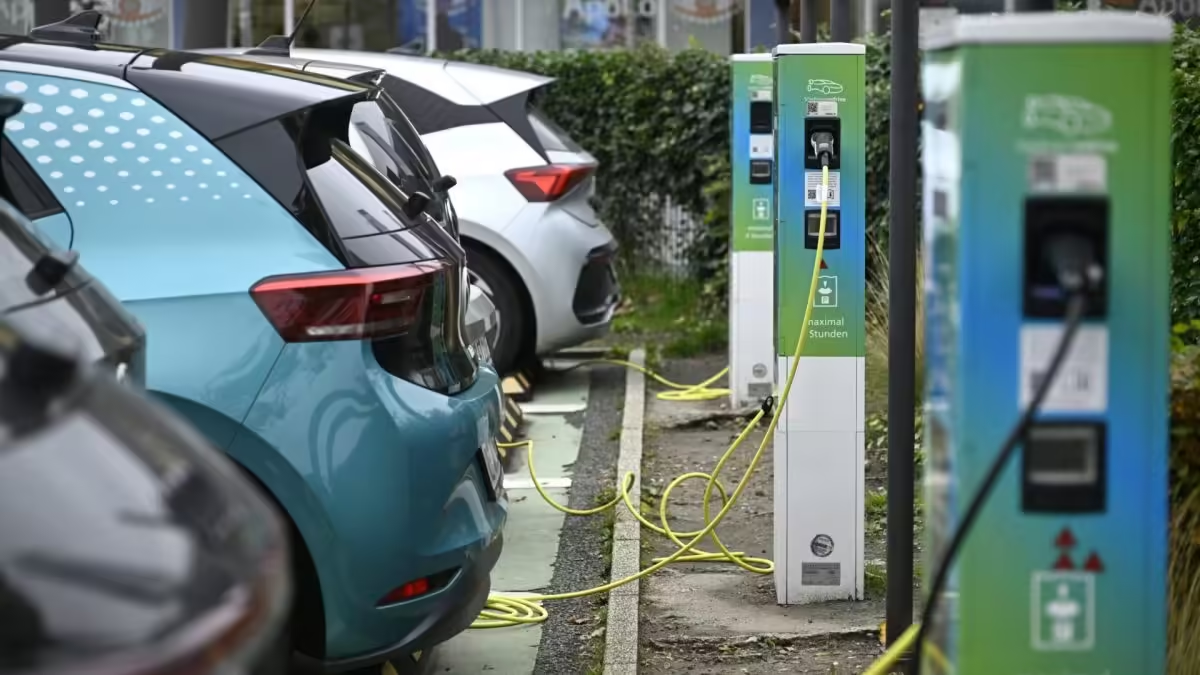
British ministers also continue to consider demands from EU countries to increase tariffs on Chinese electric vehicles, to ensure UK firms are included in the favourable treatment given to European manufacturers in the Made In Europe scheme.
A failure to do so would likely be regarded as “cherry-picking” of EU rules by member states, who are concerned about the UK becoming a backdoor into the bloc for Chinese imports.
But the mixed messages were a sign of “panic” in the EU that suggested it would be “very difficult” for the UK to influence the policy, according to one Brexit expert.
David Henig, director of UK trade policy at the European Centre for Political Economy (ECIPE), said: “Panic without much strategy is what is going on with regard to EU-China relations, and the collateral damage could include any third country, particularly if they are suspected of having the potential to be a backdoor into the EU.
“At this stage it is all negotiations around EU institutions, and we really have to see how they land, it is very difficult for the UK to do much from the outside, but at least we need to be aware of this.”
In a sign of how dynamic and fluid negotiations are between the EU and China, on Friday the EU said it had reached a deal with China over the export of hybrid cars, Politico reported.
“We have reached a shared understanding to moderate China’s export of hybrids and plug-in hybrids to the European Union. This opens the prospect of cutting China’s exports by more than a half,” EU trade commissioner Maros Šefčovič said.
UK open to joint fighter jet production
At the talks in Berlin, Burnham told Merz the UK was “open” to Germany joining an international coalition to build the next generation of fighter jets known as the Global Combat Air Programme (Gcap).
Gcap, initially a pact between the UK, Italy and Japan to build a sixth-generation fighter jet, welcomed Canada as an “observer nation” in July.
Informally dubbed Tempest, the new jets will be equipped with technology including AI and next-generation sensors, as Western nations seek to maintain air superiority over threats from rival powers such as Russia and China.
The pair also ratified the Kensington Treaty, which was signed in July last year and commits Germany and the UK to deeper co-operation on science, technology, defence, security and growth.
Addressing the wider relationship with Germany and Europe, Burnham said he was “committed to securing deeper co-operation” with the EU at a summit with the bloc “towards the end of the year”.
He added: “We’ve had an excellent discussion, and we will look to see if we can turn the summit into a good outcome for the EU, but also for the UK as well.”
On the reset negotiations, a Government spokesman said: “We are building an ambitious, close relationship with the EU that will strengthen our economy and unlock good growth in every postcode.
“Our agri-food and drink and emissions trading deal alone will add up to £9bn a year to our economy, slashing the costly red tape that drives up supermarket prices and household bills.”
Source: inews.co.uk