




Tsetse flies remain one of the most consequential disease vectors on the African continent, transmitting the parasites that cause human African trypanosomiasis, better known as sleeping sickness, and the related animal forms of the disease that devastate livestock herds across sub-Saharan Africa. A new review published in PLOS Neglected Tropical Diseases argues that the next generation of tsetse control campaigns will succeed or fail not on the strength of any single tool, but on how well scientists can integrate population genomics, species distribution modeling, and landscape genetics into coordinated, area-wide strategies. The work, led by Norah Saarman of Yale University together with colleagues at the Joint FAO/IAEA Centre, Insect Pest Control Laboratory, and partner institutions across Africa and Europe, lays out a decision-ready framework for identifying which fly populations should be targeted, in what order, and how to confirm that elimination has genuinely been achieved.
The biological target of these efforts is a small group of insects in the family Glossinidae, unique among disease vectors for feeding exclusively on vertebrate blood and for nurturing their larvae internally until a single mature offspring is deposited in the soil. This low reproductive rate, paradoxically, is what makes tsetse vulnerable to the sterile insect technique, or SIT, a method in which mass-reared male flies are sterilized by irradiation and released over a defined area to mate with wild females. Because each wild female mates only a few times in her life and produces very few offspring, a sustained flood of sterile males can collapse a population without the environmental burden of broad insecticide spraying. The technique has a proven track record: the eradication of Glossina austeni on Unguja Island in Zanzibar in the late 1990s remains a landmark achievement, demonstrating that tsetse populations can be permanently removed from an entire island ecosystem when SIT is deployed after suppression with insecticide-treated targets and traps.
Yet islands are forgiving settings. A population confined by the sea cannot easily be replenished from neighboring territory, so a campaign that eliminates the last flies has eliminated them for good. Continental landscapes are a different matter. On the mainland, tsetse habitat forms a shifting mosaic of riverine woodlands, savanna thickets, and agricultural land, and surviving populations beyond the treatment perimeter can recolonize cleared zones within months. The review emphasizes that this reinvasion risk is the central unresolved question in area-wide integrated pest management, or AW-IPM, the coordinated framework that combines SIT with insecticide-treated targets, treatment of cattle with pour-on insecticides, and other suppression tools applied uniformly across an entire infested area rather than farm by farm.
The authors argue that the historical weakness of AW-IPM design has been a lack of reliable information about population boundaries. Campaigns have often been planned around administrative borders or convenient geographic features rather than the actual genetic and ecological limits of fly populations. When the treatment area does not correspond to a reproductively isolated population, released sterile males are diluted by immigrants, suppression stalls, and expensive operations are abandoned short of elimination. Conversely, when a population is genuinely isolated but planners assume it is not, resources are wasted treating areas that could never contribute reinvasion. Distinguishing between these scenarios requires data that field surveys alone cannot provide.
Population genetics offers that data. By sampling flies across a landscape and genotyping them at hundreds or thousands of variable markers, researchers can infer how much gene flow connects different sites, whether physical barriers such as escarpments or deforested corridors have split populations into isolated units, and whether a recent outbreak in a cleared zone represents reinvasion from outside or the survival of a remnant population that escaped suppression. Microsatellite markers powered earlier studies of this kind, but the review highlights the transition to genome-wide approaches, including reduced-representation sequencing methods and whole-genome data, which provide far greater resolution and can detect subtle structure even in species with historically high gene flow. Genomic data can also reveal source-sink dynamics, the asymmetric relationships in which large, stable populations continually export migrants to smaller, marginal populations that would otherwise die out. Identifying source populations is strategically critical, because eliminating a sink without addressing its source guarantees recolonization, while targeting a source can destabilize an entire network of dependent populations.
Complementing the genetic picture, species distribution modeling uses occurrence records together with environmental variables such as temperature, rainfall, vegetation indices, and land cover to predict where a tsetse species can persist. These models have matured considerably in recent years, incorporating higher-resolution climate data, remote sensing products, and algorithms that can extrapolate to unsampled regions with quantified uncertainty. The review stresses that distribution models must be updated regularly, because land-use change, deforestation, agricultural expansion, and climate shifts are continuously redrawing the map of suitable habitat. A model calibrated on conditions from two decades ago may badly misrepresent the current extent of fly populations, and therefore the true perimeter that an area-wide campaign must enclose.
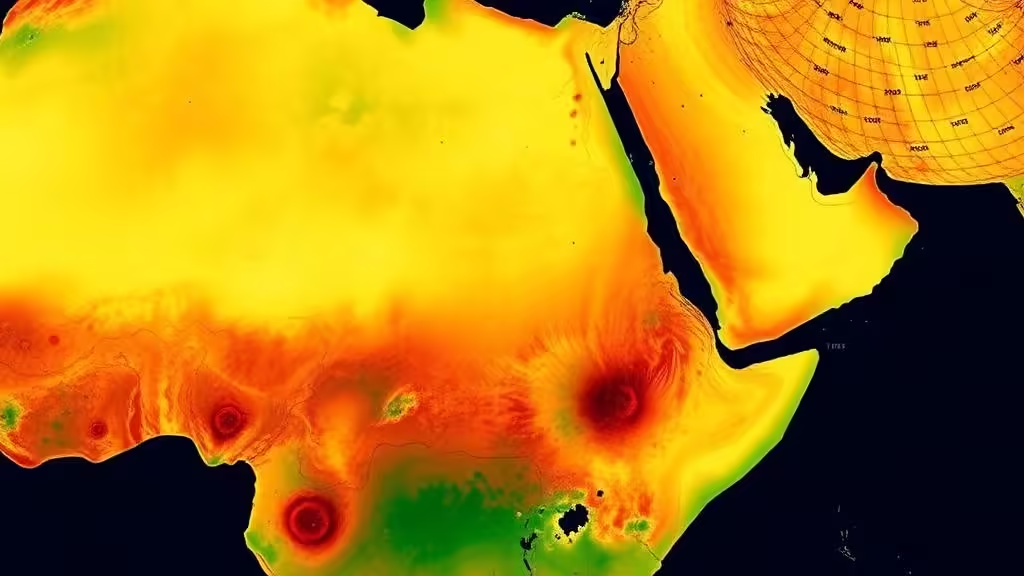
The most innovative element of the proposed framework is landscape genetics, the discipline that fuses these two streams by asking how features of the physical landscape facilitate or impede the movement of genes. Instead of treating distance as the only predictor of genetic similarity, landscape genetic analyses test whether rivers, ridgelines, cultivated fields, or riparian forest corridors shape dispersal, and they produce explicit connectivity maps showing which patches of habitat are functionally joined and which are effectively isolated. For campaign planners, such a map is transformative: it converts an abstract genetic dataset into a practical guide for drawing treatment boundaries that follow the true limits of population connectivity, and for identifying the corridors through which reinvasion is most likely to occur. Where feasible, the authors propose extending this approach to model source-sink dynamics directly, generating a ranked list of intervention sites that would deliver the greatest strategic value per unit of investment.
To make these tools routine rather than exceptional, the Joint FAO/IAEA Centre has launched a Coordinated Research Project titled Tsetse Population Genetics, which brings together research groups from affected countries and international partners to develop standardized protocols, shared molecular markers, and common data formats. Standardization matters enormously in this field. If each laboratory uses different marker panels, sampling designs, and analytical pipelines, results cannot be compared across studies or pooled into continental-scale syntheses. The CRP aims to build the infrastructure for a shared evidence base, so that a connectivity analysis conducted for one candidate intervention area can be interpreted in the same terms as one conducted elsewhere, and so that the accumulating data progressively refine the underlying models of tsetse dispersal and population structure.
The review is candid about the gaps that remain. Evidence for population isolation exists for only a fraction of the more than thirty tsetse species and subspecies, and for many regions of the endemic zone there is essentially no genetic data at all. Reinvasion risk has been quantified for even fewer systems, and the field still lacks agreed thresholds for how much gene flow is too much for SIT to overcome. Sampling tsetse is labor-intensive and expensive, requiring traps deployed across remote and sometimes insecure terrain, and the logistics of preserving DNA from field-caught flies have historically constrained sample sizes. The authors argue that scalable genomic tools, including portable sequencing and streamlined library preparation, together with the falling cost of high-throughput sequencing, are now bringing these questions within reach for national control programs, not just well-funded international consortia.
The payoff for getting this right extends beyond entomology. Animal African trypanosomoses, transmitted by the same flies, impose losses estimated in the billions of dollars each year across the continent through livestock mortality, reduced milk and meat production, and the cost of prophylactic drugs, while sleeping sickness continues to threaten tens of millions of people in remote rural areas. Eliminating tsetse from defined areas, rather than merely suppressing them, would allow sustainable agriculture and improved cattle breeds to be introduced where disease pressure currently forbids them. The framework proposed by Saarman and colleagues offers a path to that goal grounded in evidence rather than optimism: updated distribution models to define the battlefield, genomic connectivity maps to define the enemy’s true boundaries, source-sink analysis to prioritize the decisive targets, and post-control genetic monitoring to distinguish a genuine elimination from a temporary clearing that reinvasion will soon undo. As area-wide campaigns move from islands to continental landscapes, the integration of these advanced eco-geographic tools may determine whether the century-long struggle against the tsetse fly finally reaches its endgame.
Subject of Research: Integrating genomics and eco-geographic modeling to improve area-wide tsetse fly control and sterile insect technique campaigns in sub-Saharan Africa
Article Title: From islands to landscapes: Integrating genomic and advanced eco-geographic tools in area-wide tsetse control
Article References: Saarman, N., De Beer, C. J., Solano, P., Barreaux, A., Gimonneau, G., Ravel, S., Opiro, R., Amatulli, G., Cecchi, G., Aksoy, S., Weiss, B., Bourtzis, K., & Abd-Alla, A. M. M. (2026). From islands to landscapes: Integrating genomic and advanced eco-geographic tools in area-wide tsetse control. PLOS Neglected Tropical Diseases, 20(10), e0014752. https://doi.org/10.1371/journal.pntd.0014752
Image Credits: AI Generated
DOI: 10.1371/journal.pntd.0014752
Keywords: tsetse flies, sterile insect technique, area-wide integrated pest management, population genetics, landscape genetics, species distribution modeling, African trypanosomiasis, reinvasion risk, connectivity maps, FAO/IAEA, Glossinidae, livestock health
Source: bioengineer.org