

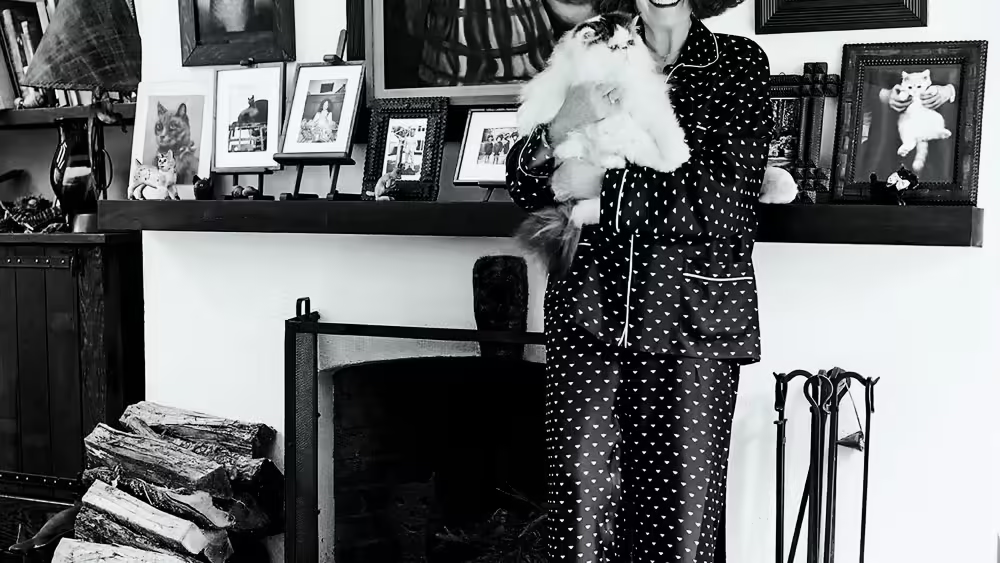

Grace Coddington isn’t particularly interested in slowing down. “Life goes on, and just because I’m a bit older doesn’t mean I’m stopping,” she tells Variety over Zoom from her Chelsea apartment.
Her fire-engine-red hair, now cut chin-length and swept into a side part, stands in striking contrast to her ivory skin, nearly matching the deep maroon of her freshly applied lipstick. “It’s gotten redder!” she exclaims, explaining that her signature mane remains an easy calling card for fans who stop her on the street — recognition she credits entirely to her appearance in R.J. Cutler’s 2009 documentary “The September Issue.”
“Probably you wouldn’t even be interviewing me except for him, because you wouldn’t care,” she says of Cutler, whose depiction of Coddington’s sometimes tumultuous working relationship with Wintour became a centerpiece of the fashion film.
But fame was never the goal for Coddington, who began her career as a model in the late 1950s before transitioning to fashion editing following a serious car crash. She joined British Vogue in 1968 and moved to American Vogue in 1988, where she spent nearly three decades as a creative force behind the magazine’s most imaginative fashion editorials. “I’m not setting out to be an exceptional kind of person,” she says. “Do I want to wear designer clothes head to foot?”
“I might end up wearing them head to foot,” she adds after a self-aware pause. “But I don’t like the ones that are recognizable necessarily.”
Now, the famous image-maker is looking back at her latest decade of work in “Grace: Now,” a 312-page tome that collects more than 200 images from Coddington’s work over the past decade. Highlights range from Pinter Lindbergh’s “Wildest Dreams” shoot with Rianne Van Rompaey to Annie Leibovitz’s Edward Hopper-inspired story with Maya Hawke. The book also includes reflections from longtime collaborators and subjects including Anna WintourSofia Coppola, Mia Goth and Julianne Moore.
In the forward, she calls the book a “completion.” But is this really a final bow? “Who knows?” she says. “I don’t know how many more shoots I’ll be doing because what’s happening with magazines, what’s happening with fashion, what’s happening with me. But it doesn’t mean I’m going to go to bed and be forgotten.”
Below, Coddington talks about the current state of the media industry, beauty standards, AI and aging:
You’ve worked with many celebrities, many featured in this book. But you’ve said you’re uninterested in celebrity culture. What are your thoughts on this increasing relationship between Hollywood and fashion?
I’m not a celebrity person. I shy away from them like crazy.
There are people I love, like Mia Goth, who I think is fabulous. I love everything about her, and she’s wonderful to photograph and she’s a funny girl. And she’s interesting, she’s not just a pretty face and that’s what I liked.
I was introduced to her by Nicolas Ghesquière from Louis Vuitton. We were doing a story on his clothes, and I said “Who do you know?” meaning a model. And he said, “Well, I love this funny girl called Mia” and she turned up, and I’m like, “What the hell?” But she was fantastic, so I sort of go on loving her. I don’t go in and out of loving people. I just either love them or I don’t love them.

Mia Goth in American Vogue, April 2018 by Steven Klein
You’ve always been attracted to quirkiness — does quirkiness exist in today’s world of Ozempic and plastic surgery and algorithms?
Well, they’re there. You just got to find them. You see them in movies but they’re not in “Spider-Man” or something like that. They’re in little indie movies. Or English movies or German movies. But you don’t find them in the big blockbuster American movies.
Your old boss Bea Miller said you bring an “enhanced reality” to your work, which you say you do naturally. It’s a term that might have a different meaning now with AI. What are your thoughts on AI and the creative process?
I’m not against [AI]. It’s there and it’s coming and it’s taking us over. But I’ve never been one that likes things done in a not-real way, from the very beginning. I like real film as opposed to digital film, I like big plate cameras.
I also like things that are like little mistakes and things like that. That’s the difference with digital photography and film photography – it’s that tiny mistake that makes the picture special. It starts off in one way and it goes in a different direction once you start, and you respond to the people or the situation.
You experienced “no budget” during your days at British Vogue but also the media heydey at American Vogue. How do the budgets today compare?
It’s always difficult to go backwards. Not so difficult for me because I’ve been there before but the photographers that are used to having 10 assistants or whatever. I’m not. I’ve only ever had one, and a lot of the time I didn’t even have one. But for them, suddenly they turn around and they’re looking for something, and normally there would be someone there to get it for them, and there isn’t.
Also, everybody charges so much more for things now. If you want to rent a house, it’s thousands of dollars. Whereas back in the day, you just called up and said, “Can I come around and shoot in your house?” I used to go around to Karl Lagerfeld’s house all the time because it was so beautiful, and he had several of them, and I would shoot in them, and it didn’t cost me a penny.
“American Daydream” is one of the shoots in the book which took on a heavier meaning after the Charlottesville riots. Can you talk to me about having that come out unexpectedly during this political moment?
I’m not a political person. In fact, I really shy away from it and never want to talk politics because it’s too complicated, and there seems to be no right way to talk about it.
So I never thought of it as political. One is very aware of racial problems, whoever you are. But I didn’t take it into what happened after that. There’s all these riots and things seem to happen every other day, and all the problems seem to happen one way or another every other day, but I love the pictures for their pictures’ sake.
American Vogue, September 2017 by Steven Klein
I did think it was interesting to shoot two families and we made these two families up. And it was based on a film that George Clooney was doing, “Suberbicon.”I also love the idea of suburbia, I think it photographs really well. You see what a shallow person I am. [Laughs]
There’s another story I did a while back, actually with Steven Klein also, and I had two girls, and they were out in the country and there was a car all sort of smashed up in the brown wall. Then the next day there was [Hurricane] Sandy. So everybody said to me, “Oh, you brought on Sandy!” I said, “No, it’s just, again, by chance.”
Many of the photographers in this book are ones you’ve worked with for decades, but you also work with a younger generation. How would you describe the difference in how they approach the work?
There’s sort of three generations. There’s the Steven Meisel generation and then the Craig McDean generation. And then there’s the very young ones that just are kind of slapdash to me, and very often pretentious.
Expand on that.
I don’t want to. [Laughs]
Well, they just think they can do everything ‘like that.’ Whereas Steven [Meisel] might take a picture very quickly or whatever but it’s because he’s had years and years of knowledge and training but it didn’t come overnight. Whereas the young ones are out there claiming big dollars, and they’ve only been doing it for a few days, or they have an exhibition in the Met or something.
You’re constantly asked about Anna Wintour — what is that experience like for you? Is she really that interesting?
No, she is interesting. But everyone’s waiting for me to say something nasty about her. A: I’m not going to. And B: I don’t have anything nasty to say about her. I really respect her. I know I’ve said, “Oh, I could kill her” sometimes but I really respect her. It’s a tough job that she does. But people ask me all the time. I think she’s probably the most brilliant editor-in-chief that there has been.
There’s Diana Vreeland also, but very different. Diana’s all about drama and things and Anna is able to encompass that sort of drama as well as the business side of everything. She can incorporate everything and take on the new social media point of view and things she’s eased her way into.
You don’t seem scared of aging — you haven’t gotten plastic surgery, you wear minimal makeup. Why is resisting today’s anti-aging obsession important to you?
Because it is! I wish people would stop with it. Everybody walks around looking like Kim Kardashian. It’s great for her but it’s tiresome that everybody wants to emulate that.
Everybody wants to look young and it’s ridiculous. And maybe you have a very young face because it’s all pulled but then eventually when it’s pulled you look like a very old face. You look older than if you let all the wrinkles hang out there. And then, also, your body doesn’t fit your head. So, unless you’re prepared to have hunks of flesh cut off or something, which I’m definitely not…But I think everybody now is obsessed with perfection, which is not perfection, really. It’s fake.
How have these beauty standards evolved?
There’s all those shots you can have for slimming and things like that. And plastic surgery has become much, much better than it was but it’s going too far sadly, I think.
Technically, it’s probably not getting worse, but I don’t know what people see when they look in the mirror and they’re very stretched. Do you really think that’s beautiful? I don’t think so.
Will you ever go gray?
This is gray. This is my gray.
Source: variety.com