




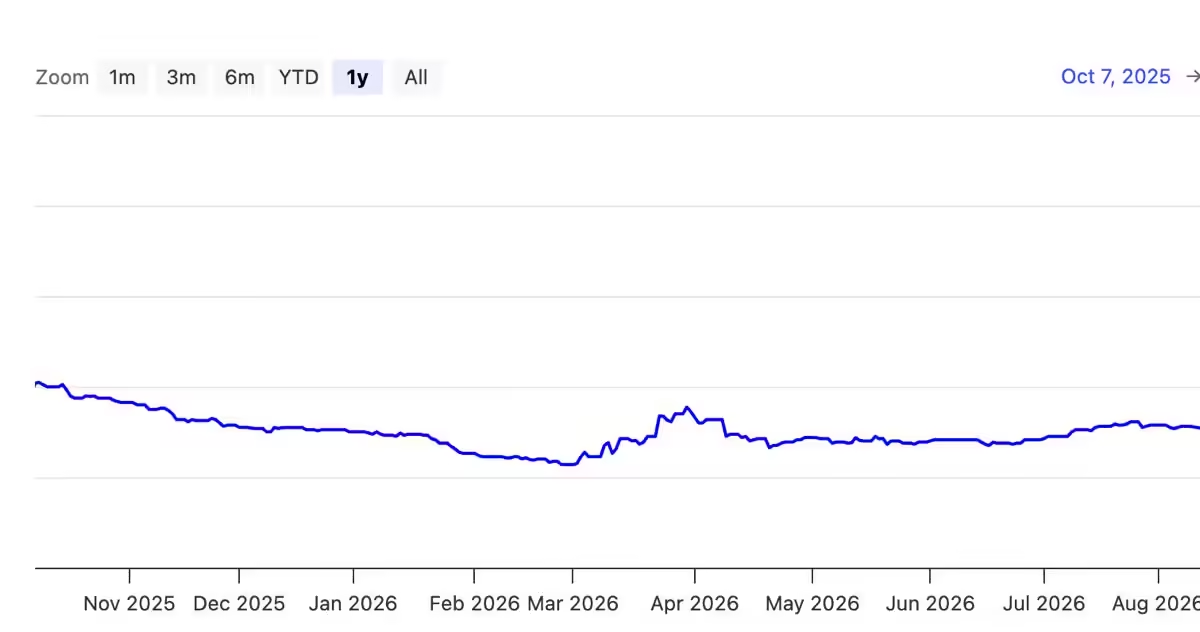

France: 5 year CDS
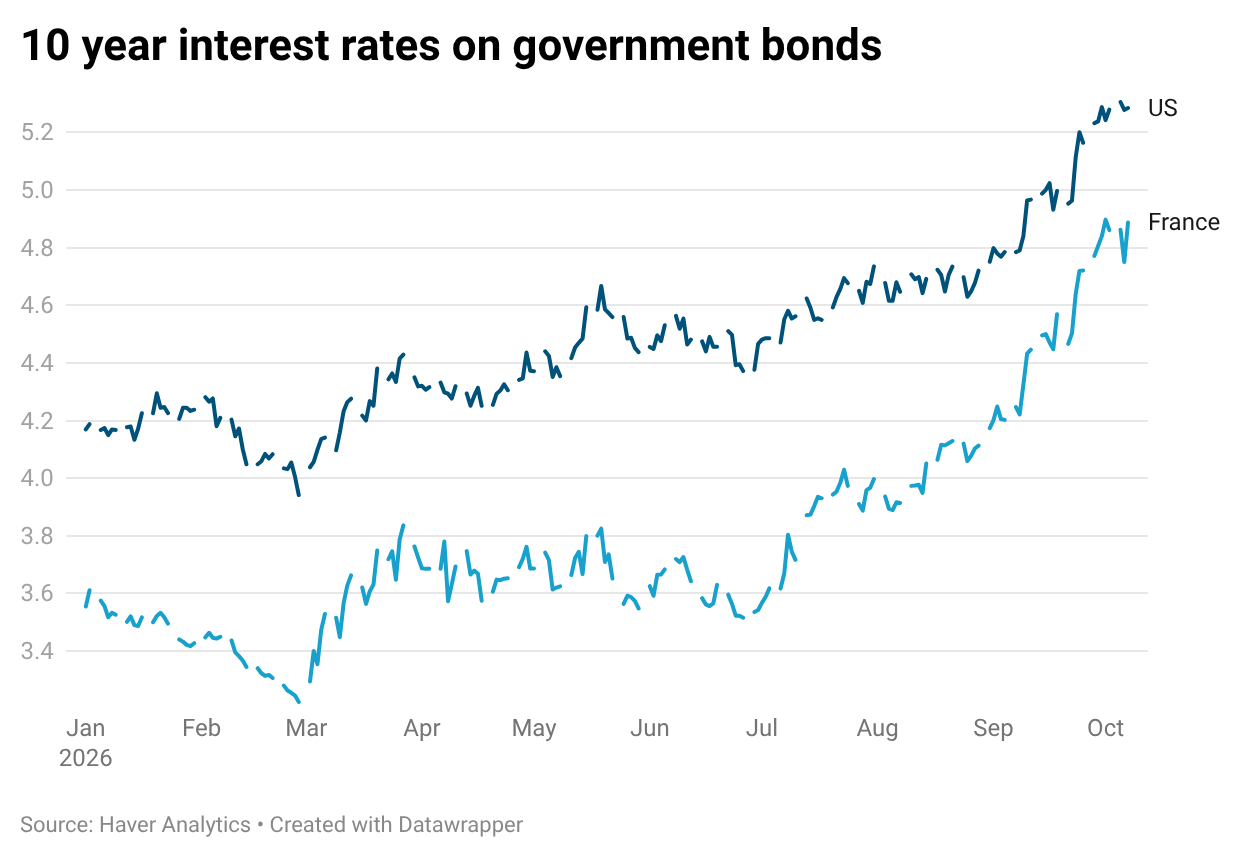
Suddenly, financial markets are treating France as the economic sick man of the Western world. Yes, interest rates have been surging everywhere. But the spike in interest rates on French government bonds over the past month has been especially large:
The rise in interest rates on French government bonds is largely driven by heightened perceptions of the risk that France could default on its national debt. The chart at the top of this post shows the price of credit default swaps on French government debt — that is, insurance against default by the French government. While still far below the CDS prices of the Club Med countries during the euro crisis of the early 2010s, the sudden rise of the current CDS price on French government bonds is very worrying.
Simultaneously, and not altogether coincidentally, France is being swept by large-scale, occasionally violent student demonstrations. Furthermore, Marine Le Pen, leader of the hard-right, Putin-friendly and EU-skeptic National Rally party — formerly known as the National Front — is leading in the polls to win the 2027 presidential election.
OK, before I go on, I need to talk about one big problem that affects how foreign observers discuss France: ideologically motivated reasoning.
If, like me, you closely followed the euro crisis 15 years ago, you know that financial media — certainly English-language financial media — had, and to some extent still have, a strong anti-French animus. Readers were constantly bombarded with claims that France was going to be the next domino to fall and that the fallout would be worse than Greece. Yet the data never backed those assertions. Instead, it was obvious that many commentators implicitly wanted France to fail because its high taxes and generous welfare state offended their conservative sensibilities.
Conversely, however, U.S. progressives like me are tempted to push back against this conservative bias by underplaying France’s problems, by noting, for example, that even now French interest rates are slightly lower than U.S. rates — but the important point is that French rates have risen compared with the rest of Europe, and are now above rates in Italy.
So I’m going to try to be objective here and acknowledge that France’s current situation is really worrisome. In particular, it’s not just a matter for France alone. France’s membership in the euro area creates the possibility of an explosive debt crisis — and such a crisis could be destructive to European unity.
What is France’s problem? France is on a fiscally unsustainable path. Debt is already very high as a percentage of GDP, and the French government is adding to that debt by running large budget deficits even though there is no emergency like a war, a severe recession, or a pandemic to justify such deficits. Furthermore, France has an aging population, which means that pension costs will, other things equal, grow much faster than revenue.
Now, everything I just said about France’s fiscal situation is true for other major advanced economies too, the United States very much included. But France does stand out, even among fiscally troubled nations, in one main way: its persistent inability to get realistic about retirement.
The official French retirement age — the age at which workers can collect full benefits — was only 62 in 2023. By comparison, the retirement age in Denmark, which is often held up by U.S. progressives as a model of a nation with a strong safety net, was 67 (which is also the age in the U.S.). The average actual age of retirement, which is always lower than the statutory age because some people choose to accept reduced benefits, was lower in France than anywhere else in Western Europe:
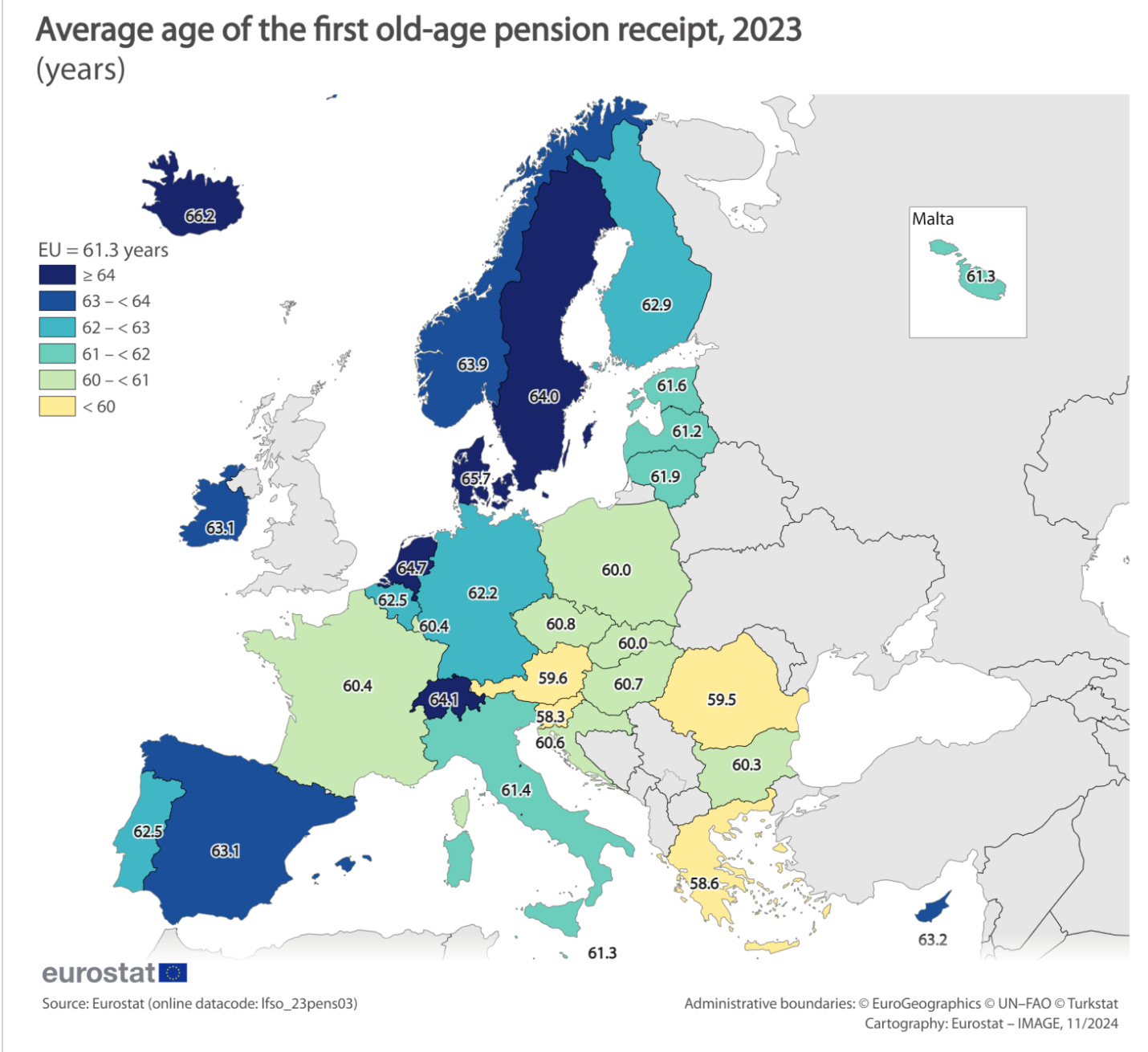
Macron’s center-right government was on track to gradually raise the retirement age to 64, still low by the standards of other advanced nations. But due to opposition by the extreme right and the extreme left parties in France, this rise has been frozen until after next year’s election. As a result, the retirement age is currently stalled at 62 years and 9 months.
You don’t have to be a conservative to see France’s early retirement as unsustainable, especially given that French life expectancy at age 65 is about 87 years of age, 2 years longer than in the US. Thus the fiscal pressure caused largely by France’s very generous government pension plan has led to cutbacks in other spending, notably on education. France is effectively handing over large subsidies to older French at the expense of everyone else. Mass national student demonstrations should come as no surprise.
The underlying problem, of course, is politics. Le Pen has pledged to roll the retirement age back to 62. This would be extremely expensive and is symptomatic of a general unwillingness on the part of France’s rising right to face reality. Again, this is hardly unique to France — think of all the false promises and claims Donald Trump has made. But for now, at least, financial markets believe that fantasy economics is an even bigger problem for France than for the rest of us.
And France’s reliance on the euro means that it’s all too easy to see how this loss of confidence could turn into an ugly crisis.
Before I describe how that might happen, another warning about perspective. While that surge in CDS spreads is alarming, the implied probability of French default over the next 5 years is still only 1.2 percent – which I think is too low.
But if it comes to that, we know how a French crisis will develop. We saw this movie in 2009-2012, first in Greece, then in Portugal, Spain and Italy. First, investors stop buying a euro-area nation’s bonds, raising the specter that the government will be forced into default because it simply doesn’t have the cash to pay interest and principal on its debt. Fear of default then leads to even more capital flight, which increases fears of default and the interest rate, and the vicious circle deepens.
This can’t happen to the U.S.: it can’t run out of dollars because we print them. But France can’t print euros.
The 2010s euro crisis ended when Mario Draghi, the president of the European Central Bank, said three words — “whatever it takes’. Markets took this as a signal that the ECB would, if necessary, lend enough money to troubled debtors to avoid default.
But it’s questionable whether the ECB could or would similarly rescue France. For one thing, in 2012 southern European nations were engaged in massive spending cuts. These cuts were wildly excessive from an economic point of view, but they did mean that these nations could in effect claim that they deserved to be rescued. France, by contrast, is moving even further from fiscal responsibility — which means that there would be huge political opposition from creditor nations, especially Germany, to a French bailout. And what would the countries that underwent painful austerity measures during the euro-crisis also say about the fairness of a French bailout?
And if France does need to be bailed out, it would be extremely expensive. As the second largest economy in the euro zone, France may have crossed the line from too big to fail to too big to save. In short, it’s all too easy to describe a really ugly scenario for a French crisis that would be extremely divisive within Europe.
Right now, financial markets are behaving as if the risk of such a scenario is real but small. Maybe the French center will stage a dramatic political comeback; maybe Le Pen in office will, like Italy’s Giorgia Meloni, be far milder and more realistic than feared, or maybe, like Trump, she will govern so badly that she quickly loses her political capital; maybe the ECB will, despite everything, be there if France needs it.
But I wish being optimistic about France didn’t require so much hope that maybe things will go right.
MUSICAL CODA
Source: paulkrugman.substack.com

