




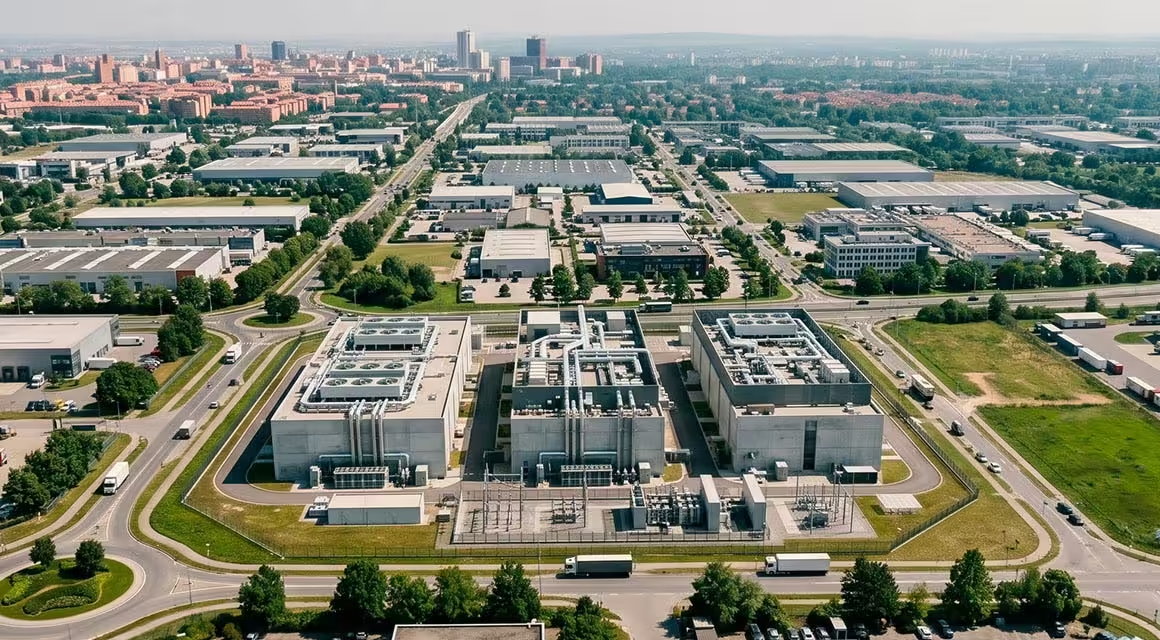

Some of the largest developments now represent multi-billion-dollar investment programs encompassing multiple buildings and years of construction. Rather than financing a single asset with a defined completion date, sponsors may be funding a campus that grows in stages as new capacity is added.
The result is a financing model that increasingly needs to evolve alongside the project itself.
Financing a project built in phases
A large data center campus is rarely developed all at once.
Sponsors may begin with land and site infrastructure before moving into the first buildings, then add capacity over time as customer demand develops. Each phase can bring different capital requirements, construction milestones and operating considerations.
That makes flexibility increasingly important.
“Five years ago, you were looking at a very different type of data center project,” says Michael Lardieri, Managing Director, Institutional Client & Financial Sponsors at BBVA USA. “Today we’re talking about campuses that can require billions of dollars of investment and are being developed in multiple phases. That changes how sponsors think about capital and what they need from their banks.”
Financing can therefore become part of a longer development strategy rather than a single transaction. Sponsors and lenders need to consider when capital will be required, how later phases relate to earlier ones and how the financing may need to evolve as a project moves from construction into operation.
Speed is changing the equation
At the same time, the expansion of AI infrastructure is putting greater pressure on development timelines.
Suitable land, power capacity, equipment and construction resources are all in demand. Once those elements have been secured, delays elsewhere in the development process can become costly.
Financing is no exception.
For sponsors, having access to capital is essential, but so is knowing that financing can be executed within the project’s timetable. Large transactions may require substantial underwriting commitments and coordination among multiple institutions, often while other parts of the development are moving simultaneously.
“Clients don’t only want to know whether the capital is available,” Lardieri says. “They want confidence that it can be delivered on the timeline the project requires. As the market has accelerated, that certainty has become increasingly important.”
The asset cannot be viewed in isolation
The infrastructure surrounding a data center is also becoming more relevant to financing decisions.
Power is the most visible example. Large AI-oriented facilities require significant electricity capacity, and the timing of that capacity can influence when a project is built and when capital needs to be deployed.
“The challenge is not simply the amount of capital required.”
But the same principle extends to other parts of a development, from connectivity and construction to customer commitments and the timing of future expansion.
For lenders, that means understanding the financing increasingly requires understanding how the project itself will develop.
Financing the next phase of growth
AI is expected to continue driving significant investment in digital infrastructure. As it does, the financing supporting that expansion will have to keep pace with a sector that is changing quickly.
The challenge is not simply the amount of capital required. It is matching that capital to projects that are being developed at greater scale, in multiple phases and under increasingly demanding timelines.
For sponsors and financial institutions alike, that is making data center financing a more dynamic part of the infrastructure landscape.
Source: www.bbva.com

