



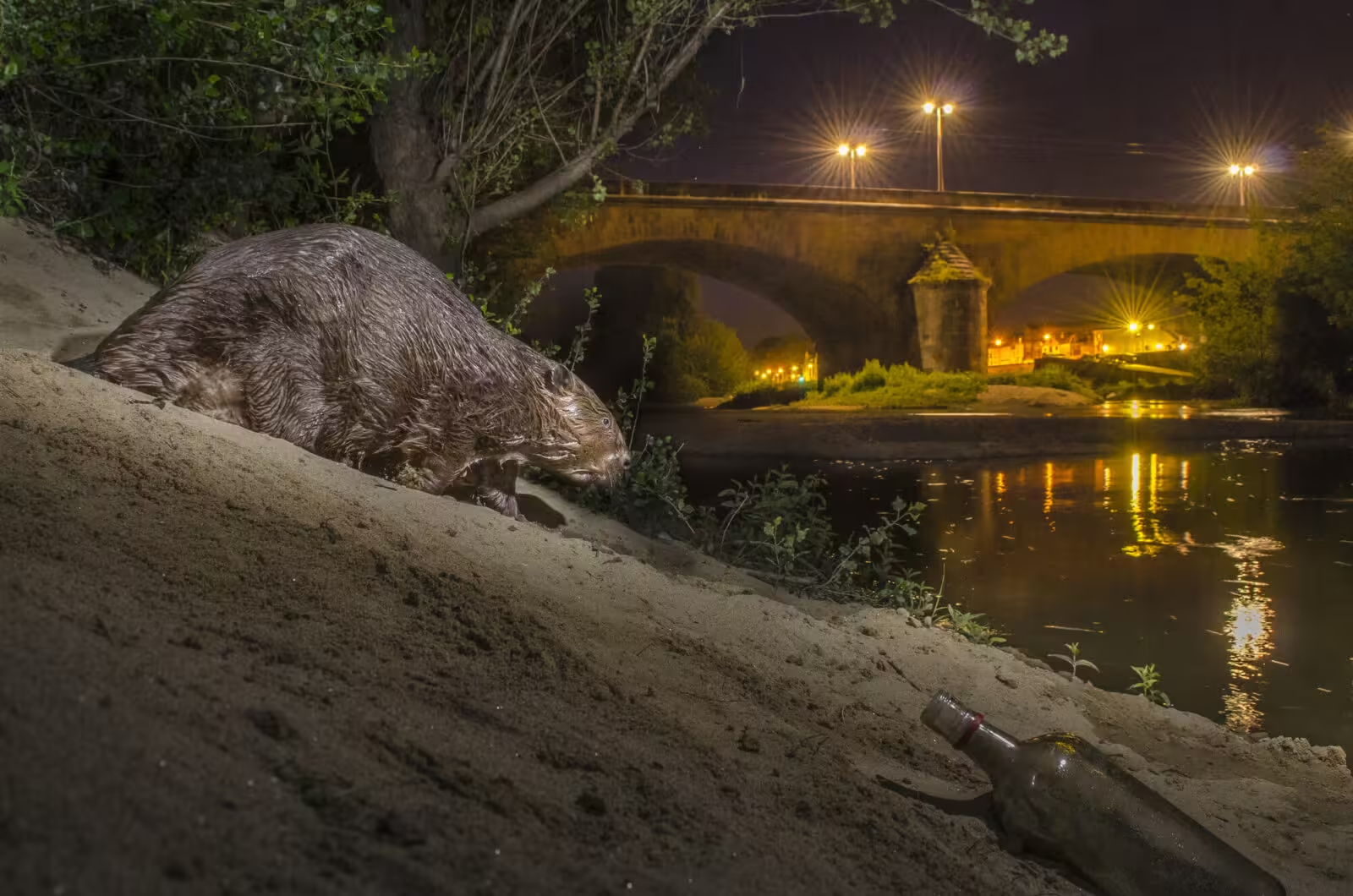

From beavers building dams in city centres to bison roaming through villages, many European wildlife species are increasingly returning to landscapes shaped by people. With the continent’s wild animals demonstrating a remarkable ability to adapt to our presence, can we learn to adapt to theirs?
Sharing space
The images recognised in this year’s Rewilding Europe Award offered compelling glimpses of a changing Europe. Beavers living beside apartment blocks, bison resting at the edge of a village, and other wild animals making their homes in landscapes shaped by people showed that wildlife comeback isn’t confined to remote mountains, forests and wetlands. Increasingly, it is happening in habitats all around us.
This shouldn’t really come as a surprise. Across Europe, many wildlife species are demonstrating an extraordinary ability to adjust to human presence — learning to navigate roads, cities, farms and industrial landscapes, and changing the way they move, feed and behave. This is not a story of pristine wilderness returning to a pre-human past. It’s a story of coexistence — complex, sometimes tense, but increasingly real. It’s also a story of wonder and resilience: of wolves and bears reclaiming huge swathes of human-dominated territory, foxes, deer, and wild boar thriving in city centres, bats roosting in buildings, peregrine falcons nesting on towering skyscrapers, and white-tailed eagles starting to breed in urban parks.
Perhaps most importantly, this is an inspirational story that asks something of us in return. If wildlife across Europe is adapting to our presence, shouldn’t we also adapt — by changing our behaviour and reshaping our landscapes so that wild nature in all its diversity has the opportunity to recover and flourish?
An overlapping future
The global trajectory is clear: people and wildlife are increasingly sharing space. Research suggests that human-wildlife overlap will increase across more than half of Earth’s terrestrial surface by 2070, driven primarily by growing human populations as people and wildlife increasingly occupy the same landscapes.
Europe is already living this future. Large carnivores once pushed into remote refuges are returning to landscapes shaped by agriculture and settlement. Species are adjusting migration routes, becoming more active at night, tolerating greater levels of noise and light, and making use of human structures and habitats.
This growing overlap brings challenges, from livestock predation and road mortality to public concern and planning tensions. But it also brings opportunities: healthier ecosystems, stronger connections between people and nature, and landscapes where wildlife recovery can benefit the people who live there.
Bruno D’Amicis / Rewilding Europe
Masters of adaptation
Barn swallows nest inside barns, stables and buildings that echo the caves and rock faces they once used. Peregrine falcons have embraced the vertical landscapes of Europe’s cities, nesting on cathedrals, office towers and industrial structures. Migratory birds increasingly use reservoirs, sewage works and farmland as stopover sites where natural wetlands have disappeared.
Larger species are adapting too. Beavers are recolonising modified river systems, sometimes building dams in drainage channels and urban waterways — as Jan Wieczorek‘s Rewilding Europe Award-winning image “Urban beavers” skilfully captures. Brown bears move through forest-farmland mosaics, becoming more nocturnal and changing their routes to avoid people. Even Eurasian lynx can slip almost unnoticed through human-shaped landscapes, adjusting where and when they move.

Laurent Geslin / naturepl.com
Wolves: the ultimate generalists
Perhaps the most striking example is the wolf. Once nearly eradicated across Western Europe, wolves are again roaming farms and forests and even venturing into peri-urban areas. Today, Europe is home to more than 21,000 wolves, with populations recovering in countries such as France, the Netherlands, Germany, Italy and Poland.
Wolves are consummate generalists. They can travel huge distances, exploit many different prey species and survive in highly fragmented landscapes. Where people are present, they adjust their behaviour to balance the risks and opportunities of human proximity. Their return demonstrates just how adaptable wildlife can be when its basic needs are met.

Bruno D’Amicis / Rewilding Europe
From resilience to recovery
The return of the wolf — and many other species — shows that wild nature is dynamic, capable of change and often surprisingly tolerant of human presence. Yet there are limits to what wildlife can accommodate. Living in human-dominated landscapes can bring stress, road mortality, genetic isolation and other pressures, while many species are far less adaptable than wolves, foxes or wild boar. Climate change adds another challenge, particularly where degraded and fragmented landscapes make it difficult for animals to move.
Even wolves need space. Their recovery shows that coexistence works best not when wildlife is squeezed into the margins, but when landscapes become healthier, better connected and more dynamic.
This is where rewilding can make a difference. By restoring natural processes and creating more space for nature, rewilding can give wildlife greater freedom to move, multiply and disperse — turning adaptation from a survival strategy into a pathway towards recovery.

Peter Cairns

Bruno D’Amicis and Umberto Esposito
The case for co-adaptation
As people and wildlife increasingly share landscapes, the question is how to shape a future in which both can thrive. When wildlife recovers, ecosystems can become stronger and more self-sustaining, with benefits ranging from healthier food webs and natural forest regeneration to pollination and reduced flood risk.
Researchers sometimes describe the two-way process of people and wildlife adjusting to one another as “co-adaptation”. For people, this means learning through experience and making practical changes that enable wildlife comeback while addressing the challenges it can bring.
Across Europe’s rural landscapes, these changes can include livestock guardian dogs, electric fencing and improved carcass management. Wildlife crossings and green bridges can make roads safer, while ecological corridors help animals move through built-up landscapes. Such measures don’t eliminate every difficulty, but show how coexistence can evolve as wildlife returns and people gain experience of living alongside it.
Let’s meet nature halfway
The future of Europe’s wildlife won’t be decided in national parks, remote forests and mountain ranges alone. It will also be shaped on farmland, beside roads and railways, and in our towns, cities and suburbs.
From wolves and bears to beavers, lynx, peregrine falcons and barn swallows, Europe’s wildlife is demonstrating an extraordinary capacity to live alongside us. Their adaptability offers both inspiration and an invitation to reconsider how we share the landscapes we call home.
The growing overlap between people and wildlife is not simply a conservation challenge — it’s an opportunity to create wilder, more connected landscapes where healthy ecosystems and thriving communities reinforce one another. By changing our behaviour, restoring natural processes and creating more room for wildlife, we can help turn Europe’s increasingly shared landscapes into places where people and wild nature can thrive together.

James Shooter
Source: rewildingeurope.com