



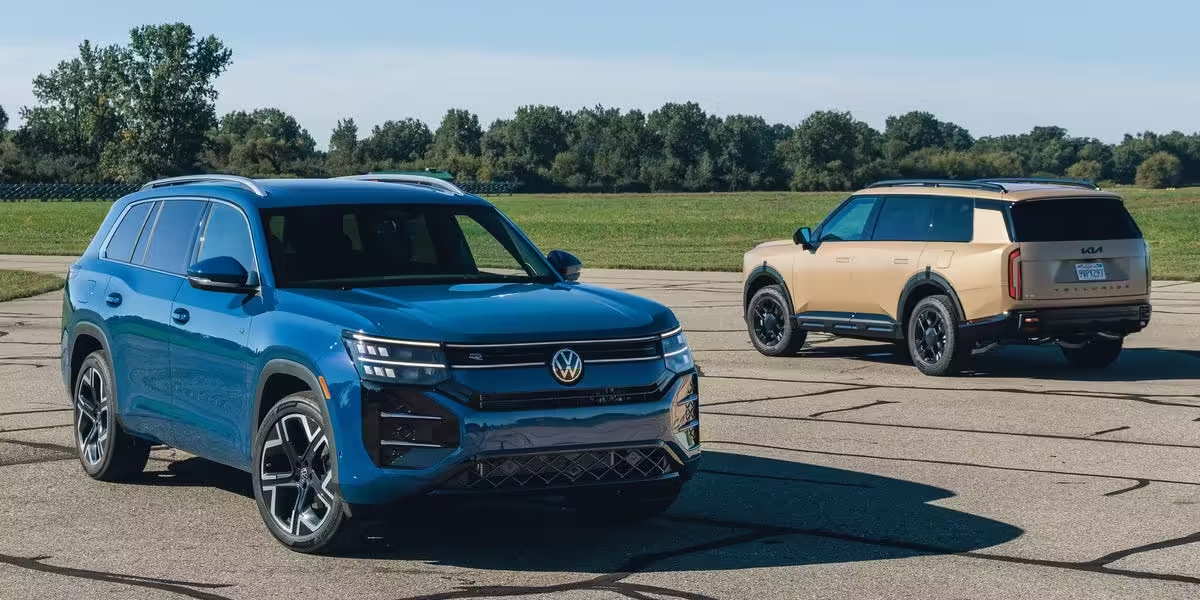

The Kia Telluride is a winner. Who says so? We do. The 2027 Telluride won our most recent three-row SUV comparison test against seven highly competent competitors. Conspicuously absent from that family-vehicle-focused confrontation, however, was the new 2027 VW Atlas. It was still germinating, months away from being let loose on the public. Of necessity, we drafted the outgoing 2026 model into the fight. Not surprisingly, it managed only a sixth-place finish in our summertime test.
But that was then. The comprehensively updated 2027 Atlas has arrived—looking good to the editorial eye, no less—so now is the perfect moment to pit it against the mid-size family transportation champ to assess whether Volkswagen has engineered an SUV that’s compelling enough to lure buyers away from the cool Kia.
What We Tested
The two vehicles facing off here, the 2027 Kia Telluride X-Pro SX Prestige AWD and the 2027 Volkswagen Atlas SEL Premium R-Line 4Motion, have a lot going for them beyond two of the longer model names in the car market. Both are top-spec, loaded versions, but we purposely bypassed the Telluride’s optional 329-hp hybrid powertrain and opted instead for its standard 274-hp nonhybrid turbocharged four-cylinder, which better matches the Atlas’s standard 282-hp nonhybrid turbo four, the only powertrain it currently offers.
The Telluride SX Prestige’s standard engine came wrapped in the X-Pro trim, a package of modest upgrades to better deal with the rigors of off-road driving: an additional 1.7 inches of ground clearance, a limited-slip rear differential, 18-inch all-terrain tires in place of the regular SX Prestige’s 20-inch all-season rubber, a ground-view camera, and recovery hooks. The top-of-the-line Atlas came equipped with its standard suspension and 21-inch all-season tires.
These top-shelf trims go tit-for-tat in terms of features and amenities. Both come with all-wheel drive, heated and ventilated first- and second-row seating, some form of massage for the driver, large infotainment screens, premium sound systems, head-up displays, dual wireless phone chargers, power liftgates, 115-volt outlets, USB-C ports galore, glass sunroofs, and much more. The Atlas Premium R-Line starts at $58,135; our test car had the optional second-row captain’s chairs ($695) and floor mats ($296), bringing the final price to $59,126. The Telluride X-Pro’s base price is within spitting distance, at $58,335; adding its Terrain Brown matte paint (which looked gold to us) for $995, plus $250 in floor mats, brought its bottom line to $59,580.
Exterior and Interior
Two design philosophies are on display in this pair of mid-size SUVs. In shape and detailing, the new Atlas’s exterior is a conservative evolution of the previous generation’s; you’d be forgiven for not clocking that it’s the new model at first glance. The Telluride, meanwhile, is a complete departure from the good-looking, perennial 10Best winner it replaces—a more avant-garde take with slab sides, a blunt and blacked-out front end, and a grille filled with shiny black teeth. It’s as if Kia wanted to sever any family ties that might remind you of the old Telluride.
Those very different wrappers contain vehicles that are close in size. Though we would have guessed the Telluride is larger, it measures 3.9 inches shorter in overall length. The Atlas has a 0.4-inch-longer wheelbase. The width of the two SUVs is identical.
Kia Telluride X-Pro SX Prestige AWD
HIGHS: Comfortable in the extreme, equipped like a luxury SUV, not scared of some soft-roading.
LOWS: Somber all-black interior, front passenger seat can’t give you a back rub.
VERDICT: Cool-looking, roomy, and comfy, the Telluride is a capable all-arounder.
Subjectively, and not surprisingly given their similar dimensions, the two vehicles are exceptionally close in interior room. We were able to adjust the sliding second-row captain’s chairs of both SUVs in a way that allowed six-footers to sit in all three rows without the second- and third-row riders’ knees contacting the seatbacks ahead of them. The Kia’s second row felt a touch airier set up like this. The VW counters with a third row that’s slightly more comfortable; the Kia’s higher rear floor pushes your knees closer to your chest.
Our sense of their near-equal interior room is backed up by the pair’s measured passenger-volume numbers. At 158 cubic feet, the Telluride cabin contains but four cubic feet more space inside than the Atlas. Indeed, both of these SUVs offer adult-size roominess in all three rows; grown-ups, not just kids, will be able to handle long trips in the waybacks. And isn’t room for the tribe what three-row SUVs should be about?
Well, that and cargo space. Here, too, the cargo-volume lead seesaws back and forth depending upon how many rows are folded down. The Telluride offers 22 cubic feet of space behind the third row, to the Atlas’s 21. With the third row folded, the Atlas takes the win, with 56 cubes to the Telluride’s 49. And with both the second and third rows folded, the cargo space advantage shifts back to the Atlas, with 95 cubic feet of room to the Telluride’s 89. Or to put it another way, both of these SUVs have plenty of space to haul your stuff.
The space race may be a standoff, but interior room is only half of what these two offer. They’re the top models in their respective lines, so features, amenities, and cabin ambience weigh in against the practical considerations of people-and-cargo room. And, surprise! Both are loaded, and the differences between their equipment rosters are minor.
Both SUVs come with large infotainment screens with crisp graphics: The Kia’s 12.3-inch display is integrated with its 12.3-inch instrument cluster in a single screen that spans much of the dash; the VW has a separate 10.3-inch digital instrument cluster and a 15.0-inch center-mounted screen. Both have redundant buttons on their steering wheel spokes to operate some features. While the latest VW user interface is improved, the Telluride’s system is more intuitive to operate, and its dash offers more convenient and easier-to-use physical and haptic buttons for accessing HVAC, media, and navigation functions.
The premium audio systems in both SUVs (Meridian in the Telluride, Harman/Kardon in the Atlas) sound great and have volume knobs, though the VW’s console-mounted knob doubles as both the drive mode selector and as the controller for ambient lighting-and-sound combinations. It’s odd, but it works.
Volkswagen Atlas SEL Premium R-Line 4Motion
HIGHS: Lively powertrain, luxury-car interior trimmings, murmuration-inspired light show.
LOWS: A rugged-looking model would make a nice addition, unique HMI quirks, more evolution than revolution in its visual overhaul.
VERDICT: With handsome interior environs, plentiful features, and a credible luxe vibe, the new Atlas has risen to be a serious mid-size SUV player.
While the Atlas has one large glass sunroof, the Telluride has separate front and rear glass sunroofs. Both of the Atlas’s front seats offer massage in several styles, while the Telluride’s less aggressive massage action is only available to the driver. But it offsets that negative with a power-adjustable steering column versus the Atlas’s manual setup. Both have second-row HVAC controls and vents, and come with navigation, wireless phone charging, ambient interior lighting, seven USB-C ports, and Apple CarPlay and Android Auto.
And so it goes, back and forth, a seeming dead heat, and not much changes when you sit down behind their steering wheels and take in your surroundings. The all-black interior that comes with the Telluride’s Terrain Brown paint scheme is somber but plush, with faux leather on the seats and steering wheel so nice it fooled us into thinking it was the real thing. Synthetic suede on the seat uppers and the headliner are premium touches, and a swath of what Kia dubs “engineered carbon interior trim” adorns the dash. Other exterior paint colors can be had with lighter, two-tone interior color schemes more like the one in the Atlas.
The Atlas’s interior vibe is brighter thanks to its gray-and-black soft trim—nappa leather on the seats—with contrasting stitching throughout and handsome wood on the dash. Especially intriguing are the backlit perforated swirls on all four door-trim panels, echoed in the pixelated design on the passenger-side dash screen. The pattern evokes the murmurations of flocking birds and looks even cooler at night when the subtle lighting shows them off better; the pale cream backlighting briefly turns red when you turn the HVAC’s temperature up, blue when you lower it. Neither cabin is obviously better; which one you prefer is more a matter of taste.
Powertrain and Performance
The Telluride’s base turbocharged 2.5-liter four-cylinder and the Atlas’s 2.0-liter turbo four make similar power: 274 horsepower for the Kia and 282 for the Vee-Dub. They drive all four wheels through eight-speed automatics. They weigh similar amounts too; the 4852-pound Telluride is only 112 pounds heavier than the Atlas.
The laws of physics would suggest their performance would be similar, and it mostly is. Sixty miles per hour comes up in 7.5 seconds in the Kia, 7.6 seconds in the Atlas. Quarter-miles are also on top of one another: The Telluride zips through in 15.7 seconds at 89 mph, while the Atlas shadows it at 15.8 seconds at 91 mph. The Atlas, however, will take you farther on each gallon, according to the EPA, thanks to its estimated 23-mpg combined fuel economy rating against the Telluride’s 19.
In wide-open throttle acceleration, they both thrum at a mere 72 decibels. At a steady 70-mph highway cruise, the Telluride is considerably quieter at 67 decibels (21 sones) to the Atlas’s 69 (25). The Telluride X-Pro’s all-terrain rubber, though, hampers it in cornering grip and braking from 70 mph: It delivers 0.76 g on the skidpad and requires 182 feet to stop. The Atlas, on its all-season 21-inch rubber, manages a decent 0.84 g and a 165-foot stop in those same tests.
Driving Experience
If the mental image of mid-size family transporters peeling out from rest in our full-throttle acceleration testing and squealing tires around our skidpad has you smiling, we’re with you. Vehicles like these are made for hauling families, not hauling ass—and that’s fine. Both the Atlas and Telluride deliver more than enough performance to fulfill their basic mission without straining.
The Atlas’s over-the-road personality comes across as the more athletic one. Its engine emits a soft purr, though it’s no quieter than the Telluride on full-throttle pulls. It feels peppier off the line and in around-town traffic, something confirmed in our 5-to-60-mph test, where the VW is 0.7 second quicker than the Kia. Dip partway into the Telluride’s throttle to jump into a line of traffic—as you would, say, leaving a gas station or the mall—and it takes an extra beat before it reacts. The Atlas’s engine note has more of an edge to it too.
The Telluride, however, drives more fluidly, with a softer ride complementing its quieter highway presence. The Atlas’s tauter suspension can feel brittle over rougher road surfaces, which might be a function of its 21-inch rubber; we think its ride harshness might be improved by the standard 20-inch tires that come on the non-Premium version of the R-Line model.
And the Winner Is . . .
This is a test of two of the most competent, well-rounded mid-size SUVs on the market. Both do a great job of providing the room, features, and amenities we expect in this class and at this price point. In fact, these particular Telluride and Atlas models are so well matched—and so damn good—that it led to extensive, er, discussions around the office about their relative merits.
When folks went back to their desks, the Kia Telluride X-Pro SX Prestige emerged as the winner. Its strengths—a smoother ride, quieter cabin, and more user-friendly infotainment system—were enough of an advantage in the right places to edge out the Atlas. But in the process, the runner-up made an important point about the state of the three-row, mid-size SUV class: The new Volkswagen Atlas is now a serious contender, something to consider if you’re also considering a Telluride.
➡️ Skip the lot. Let Car and Driver help you find your next car.
Want to see these vehicles’ specs side-by-side?
Check out the Kia Telluride & Volkswagen Atlas on our new compare tool.

Specifications
Specifications
2027 Kia Telluride X-Pro SX Prestige AWD
Vehicle Type: front-engine, all-wheel-drive, 7-passenger, 4-door wagon
PRICE
Base/As Tested: $58,335/$59,580
Options: Terrain Brown matte paint, $995; carpeted floor mats, $250
ENGINE
turbocharged and intercooled DOHC 16-valve inline-4, aluminum block and head, direct fuel injection
Displacement: 152 in3, 2497 cm3
Power: 274 hp @ 5800 rpm
Torque: 311 lb-ft @ 1700 rpm
TRANSMISSION
8-speed automatic
CHASSIS
Suspension, F/R: struts/multilink
Brakes, F/R: 13.6-in vented disc/12.8-in vented disc
Tires: Continental CrossContact ATR
255/60R-18 108W M+S
DIMENSIONS
Wheelbase: 116.9 in
Length: 199.2 in
Width: 78.3 in
Height: 71.5 in
Passenger Volume, F/M/R: 59/59/38 ft3
Cargo Volume, Behind F/M/R: 89/49/22 ft3
Curb Weight: 4852 lb
C/D TEST RESULTS
60 mph: 7.5 sec
1/4-Mile: 15.7 sec @ 89 mph
100 mph: 20.0 sec
Results above omit 1-ft rollout of 0.3 sec.
Rolling Start, 5–60 mph: 8.6 sec
Top Gear, 30–50 mph: 4.0 sec
Top Gear, 50–70 mph: 5.3 sec
Top Speed (C/D est): 130 mph
Braking, 70–0 mph: 182 ft
Roadholding, 300-ft Skidpad: 0.76 g
Interior Sound
Idle: 36 dBA/2 sone
Full Throttle: 72 dBA
70-mph Cruising: 67 dBA/21 sone
C/D FUEL ECONOMY
Observed: 19 mpg
EPA FUEL ECONOMY
Combined/City/Highway: 19/17/22 mpg
—
2027 Volkswagen Atlas SEL Premium R-Line 4Motion
Vehicle Type: front-engine, all-wheel-drive, 6-passenger, 4-door wagon
PRICE
Base/As Tested: $58,135/$59,126
Options: second-row captain’s chairs, $695; heavy-duty floor and cargo mats, $296
ENGINE
turbocharged and intercooled DOHC 16-valve Miller-cycle inline-4, iron block and aluminum head, direct fuel injection
Displacement: 121 in3, 1984 cm3
Power: 282 hp @ 6500 rpm
Torque: 258 lb-ft @ 1900 rpm
TRANSMISSION
8-speed automatic
CHASSIS
Suspension, F/R: struts/multilink
Brakes, F/R: 13.2-in vented disc/12.2-in vented disc
Tires: Hankook Dynapro HPX
265/45R-21 104H+
DIMENSIONS
Wheelbase: 117.3 in
Length: 203.1 in
Width: 78.3 in
Height: 70.3 in
Passenger Volume, F/M/R: 61/52/40 ft3
Cargo Volume, Behind F/M/R: 95/56/21 ft3
Curb Weight: 4740 lb
C/D TEST RESULTS
60 mph: 7.6 sec
1/4-Mile: 15.8 sec @ 91 mph
100 mph: 19.0 sec
Results above omit 1-ft rollout of 0.3 sec.
Rolling Start, 5–60 mph: 7.9 sec
Top Gear, 30–50 mph: 4.1 sec
Top Gear, 50–70 mph: 5.9 sec
Top Speed (gov ltd): 118 mph
Braking, 70–0 mph: 165 ft
Roadholding, 300-ft Skidpad: 0.84 g
Interior Sound
Idle: 38/2 dBA/sone
Full Throttle: 72 dBA
70-mph Cruising: 69/25 dBA/sone
C/D FUEL ECONOMY
Observed: 21 mpg
75-mph Highway Driving: 30 mpg
75-mph Highway Range: 550 mi
EPA FUEL ECONOMY
Combined/City/Highway: 23/20/27 mpg
Rich Ceppos has evaluated automobiles and automotive technology during a career that has encompassed 10 years at General Motors, two stints at Car and Driver totaling 20 years, and thousands of miles logged in racing cars. He was in music school when he realized what he really wanted to do in life and, somehow, it’s worked out. In between his two C/D postings he served as executive editor of Automobile Magazine; was an executive vice president at Campbell Marketing & Communications; worked in GM’s product-development area; and became publisher of Autoweek. He has raced continuously since college, held SCCA and IMSA pro racing licenses, and has competed in the 24 Hours of Daytona. He currently ministers to a 1999 Miata, and he appreciates that none of his younger colleagues have yet uttered “Okay, Boomer” when he tells one of his stories about the crazy old days at C/D.
Source: www.caranddriver.com