





Lasting impression
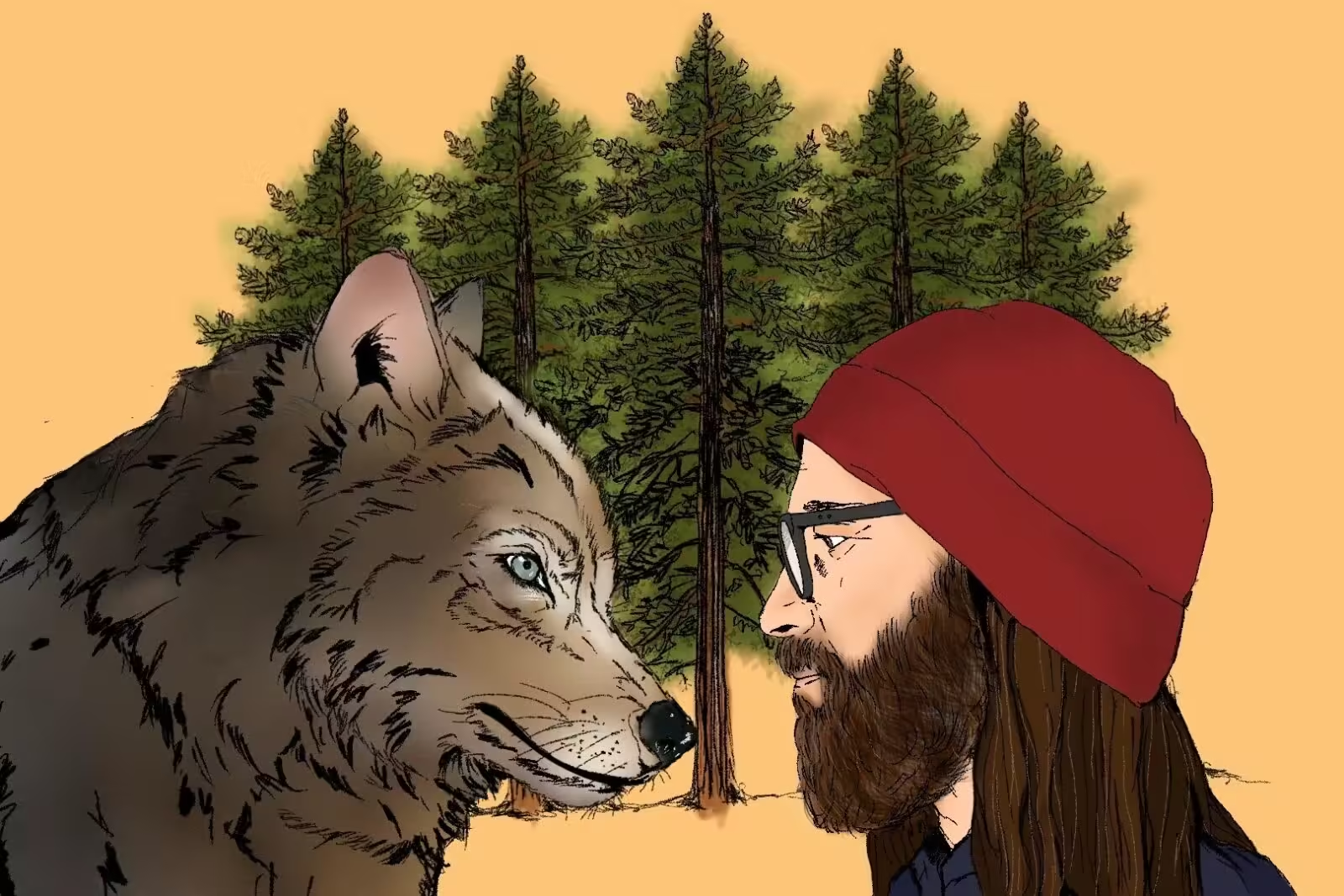
Pedersen has experienced moments like this many times throughout his career and says each one leaves a lasting impression.
No matter the reaction — fear, awe or shock — anyone who experiences close encounters with a wild predator, he said, “will feel different around the natural world than they did before”.
The encounter awakens something primal, an often unchallenged part of our brain that forces us to recognise how thin the line really is between ourselves and the wild — and how quickly the illusion of control can disappear.
For Pedersen, these encounters are not about danger but about connecting to something often missing in modern life: a deep, instinctual awareness and presence with the natural world.
Wolves embody that awareness, he said. They are highly social, intelligent animals, shaped by strong hierarchies and a constant need to read the world around them.
That perspective sits uneasily in Norway, where wolves are rare and politically contentious.
In Norway, the wolf population remains small, at fewer than 100, and is largely confined to forested areas along the Swedish border. Norway also conducts an annual wolf hunt as a government-regulated population management measure, which is controversial because the species is classified as critically endangered there.
In the winter of 2023, Pedersen saw on the local news that the wolf he had encountered the year before, recognisable from a streak in its fur coat, had been killed, along with its entire pack, during a hunt. The revelation left the photographer feeling emotional.
That loss sharpened for him the wider conflict over wolves’ place in Norwegian landscapes.
In Norway, conflict between humans and wolves is partly tied to moose, which wolves prey on and hunters depend on for meat and sport.
Wolves require large territories to survive, Pedersen explained. Yet, they have adapted to changing landscapes.
“They can thrive pretty much anywhere,” Pedersen said, noting how wolves now even live in plantation forests, ones planted by humans, which make up much of what is defined as forestry today in Norway.
While these environments may look wild, they are often heavily managed, with vast stretches of even-aged spruce planted for efficiency rather than diversity. Moose are among the few large animals able to survive there.
Pedersen said that when forests are cut down, birch and other soft-leaved trees are the first to return. Moose feed on these, but the regrowth throws the ecosystem out of balance.
Smaller animals depend on trees that are allowed to rot and decay naturally. Insects thrive in forests with trees of different ages, and small birds, in turn, feed on those insects.
Wolves are adaptable and “go where the food is”, he said. So if moose are thriving, so are the wolves.
Humans, however, increasingly move through these landscapes differently than before. Where earlier generations of loggers and farmers had daily, practical relationships with the land and its animals, Pedersen believes most people now experience nature as something secondary — for exercise, recreation or a short-term escape.
“Now, most of us only use the natural landscapes as courses for our walking or jogging trips,” he said.
Even hunting, once rooted in deep familiarity with the land and its species, has, in many cases, become seasonal and compartmentalised. While many hunters are extremely knowledgeable and respectful of their natural environments, he said most people have moved away from intimacy with the wild.
“Everything feels superficial, and hardly anyone is able to form a real connection with the natural world,” Pedersen said.
He believes that this loss of connection makes individuals’ encounters with wild animals so destabilising.
“The eyes that meet your own are bright, teeming with life and intelligence,” he said, describing wildlife encounters. “They assess you from the moment they lock on to yours. What are you? Are you a threat? What will you do next?”
In that brief exchange, attention flows in both directions. The wolf is fully present, reading posture, movement and intent.
“The eyes that meet your own are bright, teeming with life and intelligence. They assess you from the moment they lock on to yours. What are you? Are you a threat? What will you do next?”
Pedersen said he has become addicted to this feeling, and that he patiently tracks wolves for days, weeks, months — all for that brief moment of interspecies connection.
The animal looking at you, evaluating your every breath, your anxiety, the way you smell, most likely pays you more attention in those short moments than your fellow humans ever would, he explained.
For Pedersen, that asymmetry is revealing. Modern life, he says, is structured to minimise friction and unpredictability. Encounters are managed, risks reduced and outcomes anticipated.
As a result, certain instincts — awareness, restraint, attentiveness — are no longer routinely honed.
“Being disconnected from nature means that you are disconnected from a big part of who you are and where you come from,” he said.
That disconnection, he argues, is not just an abstract concept. It is felt in the body, in the way people move through landscapes without noticing what lives there — and in how rarely they are required to engage in deep interactions with other beings, assessing their behaviour and intentions by using raw instincts.
The remedy, Pedersen suggested, is not to put oneself face-to-face with a wolf, but to let the natural world influence how one moves through it.
“Maybe it is time to slow down,” he suggested. “Kneel in the moss quietly and let the other voices speak.”
For him, the wolf is not a symbol of wilderness or danger, but a reminder that the world does not always organise itself around human convenience.
After the wolf disappeared, Pedersen walked back through the forest. The adrenaline slowly wore off, but he remained on high alert; he felt every twig and stone beneath his bare feet, and he heard every whisper the forest made.
His brush with wild nature had left him more alive than ever.
Other articles in the series:
Source: www.aljazeera.com