



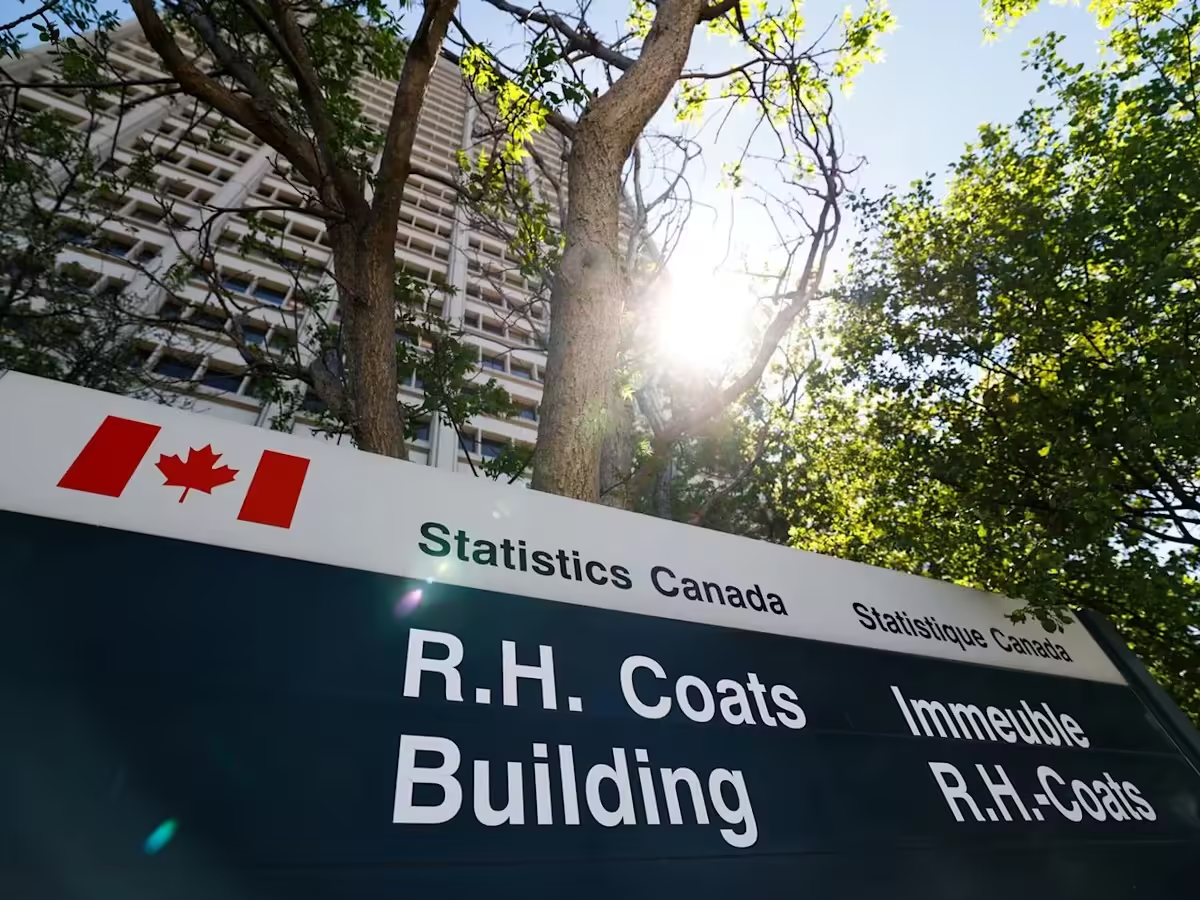

I’ve written before about how Statistics Canada, which often gets good reviews for its data, has one of the clunkiest user interfaces around. Very 2005: way too many clicks to get where you want to go and no guarantee you finally do arrive there.
For economic data that essentially formats itself I use FRED (Federal Reserve Economic Data: “Your trusted source for economic data since 1991”), which is run by the St. Louis Federal Reserve Bank. I suppose if I had to pay for it, I’d think twice about buying my data from Trumpland. But FRED is free to the user so that dilemma doesn’t arise. And it seems to stock more and more Canadian data every year, though if the White House finds out, that probably won’t last.
Clunky or not, though, Statistics Canada does keep pumping out the data. You can get your regular morning fix with The Daily, which summarizes the day’s big releases, or with My StatCan, which includes dozens of new series a day, a dataphile’s delight. The releases for Oct. 1 offered an interesting juxtaposition: tons of new data on the criminal courts side-by-side with even more numbers on postsecondary education. Crime and PSE do represent alternative uses for people’s time, especially the time of young males. Does Statistics Canada’s scheduler have a subversive sense of humour?
This one-day’s dump included all sorts of tabulations. Adult criminal cases by: median elapsed time in days, type of sentence, most serious sentence, length of custody, length of probation, amount of fine. Plus all the same for youth courts. And even more series for postsecondary education: institution type, program of study, registration status, credential type, field of study, detailed field of study, student characteristics and so on and so on.
The criminal courts decided almost a quarter million cases in 2024-25. “Guilty” was the verdict 47.4 per cent of the time. Despite the TV lawyer shows, “acquitted” wasn’t the main alternative. Only 1.2 per cent of cases ended with acquittals. Fully 50.5 per cent were stayed or withdrawn, while another 1.0 per cent ended some other way.
Cases take a long time. Measuring, not by the date of the incident being tried but rather by the first appearance in court to the date of decision, only 7.2 per cent of cases were done in a day. Another 15.6 per cent took up to two months; 15.8 per cent, two to four months; 22.5 per cent, four to eight months; and 15.9 per cent eight to 12 months. Just less than a quarter — 24.2 per cent — took more than a full year.
Source: ca.finance.yahoo.com