





MITCHELL — Three Mitchell men convicted of sex crimes involving children in the past two decades received lengthy prison sentences, but the sentences did not lead to the same possibility of parole.
Ronald Dahme was sentenced to 30 years to serve in 2008 and was paroled in 2024. Robert Gerstenecker received 90 years in 2022 and is eligible for parole in 2088. Eric Opperman received 85 years in September for two counts of first-degree rape, but a concurrent sentence that is not eligible for parole effectively prevents him from having a practical parole opportunity.
The differences are not simply a matter of how many years a judge imposed. The charges, ages of the victims, plea agreements, circumstances of the crimes and laws governing parole were different in each case.
Those differences help explain why the cases produced different outcomes, according to Davison County State’s Attorney Bob O’Keefe.
Different charges, different outcomes
Dahme, a former Mitchell youth baseball coach, was arrested in 2008 and ultimately pleaded guilty to three counts of sexual contact with a child younger than 16. Other charges against him were dropped as part of the plea agreement.
He was sentenced to 15 years, with five years suspended, on each of the three cases. The sentences were ordered to run consecutively, meaning Dahme received 45 years with 15 years suspended, for 30 years to serve. The South Dakota Sex Offender Registry says Dahme now has a primary residence in Sioux Falls and lists a secondary residence in Mitchell.
Under the rules at the time of his sentencing, O’Keefe said, Dahme would have had to serve about 60% of his time but could also earn good time credit that could come off the end of his sentence.
Luke Hagen / Mitchell Republic
Dahme did not go directly from that sentence to parole. His parole was denied at hearings in December 2019 and April 2021 before he was ultimately paroled Oct. 18, 2024.
Dahme’s case can appear particularly different from Opperman’s when looking only at the fact that both involved sexual offenses against children. But O’Keefe said the cases are not direct comparisons.
“The two main differences between this case and Opperman or Gerstenecker is the crimes charged were completely different and the ages of the victims,” O’Keefe said.
Dahme’s convictions were for sexual contact rather than first-degree rape. The ages of the victims also affected how the conduct was charged.
Opperman’s case involved a much broader set of allegations. He was originally charged with 44 felony counts involving three children under 13 and one victim between 13 and 16. The alleged offenses spanned about 12 years.
Opperman ultimately pleaded no contest to two counts of first-degree rape involving children younger than 13. Judge Chris Giles sentenced him Sept. 25 to 85 years on each count, with the sentences running concurrently, meaning he received 85 years total.
The sentence was the same as the 85 years requested by prosecutors.
Opperman and Gerstenecker
Gerstenecker provides a closer comparison to Opperman. Gerstenecker pleaded guilty to first-degree rape involving a 7-year-old and was sentenced in 2022 to 90 years in prison.
The prosecution had recommended a 75-year sentence, but Giles rejected that recommendation and imposed an additional 15 years.
The two cases also had similarities beyond the first-degree rape charges.
“They were each charged with rape in the first-degree and multiple counts of both possessing and manufacturing child porn,” O’Keefe said.
Gerstenecker’s sentence therefore was five years longer than Opperman’s, even though Opperman’s case involved more alleged victims and a longer period of alleged abuse.
But the difference in sentence length does not by itself explain the difference in parole eligibility.
“Opperman and Gerstenecker are very similar in nature and received very similar sentences,” O’Keefe said.
Gerstenecker remains in prison and is eligible for parole in 2088. That does not mean he will automatically be released at that time, but it gives him a parole eligibility date under the rules that applied to his case.
The timing of the crimes is important because South Dakota’s sentencing rules changed July 1, 2023.
“The main difference between these two is that one occurred prior to July 1, 2023,” O’Keefe said. “At that point, the truth in sentencing took effect making 1st degree rape ineligible for parole. That is why Opperman cannot be paroled but Gerstenecker can.”
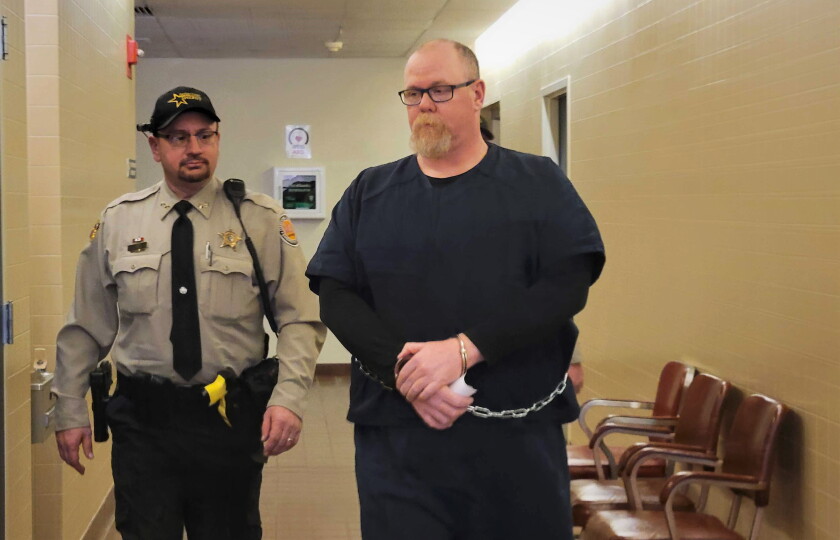
Mitchell Republic file photo
Opperman’s two first-degree rape convictions fall under different parole rules. One is eligible for parole under the older system, while the other is not eligible under the newer rules.
Because Giles ordered the two 85-year sentences to run concurrently, however, the nonparolable sentence effectively controls. Having parole eligibility on one count does not create a practical path to parole while the concurrent sentence remains nonparolable.
Under the older system, parole eligibility for first-degree rape could begin after a percentage of the sentence had been served, with the percentage depending in part on an inmate’s criminal history. A person with no prior felony convictions could become eligible after serving 50% of the sentence, while the percentage could increase to 60%, 65% or 75% for people with prior felony convictions.
That distinction helps explain why Gerstenecker, who was sentenced in 2022, has a parole eligibility date of 2088, while Opperman does not have a practical parole opportunity despite one of his concurrent counts carrying parole eligibility.
Dahme, meanwhile, was sentenced under an even earlier set of rules. His 30-year term to serve eventually led to parole in 2024, but only after two earlier parole requests were denied.
“These cases demonstrate why the total number of years handed down at sentencing rarely tells the complete story. Factors such as the specific charges resulting in conviction — such as sexual contact versus rape — the ages and number of victims, the duration over which offenses occurred, and aggravating factors like video evidence or distribution all heavily shape sentencing recommendations. Furthermore, judicial discretion allows judges to deviate from prosecutorial recommendations, while statutory changes and sentence structuring — such as concurrent nonparolable counts — ultimately dictate true parole eligibility regardless of the headline sentence length,” O’Keefe said.

Jennifer Leither joined the Mitchell Republic in April 2024. She was raised in Sioux Falls, S.D. where she attended Lincoln High School. She continued her education at South Dakota State University, graduating in December 2000 with a bachelor’s degree in Journalism. During her time in college, Leither worked as a reporter for the campus newpaper, The Collegian. She also interned for Anderson Publications in Canistota, SD the summer of 2000. Upon graduation, Leither continued to reside in the Sioux Falls area and worked as a freelance writer for the Argus Leader for a number of years.
/jennifer-leither
Source: www.mitchellrepublic.com