



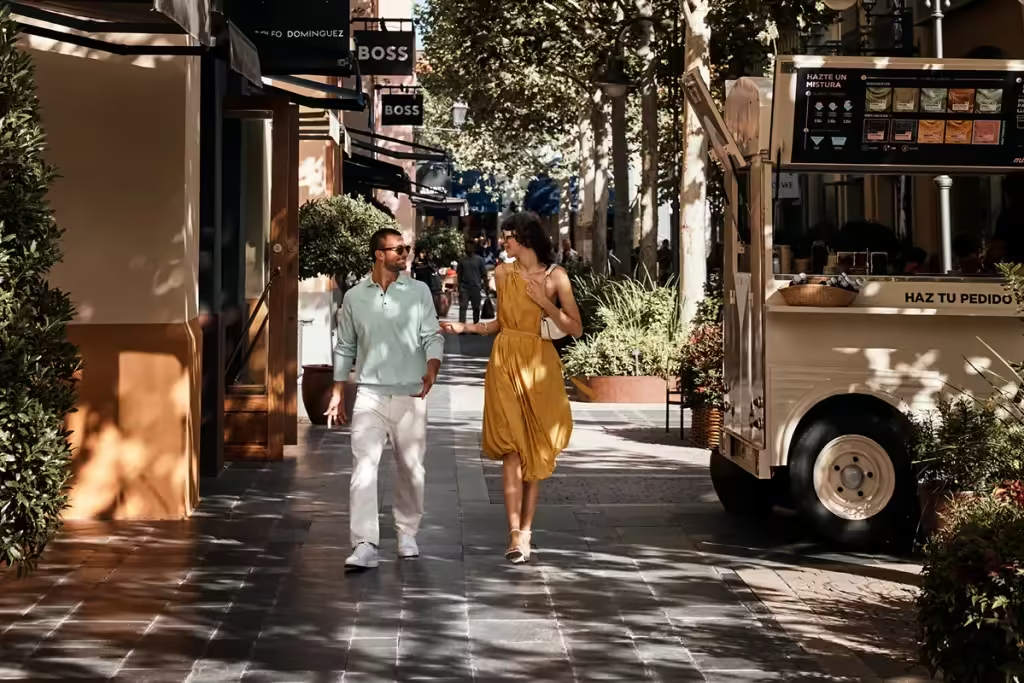

This sponsored content was created in collaboration with a Skift partner.
Luxury has always followed where desire goes first. Long before anyone defined markets or segments, it adapted to changing ideas of aspiration and identity. Today, that shift is visible in the numbers and behavior. Euromonitor’s 2025 World Market for Luxury Goods report found that experiential luxury was the fastest-growing segment in 2025, rising 8% year-on-year to reach $103 billion.
As affluent travelers demand the highest standards of experience across every aspect of their lives, luxury travel value is increasingly forming in places the industry hasn’t historically treated as travel at all.
One of those places is experiential retail. According to Visa’s 2025 Global Travel Insight reportretail accounts for more than half of affluent credit card spending abroad in some markets. Yet it rarely features in discussions about destination strategy, itinerary design, or guest experience.
“The assumption that shopping is a transaction is outdated,” said Elena Foguet, chief international business officer, Europe at The Bicester Collection. “Retail can be a point of discovery, and a way to engage with local culture, craftsmanship, design, and the people behind them.”
The traveler who visits Emilia-Romagna for Museo Ferrari and the traveler who spends an afternoon discovering independent designers in Paris are both looking for the same thing: the thrill of discovery. The experience matters as much as the product, if not more.
Why Experiential Retail Belongs in the Itinerary
That idea sits at the heart of a partnership between Virtuoso and The Bicester Collection, which began with a simple understanding: If travelers increasingly value discovery and local connection, then retail deserves to be viewed through the same lens as the rest of the journey.
Matthew Upchurch, CEO of Virtuoso, admits he was not always convinced.
“Years ago, I was dubious about shopping and luxury travel,” he said. “The challenge with any experiential offering is that its value is hard to appreciate until you’ve experienced it firsthand.”
What changed his mind was seeing how experiential retail served the same purpose as many of the experiences Virtuoso advisors already curated. It gave travelers another way into a destination.
“I realized that the value comes from discovery,” Upchurch said. “A traveler might arrive at a Bicester Collection village expecting to shop and leave having discovered a local designer, a creative community, or a side of a destination they didn’t know existed. Those are the experiences people remember, and they’re often the reason they return.”
“Virtuoso advisors were already directing their clients to our villages because they were already asking for it,” Foguet added. “The partnership formalized what the market had already decided.”
Affluent Travelers Value Human Judgment
All successful luxury travel experiences have one thing in common — they feel personal. What travelers increasingly pay for is judgment: someone who understands what will resonate with them and why.
That’s one reason the partnership between Virtuoso and The Bicester Collection works. Luxury travel advisors build their businesses on knowing their clients. They know who wants a packed itinerary and who wants empty afternoons. They know which restaurant reservations matter and which don’t. The relationship is often built over years.
That kind of knowledge is becoming more valuable as AI tools become increasingly capable of mimicking personalization. According to Upchurch, wealthy travelers are becoming more sensitive to the difference between genuinely tailored experiences and those that merely appear to be.
“One of my predictions is that people’s ability to differentiate what’s real and what’s not will be heightened as technology becomes better at generating recommendations and itineraries,” he said. “Relationships, execution, and collaboration will stand out.”
That raises the bar for advisors. The challenge is understanding which experiences belong in a particular traveler’s journey and why. The same experience can feel transformative for one client and irrelevant to another. Where the advisor’s value increasingly lies and what technology still struggles to replicate is context and trust.
The Hospitality Standard
“Virtuoso guests arrive with high expectations,” Foguet said. “They expect us to know who they are, understand their preferences, and have prepared an experience that feels personal before they even arrive.”
Expectations like these are more commonly associated with luxury hospitality than retail. Yet they increasingly shape how The Bicester Collection thinks about the visitor experience. The company subscribes to the principle of Unreasonable Hospitality, coined by restaurateur Will Guidara, and has developed its own program with Ecole hôtelière de Lausanne, one of the world’s leading hospitality schools, to embed five-star service standards across its villages.
Guests can access private shopping suites such as The Apartment, with personal shoppers and concierge services. Advisors can also arrange private appointments, stylist services, local designers, and tailored cultural programming.
What guests encounter upon arrival depends on the village’s location, with local culture and creative communities shaping the experience. La Roca Village, outside Barcelona, draws on Catalan culture and architecture. Fidenza Village, near Milan, reflects the region’s connection to Verdi and opera. Shanghai Village in China expanded by 57 boutiques in April to serve a growing international very important clients (VIC) audience. At Belmont Park Village outside New York City, guests can combine a visit with a concert or New York Islanders game at UBS Arena, or horse racing at the newly rebuilt Belmont Park from September.
Each village also showcases young designers and local artisans whose work reflects the region’s culture, alongside globally renowned luxury brands such as Ferragamo, Vivienne Westwood, Manolo Blahnik, Creed, and more. That local perspective also informed The Bicester Collection’s recently launched series of travel itineraries highlighting experiences beyond the Villages, with curated recommendations to help travelers discover more of the region.
“We’ve always positioned our villages as destinations, and a good destination gives you stories to tell when you get home,” Foguet said. “The memories come from how you spent your day, the people you shared it with, and the things you found along the way.”
The approach appears to resonate. In Europe, the company’s VICs increased spending by 17% year over year in 2025. Its hands-free shopping service, which allows purchases to be collected and delivered at the end of a visit, saw registrations rise 40% in 2025.
The Economic Case for Experiential Retail
The villages were deliberately built outside major city centers on the belief that tourism spending should extend beyond the urban core. The Bicester Collection’s guest data suggests that high-net-worth travelers who engage more deeply with the experience stay longer, spend more, and return. In that sense, retail tourism can complement the destination while supporting hotels, restaurants, transport providers, and local businesses beyond the city.
“The Bicester Collection has demonstrated that when retail is done at its best with intention, hospitality, and partnership, it extends destinations, rebalances economies, and becomes a multiplier for the entire destination economy,” Upchurch said. “That’s a powerful thing, and it’s why every serious travel and tourism leader should be paying attention.”
He added that this matters not only to advisors and destinations, but increasingly to travelers themselves.
“Today’s high-net-worth traveler pays attention to where they spend their time and money and what that supports. They want experiences that feel connected to local culture, local creativity, and local communities.”
This philosophy also shapes how The Bicester Collection thinks about growth. Through its DO GOOD programthe company supports local communities with charitable partnerships, the Unlock Her Future Prize for women social entrepreneurs, and industry initiatives such as Unlock Futures Protecting Children, which brings together World Travel & Tourism Council (WTTC), ECPAT International, and the United Nations Special Representative to the Secretary-General on Violence Against Children to embed child protection as a core business priority across travel, leisure and entertainment.
The Advisor’s Next Move
Over the next year, advisors should take a fresh look at their most-booked itineraries and ask a simple question of every inclusion: Does this create discovery, connection, or a deeper understanding of a destination, or has it become a default?
It’s a question worth asking now, because the economics of the job are shifting. An advisor’s value has historically rested heavily on access and the ability to book. As those capabilities are increasingly automated, what remains distinctly human is judgment. In Upchurch’s words, “You can’t think the human out of humanity.”
Travelers do not categorize their experiences by industry. They do not separate retail from culture or discovery from destination. They remember the moments that felt meaningful.
“For too long, shopping tourism has been underestimated by an industry that measured value in room nights and flight seats. That era is over,” Foguet said. “The world’s most valuable travelers are already voting with their time and their spending. The question is whether the industry intends to shape this shift or be shaped by it.”
The next step is to bring retail into the itinerary with greater intention, and The Bicester Collection provides a model for what that could look like — an experience designed around hospitality, local culture, and discovery.
To explore partnership opportunities with The Bicester Collection, visit thebicestercollection.com
This content was created collaboratively by The Bicester Collection and Switch Studio.
Source: skift.com