


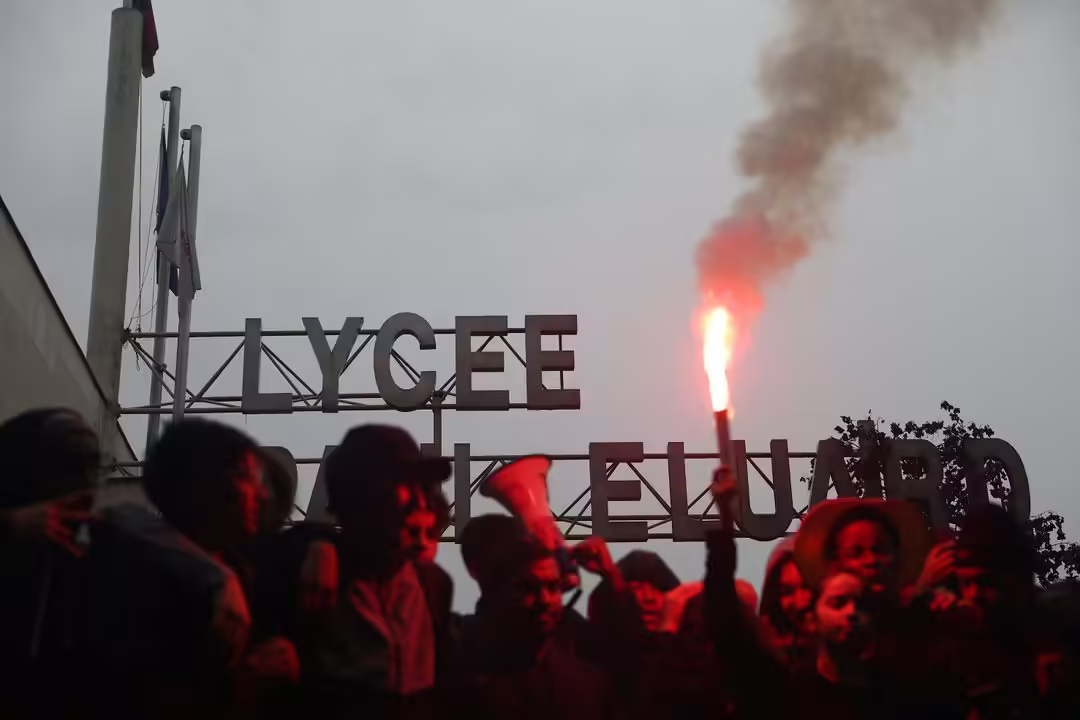

In 2019, Macron’s proposed pension reforms sparked widespread protests, adding to public anger after the Yellow Vest movement began in 2018 over fuel tax increases.
Despite continued opposition, Macron’s government enacted a new pension reform in 2023, gradually raising the retirement age from 62 to 64, although the timetable was subsequently suspended until 2028.
But Macron’s position has been significantly weakened in recent years, as his decision to call snap elections in 2024 led to a divided parliament and further weakened his centrist allies. Since then, France has seen repeated changes of prime minister, with successive governments struggling to secure parliamentary support.

Related
Amid growing protests, Education Minister Édouard Geffray announced plans to deploy 3,000 substitute teachers to schools facing shortages, a measure backed by Prime Minister Sébastien Lecornu.
But experts say this may not resolve the structural problems facing education systems in France and other European countries.
“We are facing a serious teacher shortage, while the teaching profession is becoming less attractive. Teachers are increasingly expected to be educators, psychologists, social workers, mediators and administrators simultaneously. Many experience exhaustion or burnout,” Rogiest says.
On the other hand, many young people carry frustrations from home into the classroom, as financial difficulties, family conflicts, parental separation, social media and a lack of emotional support deeply affect their behaviour and motivation, he adds.
These behavioural problems require additional meetings, administrative reports, and constant follow-up, leaving less time for teaching and personal interaction with students.
In Belgium, for example, new rules introduced in September 2026 require secondary schools, in principle, to organise supervision or alternative activities when lessons are cancelled.
Although limited exceptions exist, Rogiest says this creates additional organisational pressure on teachers.
He also notes that the current digital age makes his job difficult in certain ways, as students are increasingly influenced by social media and constant digital stimulation, which creates unrealistic teaching expectations.
“We expect teachers to solve society’s problems inside the classroom, while giving them fewer resources and less time to build relationships with their students,” he says.
“This is neither fair to teachers nor beneficial to children.”
Future of European education
Europe has been facing not only rising inflation, which has increased the cost of living, but also growing political divisions between left-wing and far-right groups, both of which accuse mainstream politics of social and economic problems.
While worsening economic conditions hit classrooms, leading to various cuts in the educational sector, political divisions do not help countries meet the new generation’s demands, exposing deep social insecurity in the new digital age.
“European education has many strengths, but I am deeply concerned about its increasing focus on economic productivity rather than human development,” Rogiest says.
“Historically, we spoke about the humaniora: an educational tradition that sought to develop the whole human being, intellectually, morally, culturally and socially.”
But today, education is increasingly reduced to obtaining qualifications, entering the labour market, becoming economically productive, and paying taxes, he adds.
While earning a decent salary is important for a decent life, education must be much more than professional training, according to Rogiest.
“We should not only ask what profession our students will have, but what kind of human beings they will become.”
From this perspective, Rogiest says the future of European education depends on restoring its human dimension.
“We need smaller classes, better support for teachers, more investment in mental health and stronger cooperation between schools and families.”
While digital education and artificial intelligence offer enormous opportunities, young people “need guidance in developing concentration, discipline, empathy, responsibility and critical thinking,” he says.
Without these fundamental skills, modern technologies will help students little, he adds. This also requires restoring the dignity and attractiveness of the teaching profession.
“Education should not simply produce skilled workers for the economy,” Rogiest tells TRT World.
“It should develop responsible, compassionate and thoughtful human beings who can contribute positively to society. That is the educational vision Europe needs to rediscover.”