





- Advanced diagnostics determine most medical decisions yet receive only 2% of global spending.
- Expanding precision testing across Asia-Pacific is essential to manage rising chronic disease burdens.
- Scalable innovations like automated mass spectrometry make high-precision care accessible in routine settings.
Asia-Pacific carries a disproportionate share of the global disease burden. The region accounts for 62.6% of global deaths from liver disease, 60% of global tuberculosis cases and nearly half of global breast cancer diagnoses. A rapidly ageing population – 1 in 4 people in the region are projected to be over the age of 60 in 2050 – increases demand for healthcare, placing pressure on systems that are already strained.
This is all intensified by a major diagnostic gap in the region, where the field remains undervalued, by both the medical community and policy-makers.
It is a gap that does not just exist here, but globally. Strikingly, diagnostics represent only 2% of healthcare spending globally, despite determining over 70% of clinical decisions. Yet, for a region like Asia-Pacific, grappling with rising chronic diseases and the ever-looming threat of infectious disease, the diagnostic gap can have real consequences.
Diagnostics is where health equity begins
In healthcare, diagnostics is considered the “first mile” of care. It informs what conditions are treated, how they are treated, and whether the treatment works. A missed or imprecise diagnosis cannot always be corrected later, no matter how advanced the therapy.
Take organ transplants, operations that save lives. Following an operation, patients need to take immunosuppressive drugs to prevent the immune system from rejecting the transplant, and getting the right drug dosage can be a matter of survival. Diagnostics makes this possible by giving clinicians clear, reliable information to adjust treatment for each patient.
New, advanced solutions are helping to democratize care
Diagnosis for many diseases, particularly rare ones, is complex. It requires detecting minute molecular concentrations with high specificity – precision that has traditionally required specialized laboratory facilities and staff, ruling it out of routine care.
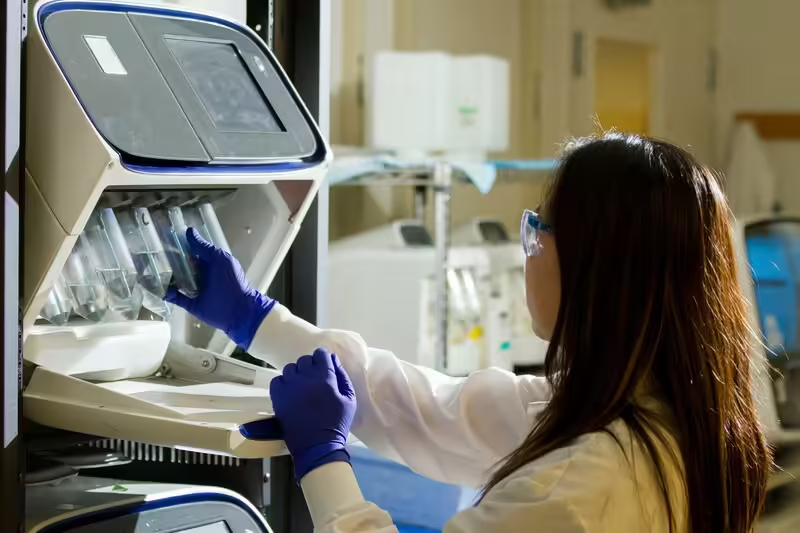
Today, technological advancements are breaking down those barriers. Mass spectrometry is one key example of how automation and modern engineering are expanding diagnostic access across the region.
For decades, mass spectrometry has been a gold standard tool, trusted for its high accuracy and specificity across certain clinical applications such as hormone testing, therapeutic drug monitoring and metabolic analysis. It is able to address many of the challenges of immunoassays, providing high analytical sensitivity in many cases while being less impacted by interferences or cross-reactivity.
Still, many users say that current mass spectrometry systems are unsuitable for routine testing due to their operational complexity, lack of integration and standardization. As a result, conventional mass spectrometry is often only found in specialized testing settings, and is often unavailable where it is needed most – not because it was clinically unnecessary, but because hospitals and clinics simply could not support it.
A shift from specialized innovation to scalable access
What is changing today is not the science itself, but who can use it more routinely and how accessible it is to them.
Advances in automation, standardization and integration are making the consolidation of high-precision diagnostics feasible in more routine clinical settings. Technology that once required specialist expertise can now be incorporated into routine workflows, supporting faster turnaround times and more consistent results.
This matters because it matches diagnostic capability to the common realities facing health systems, as diverse as they are across Asia-Pacific: rising patient loads, coupled with increasing diagnostic complexity, workforce shortages that put pressure on operational efficiency, and the need to diagnose conditions earlier.
The challenge of diagnosis plays out clearly in the management of hormone-dependent breast cancer in pre-menopausal women. With almost two-thirds of malignant breast tumours associated with female sex hormones – most often estradiol – maintaining effective estrogen suppression is critical, yet the side effects of this treatment can be overwhelming and often prolonged, leading to poor adherence and higher relapse risk. The hormone estradiol is a key marker of whether suppression is working, but until recently it was difficult to measure reliably at low levels, leaving many patients insufficiently informed about their risk levels and the potential need for treatment adjustments.
More sensitive and reliable measurement with technology such as advanced mass spectrometry changes that dynamic. In the case of hormone-dependent breast cancer, the technology helps clinicians gain greater confidence in assessing estrogen suppression, which in turn help patients better understand their own risk, underscoring the importance of staying on therapy. As a result, decisions can be made sooner with clearer evidence, and with the potential to avoid preventable recurrence.
Prioritizing diagnostics as a policy imperative
Expanding access to advanced diagnostics is not only a matter of technology and innovation, but of policy choice.
For governments facing rising healthcare costs, diagnostics should be seen as a strategic investment. After all, earlier disease detection can potentially prevent some diseases from reaching advanced stages, and could minimize costs, while better monitoring helps optimize therapy, thus minimizing ineffective treatment. When integrated into national health systems, it can have a significant impact on lifting the disease burden.
But these initiatives must be matched by a commitment to embed high-quality diagnostics into everyday care, not just centres of excellence.
That means creating incentives for adoption within public health systems, integrating precise testing into preventive pathways, and sustaining investment in training so laboratory professionals can fully use new capabilities.
Why this matters now
Health equity is often discussed in terms of access to treatment. But without equitable access to accurate diagnosis, treatment equity is incomplete.
Asia-Pacific faces a narrowing window to make meaningful changes for its people against rising pressures from multiple fronts – demographic change, disease burden and workforce constraints. Broadening access to advanced diagnostics is a practical way to strengthen healthcare at its foundation, supporting better outcomes for patients while improving system resilience for the future.
The effectiveness of healthcare in the years ahead will depend not only on what treatments exist, but on how well health systems can identify who needs them, and when. It is a choice whether diagnostics operates quietly in the background or is championed to create greater opportunities. Either way, it will help shape the future of care more than almost any other part of the system.
Source: www.weforum.org

