

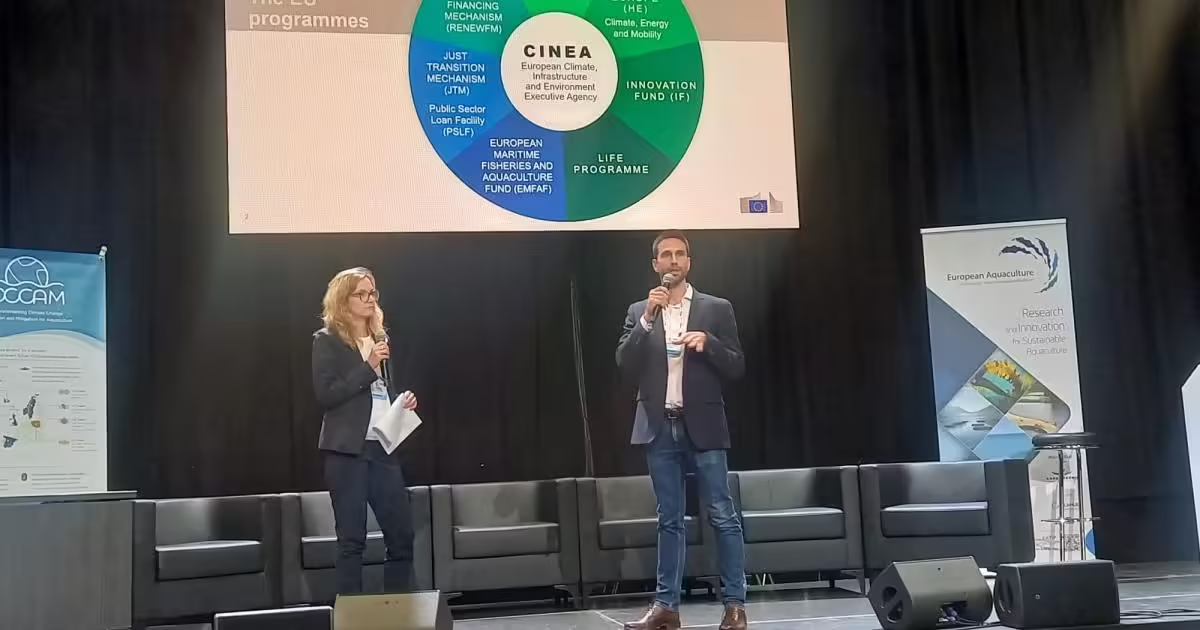

What if the by-products of aquaculture could become building materials, new farm inputs or the raw material for entirely different products? That question was at the heart of a workshop organised by CINEA, together with EAS, EATiP and the EU Aquaculture Assistance Mechanism, at Aquaculture Europe 2026 in Ljubljana (Slovenia) this week. Researchers, aquaculture businesses and public authorities came together to ask how aquaculture could use resources more fully, cut waste and create new value.
From waste to value
The session was moderated by Julia Beile and Julien Peris, Project Advisers working on aquaculture-related files at CINEA. They opened with a challenge that framed the discussion: “How can aquaculture turn waste into value? How can circular solutions boost sustainability while creating new business opportunities?”
The session examined what it took to move circular ideas into everyday aquaculture practice.
Shells become building blocks, plastic nets get a second life
The projects brought very different materials to the table. GREENLIFE4SEAS, funded by the European Union’s LIFE programme, focuses on two difficult waste streams: mussel shells and dredged harbour sediments. It develops a process in which shells were turned into powder and combined with sediments and binders to produce paving blocks, breakwater blocks and stabilised material. The project is testing a mobile treatment approach to process and reuse these materials close to where they were generated, including in port areas.
LIFE MUSCLES tackles a familiar sight around mussel farms: the plastic socks used to grow mussels. The EU-funded project tested biodegradable and compostable alternatives to traditional plastic socks. It also developed a mobile recycling plant that could process used polypropylene socks close to farming areas and turn the recovered plastic into material for new nets. By the end of 2025, almost 100 tonnes of polypropylene had been treated for reuse and 26 tonnes of biopolymer socks produced.
BlueAquaEdu approached circularity from a different angle: people. Supported by the European Maritime, Fisheries and Aquaculture Fund, the project developed a serious game, online learning and training programmes covering areas from fish farming to the processing and valorisation of by-products. It mapped 234 aquaculture education establishments across 18 European Union countries and five outermost regions. The message was simple: circular systems need people with the right skills.
The EU Aquaculture Assistance Mechanism then connected these examples to the bigger picture through the new background paper, “Implementing the Strategic Guidelines for European Union aquaculture – Circular Economy in Aquaculture”. The paper brought together research, practical case studies and stakeholder experience to examine three broad routes to circularity: using more circular inputs, making better use of aquaculture side-streams, and connecting aquaculture waste streams with other industries. It also highlighted barriers to scaling, including regulatory uncertainty, infrastructure, finance and skills.
One sector, many ways to close the loop
The other projects showed how wide the field had become. Horizon Europe-funded VALORISH develops a cascade biorefinery for fish waste and by-products, aiming to recover products such as fish oil, protein ingredients and other valuable compounds rather than treating the material as low-value waste.
AQUAPHOENIX, also funded by Horizon Europe, is working on the collection of sludge from open-pen fish farms and testing routes to turn it into fertilisers, feed ingredients, biogas and microalgae. CIRCALGAE explores how side-streams from seaweed and microalgae production could be processed into higher-value ingredients for food, feed and cosmetics.
Taken together, the projects pointed to a shift in how aquaculture waste is viewed. A shell, a plastic net, a tank of sludge or a processing residue could each be the starting point for something else, but only if the links between production, collection, technology, markets, skills and regulation were in place.
That was the clearest message from the discussion in Ljubljana: circular aquaculture was not one technology or one solution. It was about connecting parts of the value chain that had traditionally been kept apart, and making better use of what the sector already produced.
Source: cinea.ec.europa.eu