


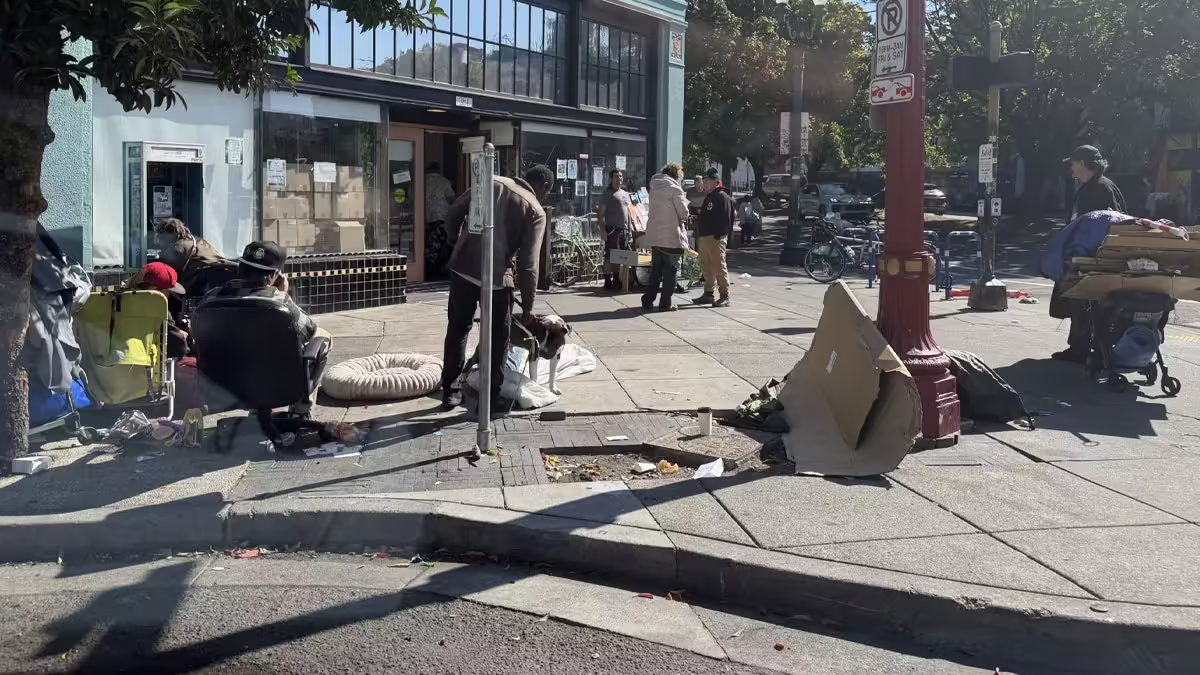

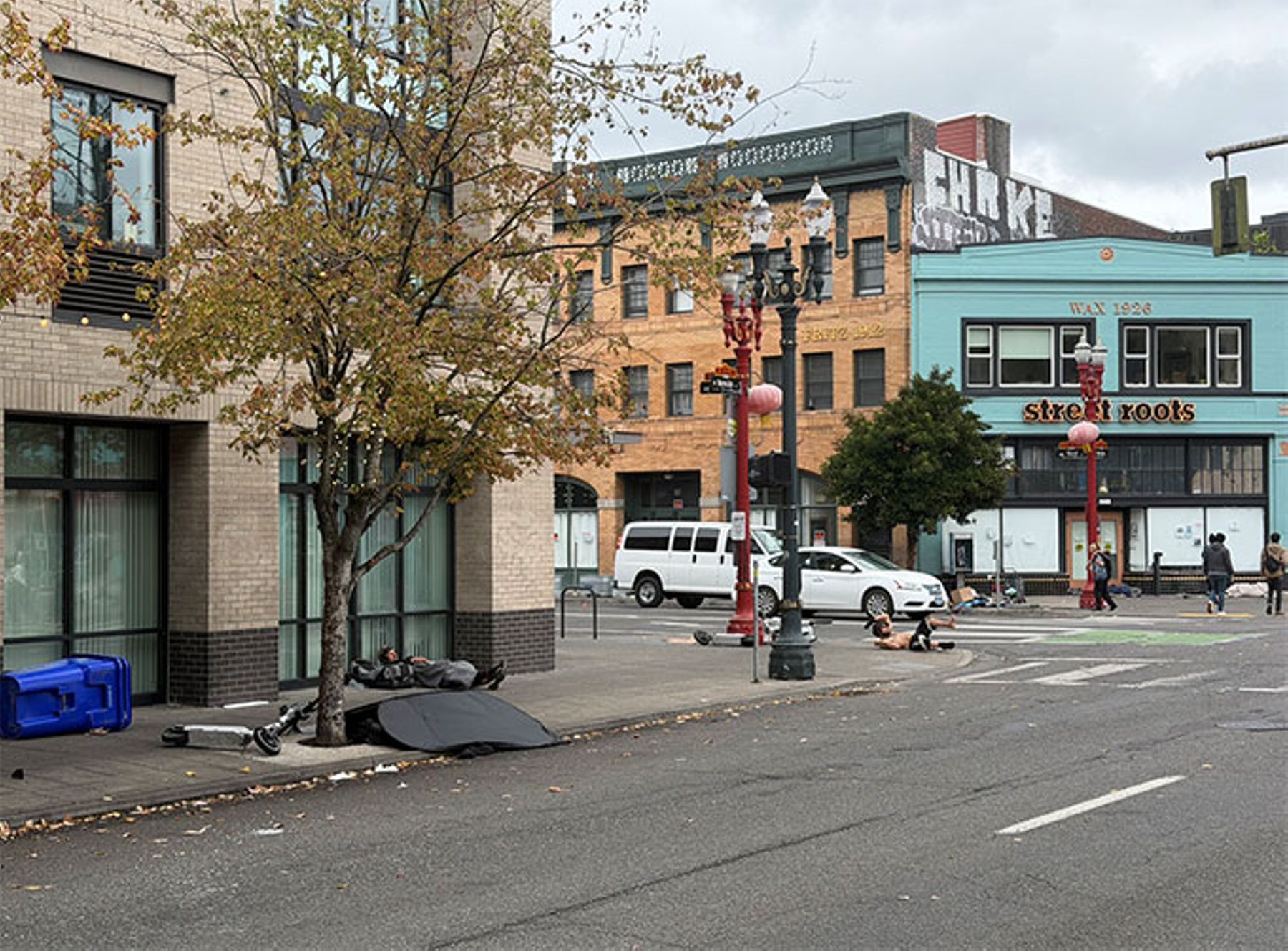
Portland, Ore.—It’s 10:30 p.m. on West Burnside Avenue. Morbid figures drag themselves up and down the street. They have erected tents on sidewalks, where they smoke meth and fentanyl, obtained for as little as a dollar. Many hunch over, “nodding out” to preserve their high. Many are in wheelchairs. Portlanders step over them on their way to a night out at the handful of bars and clubs that remain open in the area.
Scenes like these epitomize the aftermath of pandemic-era drug decriminalization, police cuts, and progressive approaches to prosecution—policies that have left Oregon’s largest city with an under-resourced, understaffed police bureau struggling to enforce basic laws. The weirdness that once attracted so many to the Rose City has devolved into pervasive disorder and squalor, turning Portland into a case study in failed urban governance.
Finally, a reason to check your email.
Sign up for our free newsletter today.
Many Portlanders I spoke with referred to their city with a tone of resignation. Some suggested that they would leave; others have already done so.
But these feelings of hopelessness are not universal, because recent years have brought a pushback. In 2024, the Oregon legislature reversed drug decriminalization; in January 2025, tough-on-crime prosecutor Nathan Vasquez took over as Multnomah County district attorney. To bolster public safety fully, though, one key step remains: give police the power to enforce the law.
A measure that would have restored funding for the Portland Police Bureau failed to make it onto November’s ballot after entrenched progressive interests brought legal challenges against it, a city hall elections insider was caught following petition-gatherers, and signatures were disqualified at disproportionately high rates. Nevertheless, the fight for Portland continues.
When the sun rises on West Burnside Avenue the following morning, the scene doesn’t look much better. A man lies with his genitals exposed. Another carries construction material down the street, swinging it at street signs as passersby cross to avoid him. Vagrants slumber on benches in well-to-do Laurelhurst Park. A woman rushes out of a CVS pharmacy, her jacket bulging with merchandise. An army of private security guards roams the streets, but the best they can do, one tells me, is “move along” anyone causing problems.
Pre-pandemic Portland already had relatively high levels of violent and property crime compared with the rest of the United States. But that did not impair the city’s rise as one of the hippest destinations in the Pacific Northwest. Between 2000 and 2019, Portland’s population grew by 24 percent, propelled by a dense downtown core of small businesses and eateries. The city became known for its tolerant culture and abundant natural beauty. “Everyone you meet in this hipster enclave . . . seems to be high on life,” editorialized a Condé Nast Traveler article in 2014.
Everything changed in 2020. That’s when those natural highs started giving way to frenzies of methamphetamine and the synthetic numbness of fentanyl after Oregon voters approved Measure 110, which decriminalized personal-use possession of all drugs. As overdoses and consumption of illegal drugs increased, so, too, did associated crimes—particularly homicide, aggravated assault, and theft. Poor policy choices compounded the effect: while month-long BLM riots damaged businesses, officials contributed to Portland’s police staffing crisis by slashing the budget of its police bureau by $15 million.
By 2025, the city had returned to pre-pandemic crime levels. But the drug problem persists, as arrests and enforcement remain significantly lower than in earlier times. Disorder remains visible everywhere, and Portland has become synonymous with urban dysfunction and crime.
Portland’s resource-constrained police bureau must contend with an environment abundant in conditions that produce crime: drug addiction, homelessness, and a sense that one can get away with it. Before touching down at the airport, I requested a ride-along from the Portland Police Bureau (PPB). The response: “We’ve temporarily paused ride-alongs at this time . . . We are currently a staffing-challenged bureau, and our priority is ensuring our officers can remain focused on core police work.”
Challenged indeed: the PPB had 809 officers on staff in 2025, amounting to 1.28 officers per 1,000 residents, versus a national rate of 3.6 officers per 1,000 residents. The force is overwhelmingly young, partly owing to mass resignations that occurred in 2021, triggering the need for new hires, many still in training. PPB told me that, factoring in paid time off, sickness, and the like, this city of over 600,000 people has approximately 60 officers on the streets at any given time.
Property crimes, particularly damaging to the goal of bringing back businesses and residents, often go unsolved. According to Brian Hughes, the PPB’s acting police chief the week I visited, the department has had “to prioritize homicide cases and put [its] limited resources towards” them. Murder counts spiked in 2020 and remain 108 percent higher in 2025 than their pre-Covid average, bucking the trend of other crime categories that have mostly returned to the (still-high) levels of 2019. Arrests remain significantly lower than in the pre-2020 period. “We don’t have any significant investigative capacity to investigate property crimes,” Hughes said.
Not that the police force isn’t trying. In recent years, the PPB has focused on restoring officer morale, and “self-initiated activities,” like traffic stops or intercepting crimes, are “up pretty significantly this year,” said Hughes.
But “a city our size should have at least 1,200 police officers,” he added. Yet despite the Portland City Council’s reversing budget cuts in 2021 with $5.2 million in additional funding to hire new officers, its authorized headcount is now lower than in 2019.
Meantime, the factors generating crime haven’t gotten much better. “Neighborhood response teams spend an inordinate amount of time addressing chronic homelessness issues and trying to get that into check,” said Hughes.
Oregon’s re-criminalization of drugs was meant to address these factors. Most of those arrested or charged with drug-related offenses receive the option to enter deflection programs, allowing them to pursue treatment rather than jail time. Of the 519 eligible for deflection in Multnomah County (where most of Portland is located) between September 2024 and August 2025, 69 percent ended up enrolling. It’s an improvement, on paper—but one that has yet to produce a visible effect. In January 2026, Multnomah County’s unsheltered homeless population stood at 8,797.
One reason the situation on the streets hasn’t improved is the still-dominant “harm reductionist” framework, which holds that cities should accept widespread drug use and instead focus on mitigating the consequences. Though Portland spent more than $700 million on homelessness in 2024, much of the spending went to harm-reduction services like distributing clean needles and administering Naloxone, rather than to addressing the ultimate cause of those harms: drug use.
“Deflection schemes are working phenomenally in some counties like Lane County, Washington County, but not here . . . because the pure harm-reduction approach still dominates,” said Rob Bovett, an adjunct professor at Lewis and Clark Law School. “Deflection doesn’t work without the initial intervention of law enforcement,” he added.
Bovett’s observation rang true as I walked across Portland. Many living on the streets suffered from both severe drug addiction and co-morbidities like schizophrenia or psychosis, making it risky for civic organizations to intervene or offer help on their own.
Other signs are more hopeful. District Attorney Nathan Vasquez is operating on the Broken Windows platform on which he campaigned, in sharp contrast to Portland’s previous district attorney, who refused to prosecute rioters and instead went after members of the police force. Tax revenue from marijuana sales and a slate of other levies mean that the money to enhance public safety exists, even if it’s not going toward policing. Portland’s main bottleneck in restoring order is therefore the under-resourcing of its police department. That problem can be solved.
Some are trying to turn things around. Earlier this year, local businesses, residents, and the police union launched the Enhanced Community Safety Initiative, a ballot measure that would have boosted funding for law enforcement without raising taxes. The measure would have obtained the funding by redirecting 25 percent of annual revenues (about $50 million) from Portland’s Clean Energy Community Benefits Fund, which, since being enacted, has raised four times its anticipated revenue. Earlier this year, officials proposed tapping $75 million of its $200 million proceeds to renovate a stadium. Portlanders largely support using these funds for policing and other essential services: 64 percent favored the idea in an independent poll.
“City Council is out of touch; my message was ‘let’s get this on the ballot,’” said long-time Portlander Bob Simril, who ran for a city council seat in 2024 and co-filed the petition.
Opposition groups quickly moved to block the measure. Progressive organizations—the Coalition of Communities of Color, Next Up Action Fund, and Portland for All—challenged it in court, unsuccessfully. Activists from the Democratic Socialists of America, the Coalition of Communities of Color, and Portland for All endorsed an alternative “participatory budgeting” proposal that would continue channeling funds toward progressive causes. After signature-gatherers for the measure began collecting the 40,437 required signatures, they were followed and filmed by individuals belonging to these groups, who filed complaints against them alleging that voters were “misled” by not being provided with the measure’s full text.
Nor did city officials act impartially. Susan Mottet, who manages a city elections program allocating funds to candidates, engaged in “overtly political” activism by secretly filming petition-gatherers, the spokesperson for the Safer Portland initiative told Oregon Live. “Media later revealed that Mottet lobbies for James Ofsink, a plaintiff in the suit to block the measure, and who leads a progressive organization and advocates for redirecting resources away from law enforcement.
In the end, supporters submitted 63,315 signatures to the City of Portland Elections Office, but the Enhanced Community Safety Initiative failed to make it onto the ballot. During pre-processing, city election officials rejected some 7,426 signatures, citing technicalities like signature variance, and renumbered the petition sheets in a way that made an audit impossible. Multnomah County’s Elections Division then rejected a further 21,759 signatures, causing it to fall short of the threshold. On September 3, a judge sided with the election officials, denied Simril’s injunction requesting a recount of excluded ballots, and officially killed the measure.
Several questions remain unanswered. A disqualification rate of 46 percent is unusual, given a nationwide disqualification rate of 21.2 percent and the fact that Fieldworks, the petition-gathering firm that the city retained, leveraged GPS-tracking and digitized page images.
“They said that 200 pages of signatures from our gatherers didn’t count because their signature didn’t match their driver’s license,” said Aaron Schmautz, who heads the Portland Police Association, in an interview with City Journal. “And then you look at them and it does [match],” he said, highlighting how advocates had retained copies of the sheets.
“The one thing the county did that was challenging is their signature verification standard was obscurely high. They were using a forensic-match type standard that, talking to the state, I don’t think is a standard that they’re supposed to use,” Schmautz added. “In Oregon, the North Star has always been enfranchising voters . . . if the standard is different, what’s going on?”
By comparison, the city pre-processing rejection rate for the DSA-backed “Participatory Budgeting” measure was 2.2 percent, versus 11.8 percent of submissions rejected by the city for the Enhanced Community Safety Initiative.
Complaints prompted Oregon’s secretary of state (who serves as the state’s chief election officer) to write to Portland officials that the “signature verification process reflects poorly on our state’s entire election system. . . . It is clear there has been a breakdown somewhere in this process.” He stopped short, however, of conducting further investigation.
Voters will not get a chance to vote on the measure in November.
But Portlanders can decide the issue indirectly, via the city council elections taking place next month. A more public-safety-minded council could pass a bill re-directing some funds from climate levies toward law enforcement, as the ballot initiative would have amended the city charter to do. Currently, a 6-6 split between the cities more moderate and progressive blocs—including Mitch Green, who reaffirmed his desire to defund the police last month—makes such a shift unlikely. But Portlanders will soon have a chance to change that.
Additional steps could be taken at the state level to address drug addiction. Currently, there is little oversight of spending from the Drug Treatment and Recovery Services Fund, established and funded largely by marijuana-tax revenues. Bovett, the Lewis & Clark Law professor, helped draft the measure that recriminalized drugs in 2024.
“It’s just basic accountability, and there’s none of that with the Measure 110 money,” he told me. “What I wanted to do is redirect the money to the programs that actually work. . . . But the ones that didn’t work wouldn’t get money.” A bill he drafted would have shifted funding to the Criminal Justice Commission. “That agency is well-respected on both sides of the legislature and gives grants for criminal justice diversionary programs while being held accountable,” he said. Though the measure failed to pass during the current legislative session, lawmakers could revisit the idea.
Finally, drug trafficking in controlled substances, contributing to both the mental health and homelessness crises worsening Portland’s crime, falls under federal as well as local jurisdiction. Many Portlanders are likely to oppose the involvement of federal agencies of any kind, but enhanced federal enforcement of drug laws, in collaboration with the cross-county Oregon-Idaho HIDTA (High Intensity Drug Trafficking Area), which facilitates cooperation on drug enforcement, could make a difference in Portland as it has elsewhere.
The Rose City has almost everything it needs to thrive—except the vital ingredient of public safety. Portlanders must decide if they’re ready to take the steps needed to achieve it.
Source: www.city-journal.org