



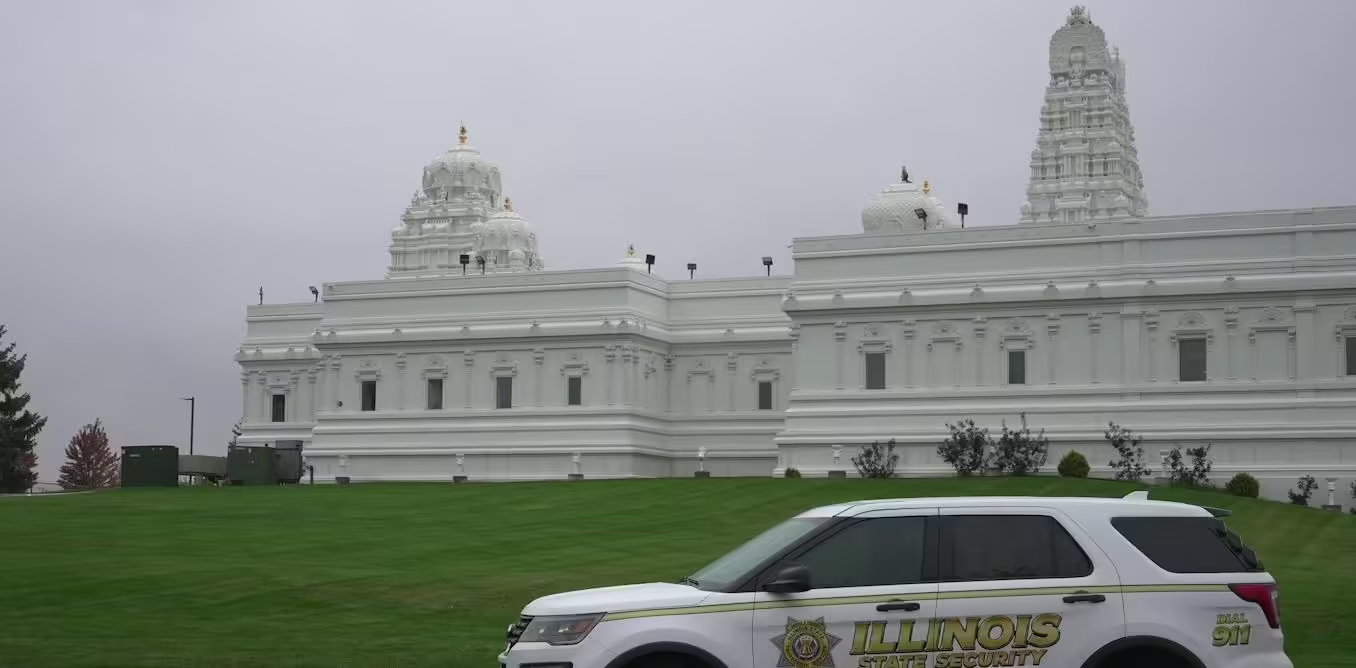

Lawmakers are calling for a failed attack on the Sri Venkateswara Swami Temple in Aurora, Illinois, to be investigated as a hate crime. On Oct. 11, 2026, as hundreds of Hindu worshippers gathered for the first day of Navaratri, a celebration of the divine feminine over nine nightsa 19-year-old man traveled to the Hindu temple, armed with a rifle and body armor, according to prosecutors. A jammed gun and a tip from the suspect’s co-worker prevented a massacre. Authorities located a manifesto written by the suspect espousing white supremacist views.
U.S. Reps. Ro Khanna, a Democrat, and Rich McCormick, a Republican, warned in a letter to the FBI and DOJ that this plot “did not emerge in isolation.” They pointed to a broader rise in hostility toward Hindu Americans and Indian Americans. A 2026 Carnegie Endowment survey found that 1 in 4 Indian American adults reported being called a slur since the start of 2025.
In September 2026, for example, Bo French, a Texas Republican candidate for state office, posted a photo of a University of Texas at Austin football game that has been viewed 54 million times. Referring to the Indian American students centered in the photo, he claimed “the problem is now obviously far worse than anyone imagined.” French’s post provoked social media responses calling for violence against Indians and desecrating Hindu temples.
French’s post said nothing about religion, yet the responses it provoked took aim at Hindu temples. As a professor of Hindu studiesI argue that this is because anti-Indian and anti-Hindu hate in the United States are deeply intertwined. Some of this hostility targets the Hindu worship of deities through sacred images, and it draws on a history of prejudice portraying Hindus as idolaters. This hate is amplified on the same online platforms that spread racial hostility.
The demonization of Hindu worship
In Hindu temples, worship centers on “murtis,” or consecrated images in which the deity is understood to be present. These temples and images have become frequent objects of online abuse.
In September 2025, Alexander Duncan, then a Republican U.S. Senate candidate in Texas, objected to a large image of the deity Hanuman in Sugar Land, Texas. He asked, “Why are we allowing a false statue of a false Hindu God to be here in Texas? We are a Christian nation!” This post was viewed over 6 million times. In August 2026, pastor Dale Partridge posted an image of the Swaminarayan Akshardham Temple in New Jersey, claiming “our 1700s Christian forefathers would have this demon temple leveled in 24 hours.”
Such rhetoric is widespread online. A September 2026 report by the Center for the Study of Organized Hate found that Hindus “have been singled out for attacks on the basis of their religion.” The report states that posts routinely refer to devotees as “demon worshippers,” deride Hindu deities and sometimes call for temples to be destroyed and replaced with “American” monuments. The report finds that these posts frame Hindu worship as “fundamentally incompatible with Christianity.”
When these posts invoke America and Christianity, they represent an outlook that sociologists Andrew Whitehead and Samuel Perry call Christian nationalism: the belief that America should be distinctively Christian. In their survey from 2017, almost a third of Americans said that the federal government should declare the United States a Christian nation.
I believe this current manifestation of Christian nationalist hostility to Hinduism is best understood in the context of the broader history of American Christian responses to Hinduism.
The long history of prejudice
As religious studies scholar Michael Altman arguesthe charge that Hindus worship false gods and idols took hold in American national culture nearly two centuries ago. Nineteenth-century American schoolbooks, shaped by Protestant beliefs, sorted religions into “true and false,” treating Hindu “idolatry” as proof of moral degradation.
In her study of Hinduism in America, scholar Vasudha Narayanan demonstrates that in the early 20th century, some Americans embraced Hindu ideas while keeping Hindus themselves at a distance. She explains that though a 1917 law barred most immigration from Asia, some Americans found inspiration in Hindu thought and yoga practices, presenting these not as Hindu but as “universal” spirituality.
Religion scholar Diana Eck estimates that after the 1965 Immigration and Nationality Act opened the door to immigrants from Asia, the population of Hindu Americans reached over 1 million by 2000.
Starting in the 1970s, these Hindus built dozens of temples. However, Eck shows that these new temples were often met with hostility. In 1983, for example, attackers desecrated a temple outside Pittsburgh, smashing sacred images and scrawling “Leave” on the temple altar. In the early 1990s, vandals spray-painted a future temple site in New Jersey with “Get out Hindoos.”
Religious studies scholar Sailaja Krishnamurti traces how this animosity continued into the 21st century. She points to the film “Indiana Jones and the Temple of Doom,” which depicted Hindus performing human sacrifice, and to televangelists such as Pat Robertson, who denounced Hinduism as “demonic.” These depictions, she argues, are reflected in violence against Hindus. In 2019, a vandal spray-painted messages about Jesus and defaced images of Hindu deities.
Reading religion as race
The Aurora suspect’s manifesto does not single out Hindus nor does it mention “false gods.” According to U.S. Rep. Raja Krishnamoorthi, the manifesto describes “Indians, Jews, Black people and other minorities as ‘sub-human.’” Yet police Chief William Nord said the suspect “was looking for a large Hindu temple.” The suspect’s hatred was expressed in racial terms, but his target was a Hindu place of worship.
Education scholar Khyati Joshi calls this blending of racial and religious animosity the “racialization of religion.” In a society where whiteness and Christianity have been treated as the norm, she argues, brown skin can serve as a stand-in for a presumed “other” faith. As a consequence of this racialization, Joshi argues that “the religious nature of discrimination is overlooked.”
She gives the example of the “Dotbusters,” a gang that attacked Indian Americans in New Jersey in the 1980s. While newspapers called the attacks “racial beatings,” the gang’s name referred to the “dot” worn by Hindu women.
From posts to violence
AP Photo/Laura Bargfeld
Krishnamoorthi, who was inside the temple with his family on the day of the attempted attack, later stated in an emotional press conference: “This shooter was radicalized by his environment. He was radicalized by social media until he told a coworker he could not wait ‘to kill Indians.’”
In tracking discrimination online, Stop AAPI Hate, a coalition tracking anti-Asian discrimination, found that South Asians were the targets of 71% of the online threats of violence against Asian groups. They note that a dominant theme of these posts was that of an “Indian invasion.”
Economists Karsten Müller and Carlo Schwarz have linked online hate to offline violence. Policy experts argue that confronting online extremism requires greater coordination across all social media companies. These scholars support a growing chorus of voices calling for accountability when hate is manifested.
Racial hatred and the demonization of Hindu gods have different sources and sometimes different voices, but on the first day of Navaratri, these forms of hate converged in a parking lot in Aurora.
In the aftermath of the failed attack, Hindu Americans are pointing to the need to speak out against both racial and religious hate.
Source: theconversation.com