


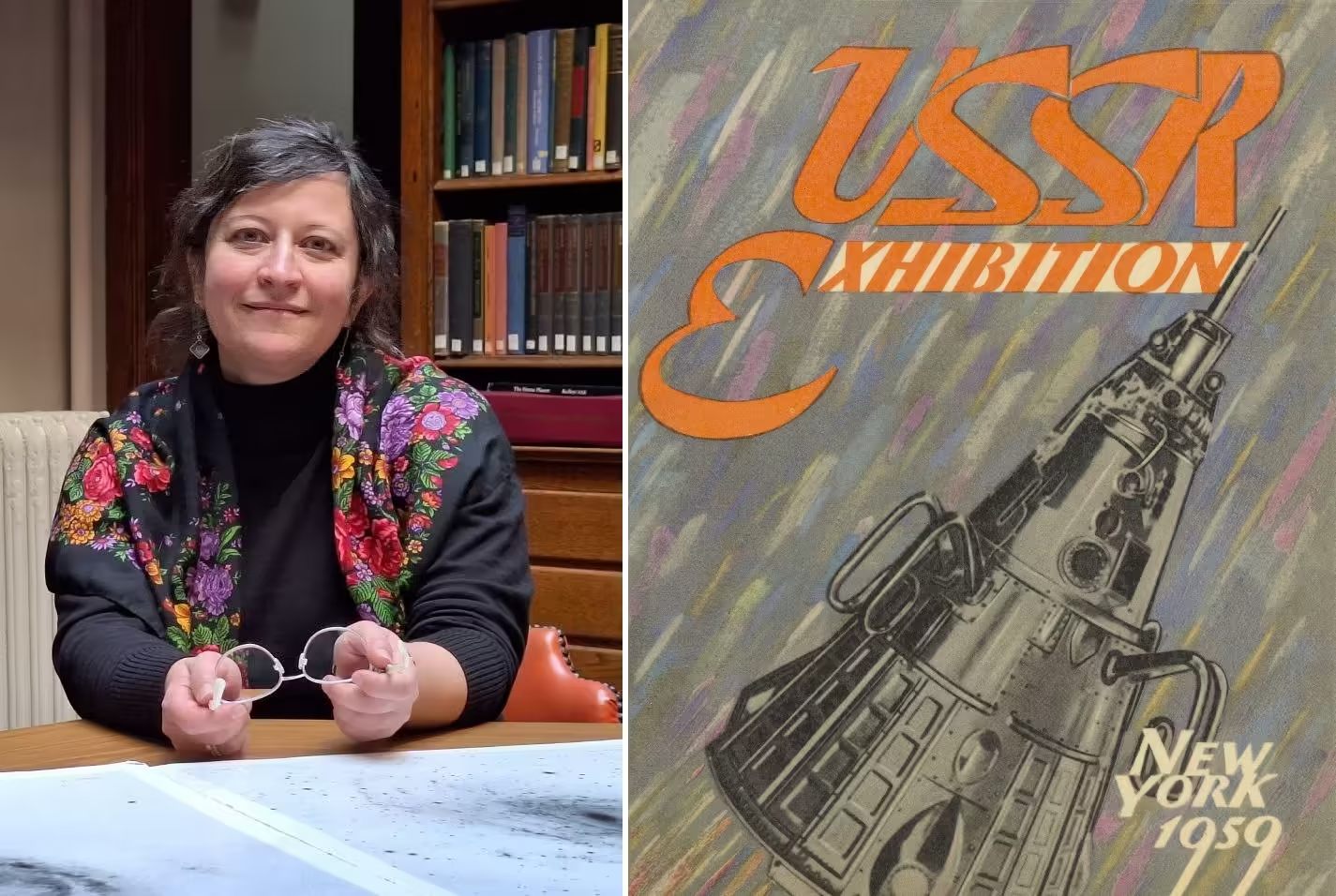

Unfolding Research is a recurring series in which people answer questions about their experiences conducting research in the Manuscript Division. Anna Doel is a historian at the American Institute of Physics and a 2024-2025 research fellow with the Consortium for History of Science, Technology and Medicine (CHSTM). Her research focuses on the intersection between the history of American and international science, Cold War studies, and Russian culture.
Tell us about yourself: Who are you, where you are from, and what were you researching?
My University of Minnesota doctoral degree is in the history of science, and my dissertation explored US-USSR exchanges and collaboration in earth and environmental sciences in the 1970s-1980s. My current book project has expanded to encompass histories of American-Soviet contacts in the natural and social sciences and the humanities over the entire span of the Cold War. I show how scientists from the United States and the Soviet Union established institutional and individual relationships, what aided or hindered this process, what those connections looked like, and why they mattered. Some participants left memoirs, diaries, and oral histories. Many wrote trip reports and kept correspondence files. My aim in archival research has been to discover and study as many accounts as I can find.
What collections did you explore while you were at the Library of Congress? What did you find that surprised you, or pushed your research in a different direction?
During my visits to the Library of Congress Manuscript Division as a Consortium for History of Science, Technology and Medicine (CHSTM) fellow, I worked with Glenn T. Seaborg’s papers and, following Josh Levy’s recommendation, Charles Herzfeld’s papers.
Seaborg (1912-1999) was an American nuclear chemist who won the Nobel Prize in Chemistry (1951) for his discovery of the chemistry of transuranium elements. He held top-tier positions in science administration in addition to pursuing a robust academic career. He also contributed to the Manhattan Project, chaired the Atomic Energy Commission for ten extremely productive years, and received many academic awards, including the National Medal of Science. During his term, President John F. Kennedy consulted Seaborg on nuclear testing capabilities of the Soviet Union.
Throughout his career, Seaborg found time to maintain extensive correspondence with numerous colleagues, committee members, and, as it turns out, distant friends. Starting in 1957, for some thirty years he corresponded with Soviet physical chemist and nuclear physicist Vitaliĭ I. Goldanskiĭ (1923-2001). Their letters address past and future meetings, specifics of recently published papers, family, arrangements for seminars during visits, and travel plans. By 1970 at the latest, they were on a first-name basis. At first glance, this exchange may look rather trivial, but to me it tells a story of mutual interest, appreciation, and determination to keep the dialogue going despite hindrances.
I keep reminding myself just how surprising the correspondence between Seaborg and Goldanskiĭ may be to a newcomer to this history. Let’s step back for a moment. Their earliest encounters in 1956-1957 preceded the US-USSR agreement on cultural exchanges (1959), which legitimized bilateral contacts between scientists. Before that agreement, keeping in touch with colleagues across the front line of the Cold War could be cumbersome and even risky. Seaborg and Goldanskiĭ must have belonged to a small group of natural scientists whose work transformed their discipline and who were authorized to share their findings, communicate with colleagues, and travel between the US and the USSR.
The content of Seaborg’s letters to other academics who, like him, were members of prize nomination committees, reveals that Seaborg made numerous attempts to solicit recognition for Goldanskiĭ’s contributions to nuclear chemistry and physics. He nominated his Soviet colleague for the 1975, 1978, and 1979 American Chemical Society’s (ACS) award for nuclear applications in chemistry, three times for membership at the National Academy of Sciences (NAS) as a foreign associate, the ACS Rochester Section’s Harrison Howe Award, and foreign membership in the American Academy of Arts and Sciences (AAAS). He also supported Goldanskiĭ’s nomination for a Nobel Prize—all in vain. Seaborg’s clout and authority, it seems, failed to overcome the reluctance of the US academic community to extend formal recognition to Soviets beyond the necessary minimum.

Those three folders of correspondence in Seaborg’s papers tell two stories I may not have learned from other sources: The inner workings of scientific recognition and awards—at least during the Cold War—contain a strong element of strategic scheming, political considerations, and divergence of priorities. And scientists not only invested time and energy in maintaining individual relationships but also saw emotional value in supporting colleagues and honoring their work. This reveals the porousness of the Iron Curtain against the backdrop of fierce competition between the US and the USSR as well as presence of an emotional component in scientific communication.
What other archives did you visit over the course of this project? How did the Library fit into that geography of archives?
For my project, three types of repositories yield the most information: university and research entity faculty records, scientific society archives, and federal department collections. Every archive I visit, even ones I walk into blindly with no expectations or preliminary research, has useful information. One of the huge benefits of the CHSTM fellowships is recommendations from Consortium member institutions. Every applicant lists archives they wish to consult and the fellowship, if awarded, provides funding and research support for visiting them. In addition, archivists and librarians from all CHSTM member institutions evaluate applications. I did not list the University of Illinois Urbana-Champaign (UIUC) archives and the National Library of Medicine (NLM)—it simply didn’t occur to me that they may have relevant materials. Archivists from both repositories volunteered to host me during the fellowship. I learned incredibly interesting stories at UIUC and NLM that will be featured in the book.
The Library of Congress was on my list, of course. It stands out because of its massive scale and scope of its collections. And I am lucky that the Manuscript Division hosts individual scientists’ papers and records of institutions like the International Research and Exchanges Board and the American Council of Learned Societies. At the same time, the Library is at the center—geographically and metaphorically—of the science-intensive DC-area archives.
Were there archival sources you were hoping to find, but that no institutions seemed to have collected? Are there ways archives can better support projects like yours?
One of my go-to archival sources is letters people wrote to each other to stay in touch across long distances. Every now and again I find myself having a moment of disappointment working in a repository’s reading room. A letter says, for example, “I am putting in this envelope some photos from our research cruise. Hope you enjoy these mementos of a happy time and a great adventure.” Can you imagine my anticipation as a researcher on a treasure hunt? Then comes the sadness: the photographs aren’t in the folder and sometimes their location is unknown. They may have been removed before the repository acquired the collection. Often, I expect to find more images in the archives than I end up seeing, mostly because they don’t just illustrate the documents or “put faces to names.” They tell their own stories but I also appreciate any help archivists are willing to offer in locating relevant images in the records.
What advice would you give to graduate students and early career scholars who are just beginning to work in archives?
The best recommendation I can give is that archivists are our friends. A historian’s first acquaintance with archives is a humbling experience. In that moment you realize that an archive is huge and it does not exist solely to serve your needs and interests. Archivists know how to navigate that complex landscape in ways that I may not. Making an effort to get to know archivists and seek their expertise in locating sources beyond your list of requests is a huge benefit to a scholar. Another important point is that no two archives have identical structures. Taking the time to understand the scope of the collections and “flavor” of an archive has always served me well. And I learn secrets! An archivist in the Library of Congress Manuscript Division reading room told me about the pneumatic mail system that the Library previously used to circulate messages, requests, and materials. The system was dismantled, but artifacts and photographs survive—and I got to see them.

Do you want more stories like this? Then subscribe to Unfolding History – it’s free!
Source: blogs.loc.gov

