



By Elias Thorsson
October 8, 2026

Asked directly at the Arctic Circle Assembly what the United States is doing about climate change, two of President Donald Trump’s appointees to the U.S. Arctic Research Commission talked about Alaska’s renewable energy potential, a landslide-triggered tsunami and disaster preparedness. Neither mentioned emissions or said what Washington is doing about the causes of Arctic warming.
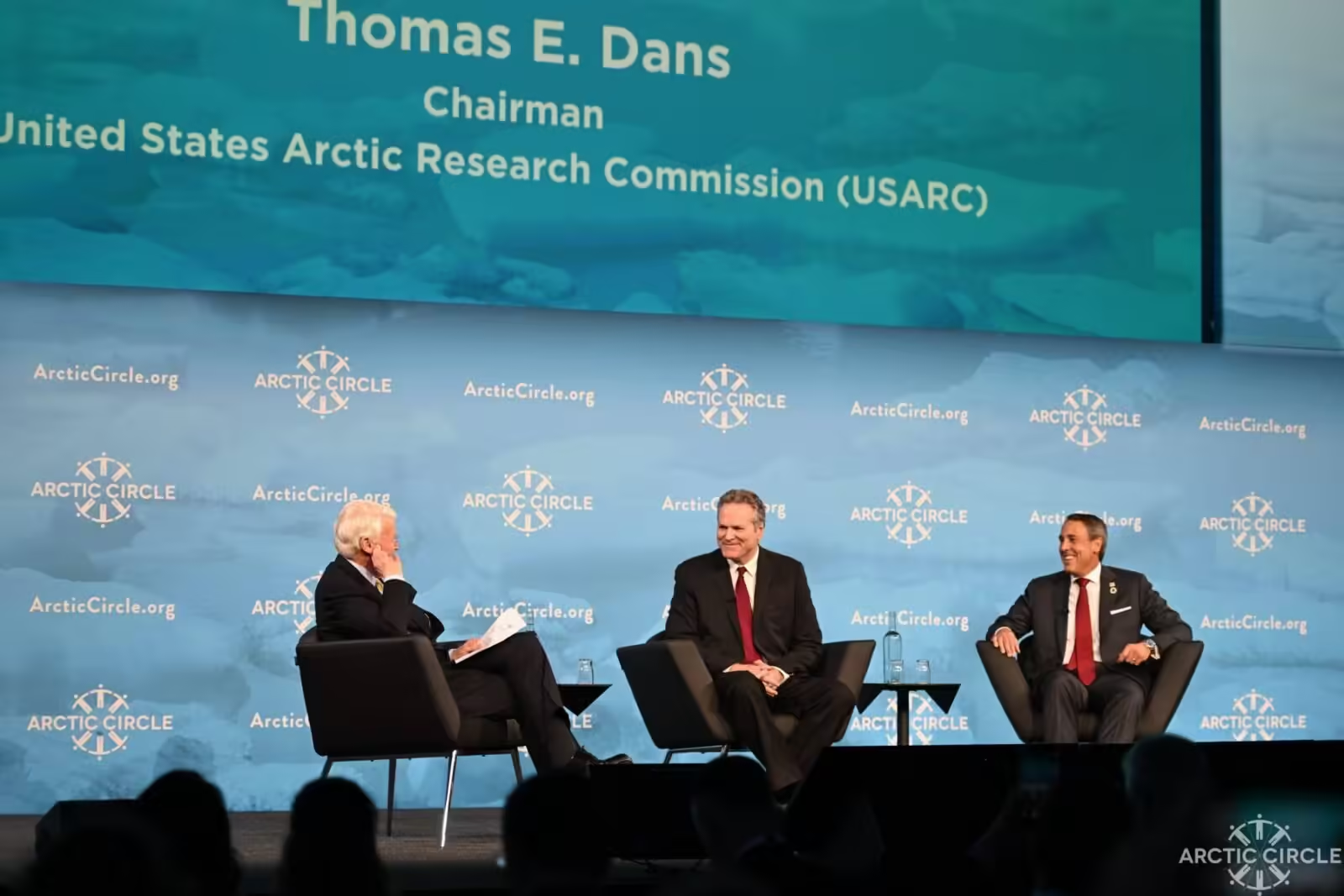
Alaska Gov. Mike Dunleavy, a commissioner, and Thomas Dans, the commission’s chair, appeared together Thursday at Harpa in Reykjavík in a session titled “The United States in the Arctic.” It was moderated by Arctic Circle chair and former Icelandic President Ólafur Ragnar Grímsson. The commission advises the White House and Congress on Arctic research. Both men had used their opening remarks to tout military and energy investment in Alaska.
The first question from the floor came from an audience member studying coastal and marine management at the University Centre of the Westfjords. He noted that the officials had “mostly mentioned defense and extracting resources, not much about climate change,” and asked them to “speak to climate change and what we’re doing in the United States to help.” The question drew applause from an audience made up largely of Arctic researchers, policymakers and officials.
Dunleavy answered first. “It’s not to deflect the question,” he said, before describing Alaska’s renewable resources: geothermal potential he called “probably equal to Iceland’s,” tidal power in Cook Inlet, wind, and the 50 solar panels on his own property.
He then acknowledged that climate had come up less in his dealings with Washington. Compared with energy, defense and infrastructure, he said, there had been “less conversations with the White House and White House officials on climate in the Arctic.”
“But again, not to deflect that,” he said, handing the question to Dans.
Dans said early U.S. science in the Arctic focused on documenting the natural environment, and that much of that record has never been digitized. “There’s no debate that things are changing,” he said, describing the administration’s disposition as “we’re about action, we’re moving forward.”
He pointed to the August 2025 landslide in Alaska’s Tracy Arm fjord. It sent a tsunami 1,580 feet (481 meters) up the opposite slope, the second-highest run-up ever recorded, in a fjord cruise ships visit daily. He listed it alongside the 1912 Novarupta eruption and the 1964 Good Friday earthquake as hazards that call for better monitoring and safety protocols. “We’re focused on response and the safety of the people,” he said.
The exchange comes as the Trump administration has dismantled much of U.S. climate policy. Trump told the U.N. General Assembly in September 2025 that climate change was “the greatest con job ever perpetrated on the world,” and the United States formally left the Paris Agreement in January.
The next question came from Sérgio Henrique Faria of the Basque Centre for Climate Change, whose institution, he noted, has climate change “already in the name.” He asked how the administration’s plans fit with Alaska’s Indigenous communities and with a changing climate.
Dunleavy said there is “no monolithic view coming out of the Indigenous populations of Alaska with regard to climate change.” He said studies had shown the average life expectancy of Indigenous people had risen by 13 years since oil production began on the North Slope.
“Everyone realizes, as Tom said, that the climate is changing, that the Arctic is warming,” he said. “But a lot of that is not occurring because of Alaska. A lot of that is occurring because of activities in other parts of the world.” He added that he did not want to get into a long discussion of “cyclical issues.”
Dans said the administration was “not drawing so many distinctions” between Alaska Natives and other residents. “You’re Americans to us,” he said. “We can’t focus just on one small group.”
The quadruple win
Elsewhere in the session, Dans called the U.S.-Denmark-Greenland defense agreement signed in New York on Sept. 22 a “historic win, win, win deal” and suggested Iceland would become part of it. “I think you’re going to add another win to that, which is going to be Iceland as another partner here,” he said. He said he expected Icelanders to bring “a lot of logistical support” to what he described as the first U.S. actions under the agreement: reopening the former Bluie West One base at Narsarsuaq and establishing a U.S. presence at Mestersvig on Greenland’s east coast. The Icelandic government has not announced any role in the arrangement.
Neither Prime Minister Kristrún Frostadóttir nor Foreign Minister Þorgerður Katrín Gunnarsdóttir is attending this year’s Assembly. Gunnarsdóttir hosted US Secretary of State Marco Rubio in Reykjavík on Tuesday.
Source: www.arctictoday.com