



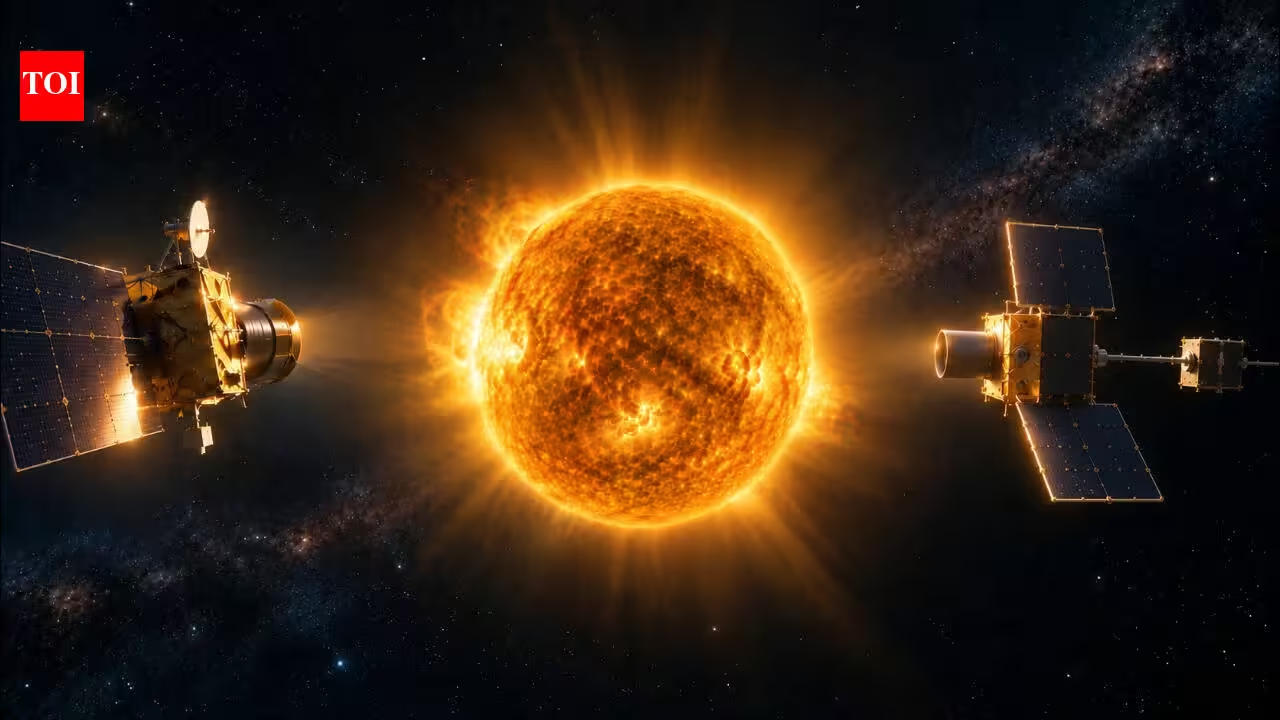

The Sun may look steady from Earth, but its outer atmosphere is a theatre of violent eruptions that hurl vast quantities of material into space. Understanding how these eruptions begin and develop matters for the study of space weather and its effects on the environment around Earth. Observing them close to the Sun, however, has long been a challenge.For the first time, researchers have jointly analysed observations of the same coronal mass ejections (CMEs) recorded by India’s Aditya-L1 mission and the European Space Agency’s (ESA) Proba-3 mission.The team examined two eruptions seen on September 14 and 16, 2025. The first travelled at around 645 km per second, while the second moved at about 145 km per second. By combining data from the two missions, scientists studied the eruptions’ mass, density and energy, getting a closer view of how they evolve in the region near the Sun.The study was led by researchers at the Indian Institute of Astrophysics (IIA), Bengaluru, along with international collaborators, and has been published in the journal ‘Astronomy & Astrophysics.’
What is a Coronal Mass Ejection, and why does it matter
A CME is a large-scale expulsion of magnetised plasma from the Sun into space. Plasma is a state of matter in which charged particles move freely, and the Sun’s outer atmosphere, called the corona, contains this extremely hot material. During a CME, large amounts of plasma and magnetic fields are thrown outwards.
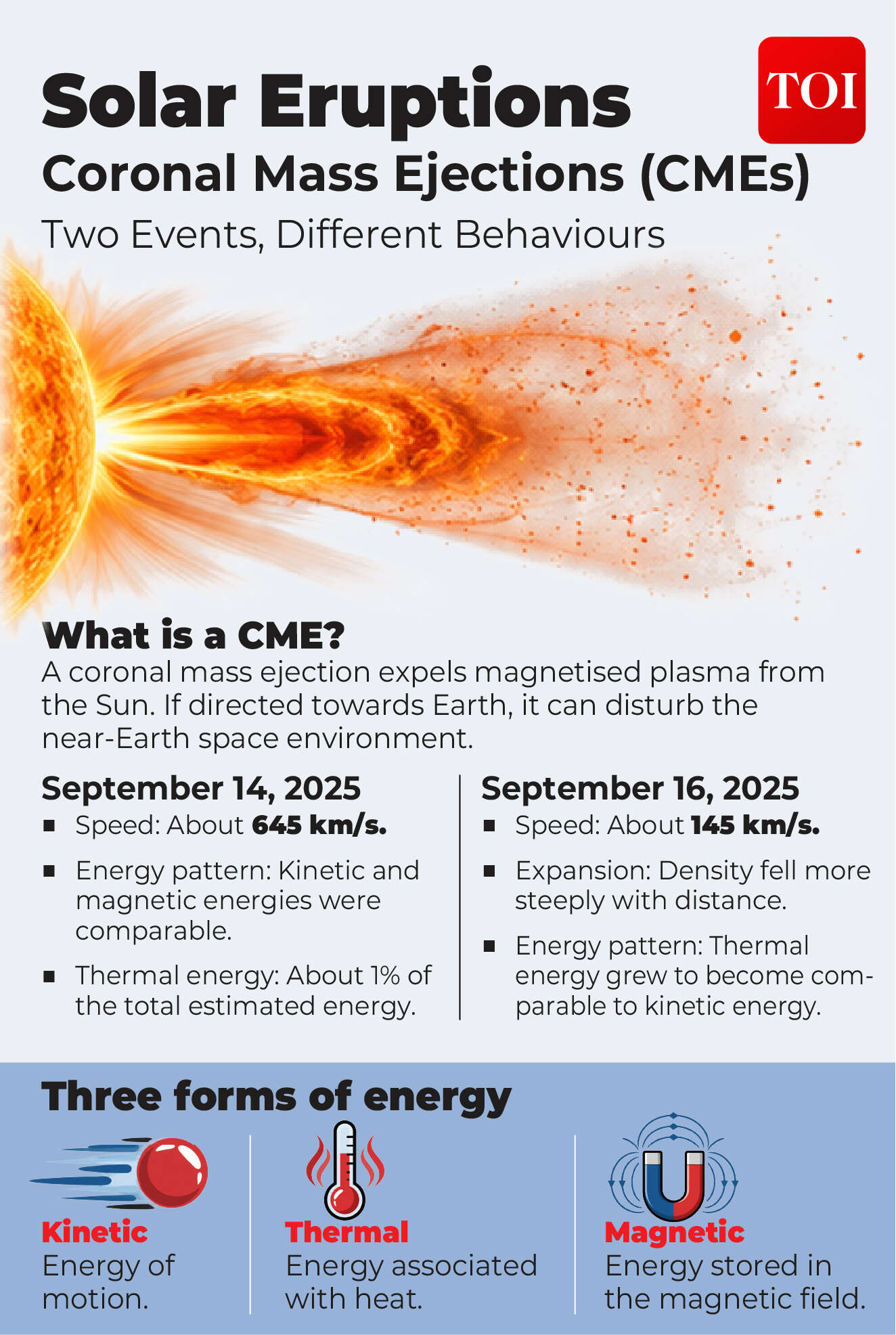
What are Coronal Mass Ejections?
Not every eruption affects Earth. But when a CME is directed towards our planet, it can disturb the near-Earth space environment, producing what scientists study as space-weather effects.How a CME behaves depends on several properties, including its mass, density, speed and energy, all of which change as it expands and moves away from the Sun.The difficulty is that scientists have found it hard to track CMEs in their earliest stages, close to the Sun. Older space-based coronagraphs provided valuable data but struggled to observe faint eruptions and follow their early evolution. Observations at these heights also suffered from gaps in coverage and limited detail.As a result, there has been little observational evidence on how a CME’s energy is divided between its motion, heat and magnetic field in the inner corona. This matters because processes near an eruption’s origin shape how it evolves later, and studying a CME only after it has travelled far from the Sun cannot fully replace observing its early development.
How the two missions complement each other
Aditya-L1 and Proba-3 are separate missions, but their instruments can complement each other when looking at the same part of the Sun.Aditya-L1, India’s first dedicated solar mission, was launched on board the PSLV-C57 rocket on September 2, 2023. It was placed in a halo orbit around the Sun-Earth L1 point on January 6, 2024, a vantage point for observing solar phenomena.
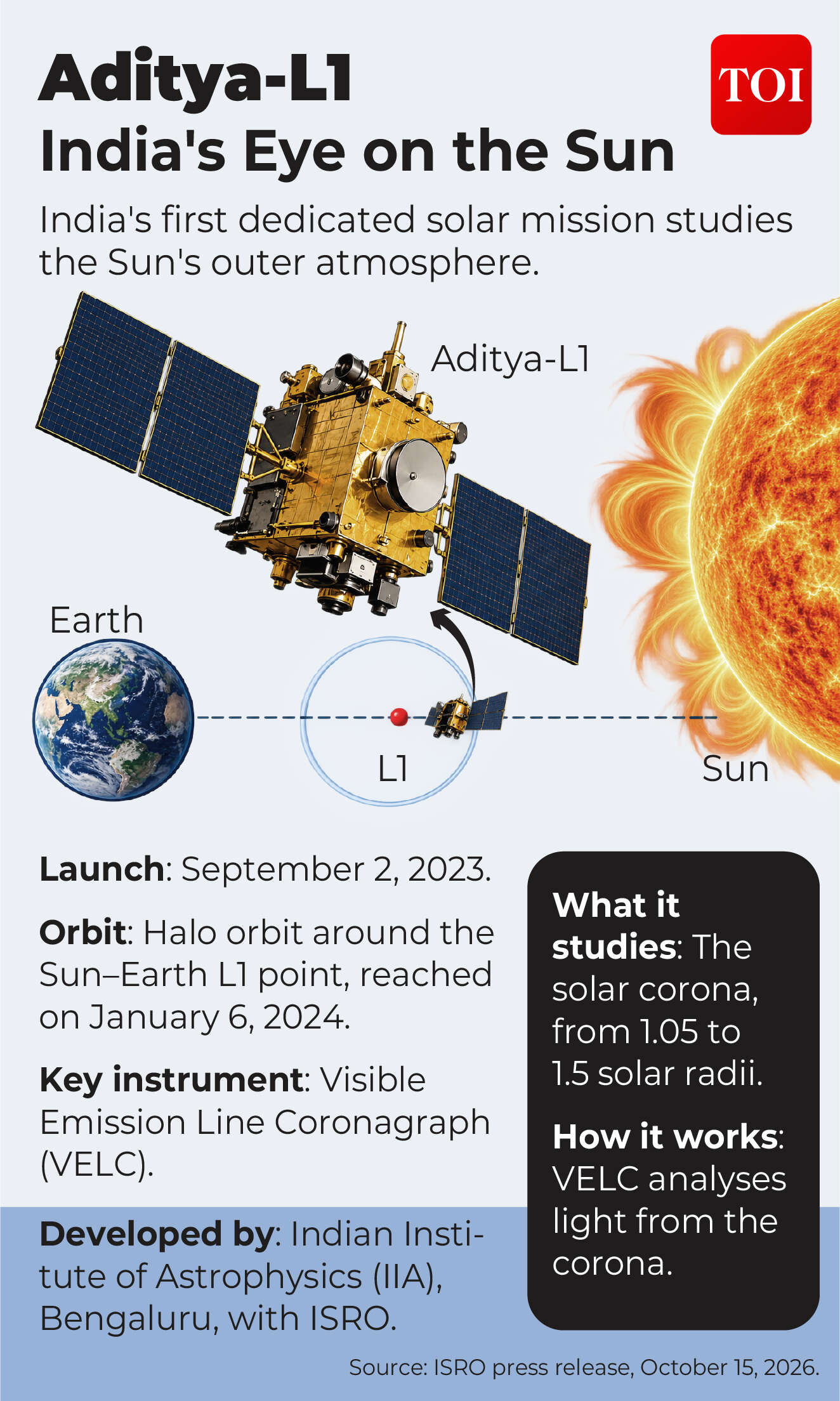
Aditya-L1
One of its instruments, the Visible Emission Line Coronagraph (VELC), was developed by the IIA in collaboration with the Indian Space Research Organisation (Isro). VELC studies the corona through spectroscopy, a technique that analyses the properties of light to learn about the material emitting it. In this study, VELC’s observations in the green coronal emission line helped researchers examine the hot gas associated with the eruptions, including estimates of density and thermal energy.Proba-3, an ESA mission, was launched on board India’s PSLV-XL rocket from Sriharikota on December 5, 2024. Its defining feature is that it comprises two spacecraft that fly in precise formation, roughly 150 metres apart.This arrangement lets one spacecraft cast a shadow on the other, creating an artificial solar eclipse in space. That allows the Association of Spacecraft for Polarimetric and Imaging Investigation of the Corona of the Sun (ASPIICS) coronagraph to observe the Sun’s faint outer atmosphere, which is otherwise hard to see against the glare of the solar disc.ASPIICS observes the corona from about 1.1 to three solar radii, while VELC covers roughly 1.05 to 1.5 solar radii. This overlap lets the two instruments view some of the same structures.
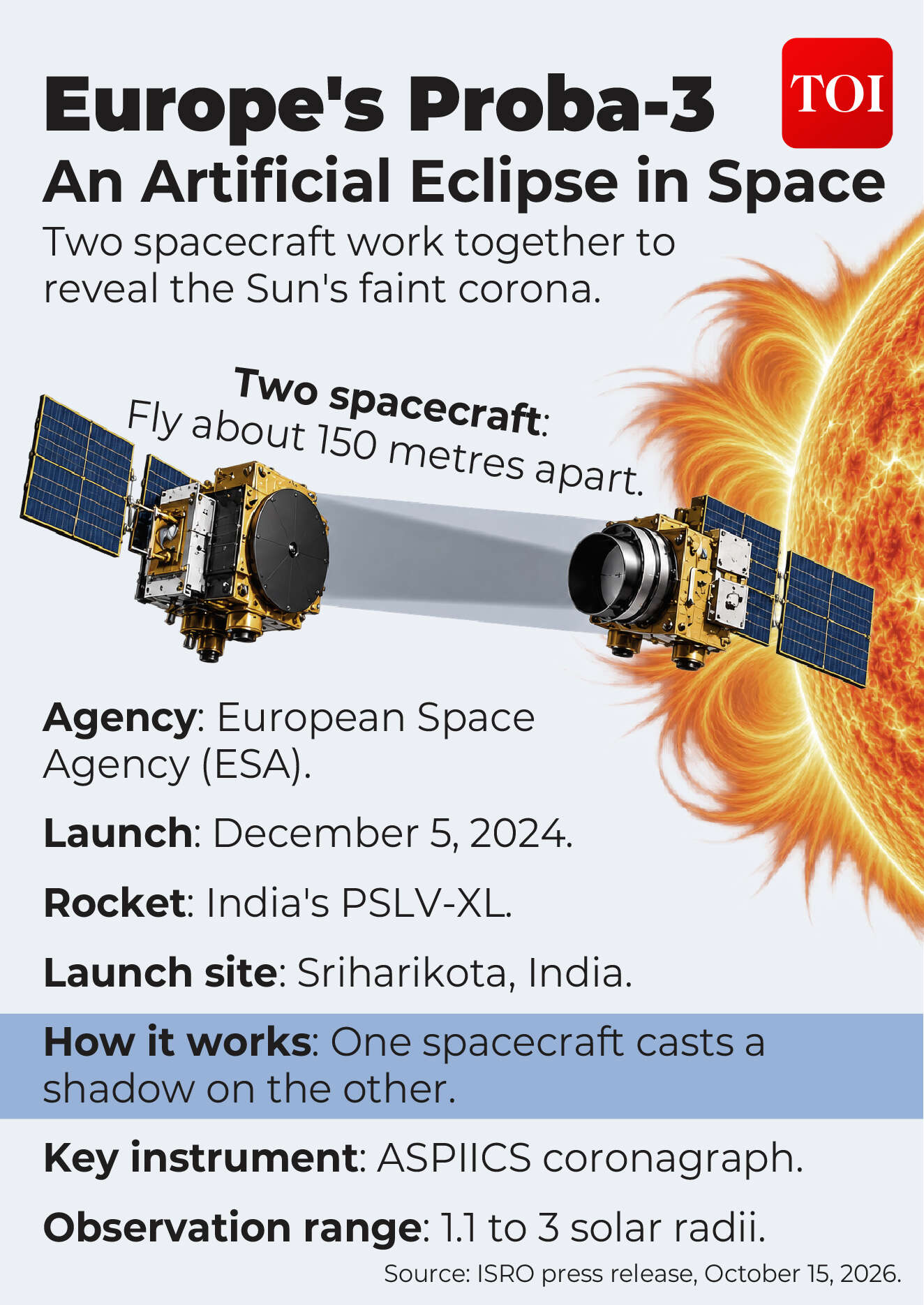
Europe’s Proba-3 was launched by Isro.
Their roles differ. ASPIICS images help scientists estimate a CME’s shape, movement and mass. VELC’s spectroscopy reveals details of the hot plasma, enabling estimates of its density and thermal energy. Comparing the two let the team cross-check certain measurements derived through different techniques and assumptions.However, the collaboration was not a merger of the two missions. It involved coordinating their observations to study the same solar events.
What did scientists look at
The research focused on the mass, density and energy of the two CMEs seen simultaneously by VELC and ASPIICS on September 14 and 16, 2025.Proba-3’s instrument recorded more than ten CMEs during the July-December 2025 period examined by the team, but only two were observed by both instruments at the same time. These gave researchers a chance to compare the observations directly.The team studied three forms of energy linked to the eruptions. Kinetic energy is the energy of motion and, for a CME, depends on the mass of the ejected material and its speed. Thermal energy relates to the heat of the plasma, while magnetic energy is stored in the magnetic field.ASPIICS images were used to estimate the eruptions’ mass, volume, density and movement, while VELC provided independent estimates of plasma properties such as density and thermal energy. The researchers then examined how the different energy components changed as the eruptions moved outwards through the inner corona.A key question was whether the two instruments, despite using different techniques and assumptions, would give broadly consistent estimates of the same physical properties. The comparison was valuable because images reveal structures and motion across a wider field, while spectroscopy sheds light on the material and its physical conditions.
What the findings show
The two eruptions behaved differently, both in their motion and in how their energy was distributed.The September 14 CME was the faster one, at about 645 km per second. The September 16 event was far slower, at around 145 km per second. The density of the second CME also fell more steeply with distance from the Sun, indicating stronger early expansion.Energy distribution differed as well. For the September 14 event, the estimated kinetic and magnetic energies were comparable, with thermal energy making up only about one per cent of the total. For the September 16 event, thermal energy rose during the observed propagation and eventually became comparable to kinetic energy.In both cases, the estimated magnetic energy was comparable to or greater than the kinetic energy over the observed height range. However, these magnetic-energy figures are lower-limit estimates, not direct measurements.Another notable result was that the mass and thermal-energy estimates from the two instruments agreed well, despite their different observational constraints and geometric assumptions. This supports the potential of combining imaging and spectroscopy to study CMEs close to the Sun.
What remains unknown
The findings come with caveats. The study examined only two relatively weak eruptions, so the results cannot establish a universal pattern for all CMEs. The researchers also had to make assumptions while estimating energy, especially magnetic energy, because direct measurements of the magnetic field and plasma temperature at the relevant heights were not available.The authors say observations of a larger sample of CMEs, including stronger eruptions, would help test the findings. Coordinated observations combined with measurements taken closer to the Sun could also offer firmer constraints on how eruptions develop.The study does not establish a new operational space-weather forecasting system. Rather, it demonstrates the scientific potential of using two complementary instruments to understand the early evolution of solar eruptions.Its wider significance lies in the approach: by observing eruptions near their origin and comparing independent measurements, scientists can better understand the physical processes that govern their development. That knowledge can feed into future research on how solar eruptions evolve as they travel through space and, when aimed at Earth, disturb the planet’s neighbourhood.
Source: timesofindia.indiatimes.com