
Listen to this article
Estimated 5 minutes
The audio version of this article is generated by AI-based technology. Mispronunciations can occur. We are working with our partners to continually review and improve the results.
When Payam Akhavan talks about the Trump administration’s new, sweeping sanctions on the International Criminal Court, the first feeling he brings up is despair.
“These institutions, which were once sacrosanct, are besieged,” said Akhavan, a Canadian who was appointed as a special adviser on genocide at the ICC in 2021.
The United States government, in the words of U.S. Secretary of State Marco Rubio, is now working to “dismantle the ICC, piece by piece.”
But Akhavan says it’s not too late to stand up for the court.
“Canada is at a historical juncture where it has to choose which side of history it’s going to be on,” said Akhavan, who now holds the human rights chair at Massey College.
“Will it continue not just to support the rule of international law, but to double down?”
On Friday, the U.S. announced it would cut off the ICC from American financial services, technology companies and even U.S. dollars within six months. The court investigates and tries individuals accused of war crimes, genocide, crimes against humanity and the crime of aggression.

Navanethem (Navi) Pillay, a former United Nations high commissioner for human rights and now a judge on the International Court of Justice, was awarded the Nobel Peace Prize in Oslo on Friday.
The U.S. has been pushing to dismantle the ICC over its investigations into the United States and its allies, including Israel. U.S. President Donald Trump strongly opposes the ICC arrest warrants issued for Israeli officials including Prime Minister Benjamin Netanyahu. The U.S. has long rejected the court’s authority to investigate, charge and prosecute American service members, treating it as a threat to national sovereignty.
Neither the U.S. nor Israel are parties to the Rome Statute, which established the ICC.
After the sanctions were announced, Canada released a joint statement along with Denmark, Germany, France, Italy, Japan, the Netherlands and the United Kingdom, expressing “unwavering support for the independence, impartiality and integrity of the ICC.”
Akhavan says Canada must go further. He and other Canadian legal professionals are calling on the federal government to take action to strengthen the ICC through additional funding or other measures.
What does ‘unwavering support’ mean?
The initial joint statement did not mention any concrete actions being taken.
“We remain both united in our support for the ICC and committed to engaging in constructive and inclusive dialogue with non-states parties,” it said.
Heidi Matthews, who has researched international law for two decades, is scratching her head about what that could mean.
“We would assume [non-state parties] means the United States here,” said Matthews.
But given “how aggressively the Trump administration has been moving against the ICC,” holding constructive dialogue with the U.S. is “almost impossible to see,” said Matthews, who teaches international criminal law at Osgoode Hall Law School at York University and previously worked in the international criminal tribunal prosecuting human rights violations in Sierra Leone.
The administration’s previous moves against the court included sanctioning individual judges, such as Canadian Kimberly Prost.
Matthews says a stronger statement would have clearly recommitted the allies’ support for their obligations under the Rome Statute, “including to arrest and surrender accused criminals.”
The joint statement appears to instead be “an attempt to appease the Trump administration,” said Matthews, and a signal that the independence of the court is up for discussion.
“If the independence of the court is on the table as something that Canada and others are willing to allow to be eroded in one manner or another, then the court is no longer worth the paper that the Rome Statute is written on.”
What can Canada do?
Matthews agrees with Akhavan that Canada should put its money where its mouth is by increasing financial support for the court.
She’d also like the government to put in place legislation that would protect Canadian ICC staff by preventing Canadian companies from complying with the U.S. sanctions — similar to the EU blocking statute.
That legislation can be used to essentially stop a third party’s laws from controlling activities on another sovereign territory.
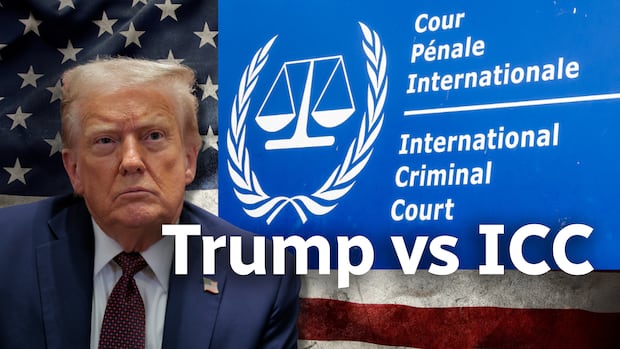
U.S. President Donald Trump has imposed sanctions against four International Criminal Court (ICC) judges. About That producer Anand Ram examines the complicated relationship between the U.S. and the ICC and explains why the Trump administration is now ramping up attacks against the international body.
Images provided by Getty Images, The Canadian Press and Reuters.
She says Canada must provide a much stronger signal of its support for the court, whose roots go back to the Nuremberg trials that prosecuted the architects of the Holocaust.
“If we’re no longer interested in prosecuting state officials who are engaged in mass atrocity, then I think we’re no longer interested in what [Prime Minister Mark] Carney so happily refers to as the international rules-based order.”
Akhavan says the ICC does have room for improvement, such as its governance and increasing efficiency.
“The question is not that we cannot criticize the court,” he said. “But to try and dismantle it as a whole I think is really an attack on the idea of the rule of international law.”
Source: www.cbc.ca