




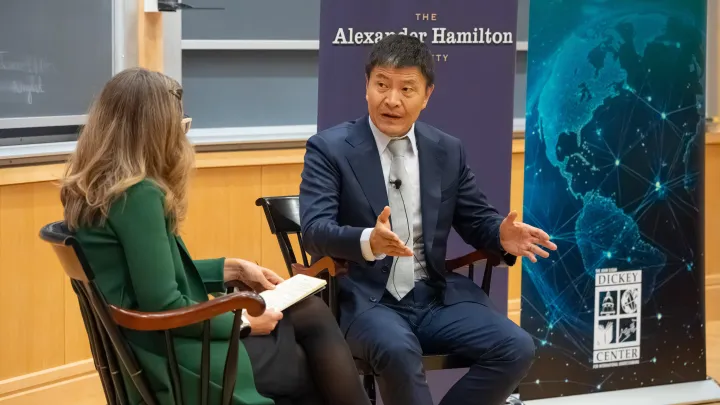

When Zhou Fengsuo helped organize student protests in Beijing’s Tiananmen Square in 1989, he and his fellow pro-democracy activists looked to the United States as a model of democracy.
Today, the U.S. would no longer serve as that shining example, Zhou said during an Oct. 12 talk co-sponsored by the Davidson Institute for Global Security at the John Sloan Dickey Center for International Understanding and the student-run Alexander Hamilton Society.
“A few years ago, most people would still think of American democracy as the blueprint,” he said. “Now probably people have other thoughts, because we are seeing the encroachment of people’s rights, and the unconstrained power on the top. That’s not what we want to see.”
Zhou’s one-hour talk, moderated by former U.S. diplomat Elizabeth Shackelfordnow a distinguished lecturer at the Dickey Center, focused on activism, digital totalitarianism, and the future of China.
Zhou was a physics student at Tsinghua University when he helped organize the protests, which included news footage seen around the world of a protester staring down a Chinese tank.
Zhou Fengsuo autographs a Chinese newspaper clipping from June 1989 displaying the student leaders wanted by the Chinese government following the Tiananmen Square protests. (Photo by Ben Joel ’27)
At the time, Zhou served on the Standing Committee of the Beijing Students’ Autonomous Union, founded the protests’ official radio station, The Voice of the Student Movement, and coordinated medical assistance for hunger-striking protesters.
Hundreds of protesters and other civilians were killed, and thousands injured, during the government crackdown, and tens of thousands were arrested, according to Amnesty International.
After the crackdown, Zhou was beaten and spent a year in jail, he said. “For me this was also a call of duty. I have become the face of this protest.”
Zhou was listed number five on the government’s most-wanted list and was forced into exile in the United States. He has spent the decades since as an advocate for democracy in China.
Zhou is executive director of Human Rights in China, and his recent work focuses on combating the Chinese Communist Party’s use of artificial intelligence and digital surveillance tools to suppress dissent.
People today often ask Zhou how he leads a normal life.
Zhou Fengsuo talks with students after his Davidson Institute talk. (Photo by Ben Joel ’27)
“This is the part we can choose,” he said. “I want to choose to be free even though I’m fully aware of what’s against me, to protect myself.”
Intimidation tactics continue, he said, including a car stopping so someone inside could take his picture following an event a few years ago in Berkeley, California. “They want me to be afraid; they want me to know I’m being followed,” he said.
Zhou said widespread surveillance and a constant crackdown on dissent by the communist government in China make it hard to imagine another powerful pro-democracy uprising.
“I think today is a different stage there,” he told around 70 people who attended the event in the Haldeman Center. (Another 100 watched the livestream.) “It’s really hard to find that consensus now.”
Sophia Calkins ’28, a War and Peace Fellow with the Davidson Institute, introduces Zhou Fengsuo before his talk. (Photo by Ben Joel ’27)
Comparing today’s China to 1989, he added: “I think we were fortunate … at that time to represent, I think, what we believed was the consensus of Chinese people, even though most people dare not to speak out.”
During questions from the audience, Caleb Smith ’30 asked Zhou how he prepares for and considers the dangers that aren’t just physical, like intimidation in person or online.
“We have to protect ourselves,” Zhou said. “So, we watch very carefully what’s happening.”
One concern he noted is when someone returns to China and is arrested for something done while in another country, calling it “transnational repression.” He cited China’s arrest of an “internet freedom researcher” who while visiting the United States invented a way to get around China’s internet firewall.
Shackelford said attacks have increased on protesters and free speech here and abroad. She asked Zhou how people should “weigh the risks” to affect change.
“What we did in 1989, I think, was remembered as a tragedy,” he said. “But … it was probably the most peaceful protest ever. I think this is very important, to keep it peaceful. And we were also adaptive. So, if you want to bring along a lot of the public, be peaceful.”
Source: home.dartmouth.edu

