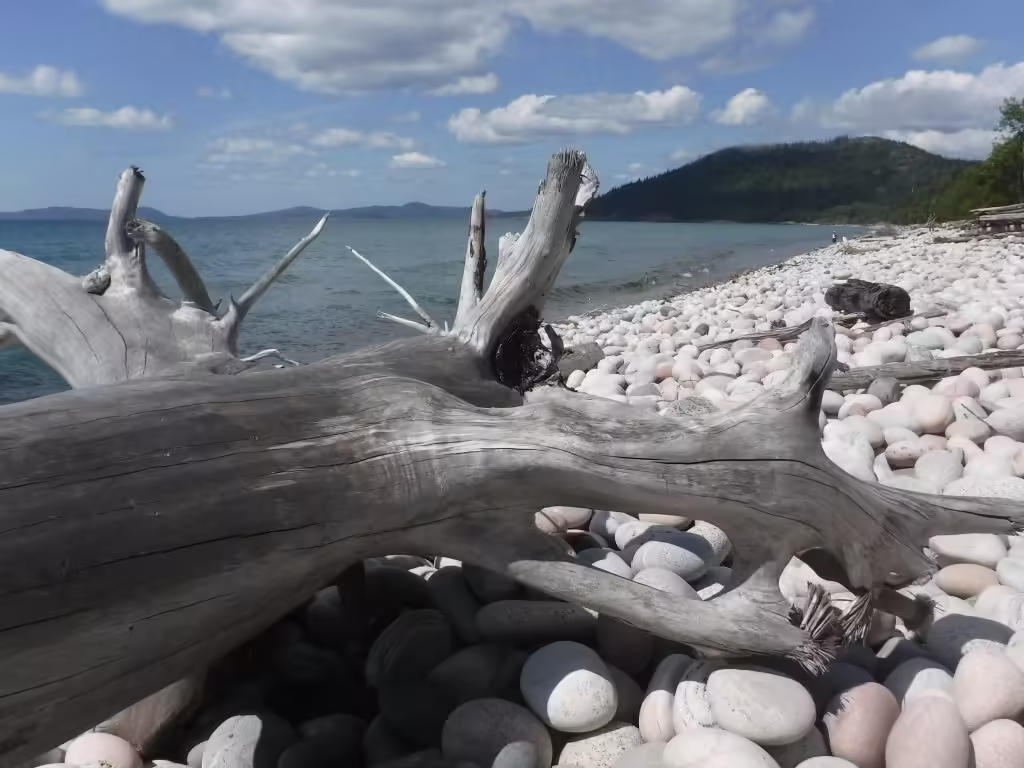

The sound was both haunting and mesmerizing. It fully immersed us in the surrounding landscape and the vast body of water beyond the overlook where we stood.
The opening of a song came into my head then. It begins with this same sound—a loon calling. The song is “Wheat Kings” by the iconic Canadian band, The Tragically Hip.
Sundown in the Paris of the prairies
Wheat kings have all treasures buried
And all you hear are the rusty breezes
Pushing around the weathervane Jesus
–Lyrics from the song “Wheat Kings” on the album Fully Completely

We were standing on a solid outcrop of Canadian Shield rock and watching a pair of loons calmly floating on the chill waters of Lake Superior. Low clouds hung to the west on the reposed figure of the Sleeping Giant and the air was dead-calm. We warded off thoughts that the next day we’d be heading back to “the states” after an amazing week camping on the Ontario shores of the lake. We were feeling both grateful and sad. As if on cue, a loon began to call and was quickly answered by its mate. Somewhere nearby, but out-of-sight, another pair eventually joined in the exchange.
Part of me was immediately transported back to 1994 when I first passed through this area. That was when I was headed west to Seattle, seeking a new start in my life. My trusty Toyota Corolla was fully loaded—trunk, back seats and passenger seat—with whatever I could fit into it. A road bike and a mountain bike were securely perched on the roof rack. I had no job waiting for me there but at least had a place to live with a good friend who had moved from Vermont to Washington State three years prior.
When I had made the difficult decision to quit a dead-end job in Vermont and make this move, I’d quickly decided that I wanted to cross the wide expanse of our North American continent via the Trans-Canada Highway. My experiences in Canada, to that point, had only included three weekend excursions to Montreal while in high school and a low-budget, backpack/hostel trip to Nova Scotia and Newfoundland when I was attending grad school in Boston.
This was thirty-two years ago and a time long before cell phones or laptops. It was just when CD players began to replace turntables and tape cassette decks. My Corolla still had the latter and I’d brought along a box full of my favorite artists’ music on tape cassettes for the long road trip. Two of them–Fully Completely and Road Apples–were by The Tragically Hip, a group from Kingston, Ontario. My brother had just introduced me to them previous year. I’d immediately become enamored with their music.
First thing we’d climb a tree
And then maybe then we’d talk
Or sit silently
And listen to our thoughts
With illusions of someday
Cast in a golden light
No dress rehearsal
This is our life
–lyrics from “Ahead by A Century,” on the album Trouble in the Hen House
I ended up spending seventeen years on the west coast—twelve in Seattle and then five in Eureka, California. During this period of my life “the Hip” were my favorite band. My current partner and I had always looked forward with great anticipation to the release of every one of their albums (CD’s). We’ll forever associate their music with those times and places. For non-Canadians who truly listen to their brilliant lyrics and music, it’s clear they evoked the heart and soul of this special country. The Hip’s lead singer and main song writer, Gord Downie, was intense, spontaneous, genuine and mesmerizing on stage. His lyrics were thought-provokingly clever and there are innumerable lines from Hip songs that will forever stick in my head. They told uniquely Canadian stories, many of which non-Canadians wouldn’t understand unless they were actually curious about another country (which all too few Americans are). The group’s music was raw and passionate, erupting unapologetically with the intensity of harsh, Canadian winters and the country’s rugged landscapes and hardy, caring people. Embracing them, in fact. Being from the border state of Vermont (and also a huge ice hockey fan), that was something with which I could identify.
Thompson girl we’re down to the dead house plants
Thompson girl we’ve jettisoned everything we can
She said springtime’s coming wait and you’ll see
It poking through with them shoots of beauty
It’s the end of rent-a-movie weather
It’s time we ended this siege together
Thompson girl
–Lyrics from “Thompson Girl” on the album Phantom Power
We could never understand why the Hip never took off in the states, though they maintained a dedicated and passionate following in border areas like Buffalo, New York, Vermont and Detroit, Michigan. Perhaps that was another part of their appeal to us. We’ve never bought into the great American myths, like the “exceptionalism” bs. We’ve never hesitated to “debunk an American myth, take my life in my hands” (a Gord Downie line). Nor are we groupies for popular culture, but drawn to musicians and other artists who are driven by their creativity and don’t sell out to the commercial forces that dominate in the U.S.
Where to now? If I had to guess
I’m afraid to say Antarctica’s next
Or Chagrin Falls
Chagrin Falls, Ohio, Chagrin Falls
Where the unknown won’t even go
–Lyrics from “Chagrin Falls” on the album Phantom Power
In Canada, of course, the Hip were a national treasure and always filled huge outdoor and indoor locations. We were lucky to be able to see them in smaller venues in the U.S. and actually got close to the stage many times without having to pay exorbitant ticket prices. Perhaps that’s why many Canadians drifted down to Tragically Hip concerts in the border states—this opportunity to be physically close to their beloved band for once. We were always struck by their near fanaticism at these events, which belied the image of the “polite” Canadian. They unapologetically reminded Americans that the band was theirs and that they did NOT need, or seek, approval from the behemoth of American “popular culture.” It was also an opportunity to “turn the tables” for citizens of a country that is constantly bombarded by the imperialistic weight of American fast-food culture.
I’m on the last American exit to the north land
I’m on the last American exit to my homeland
I’m on the last American exit to my homeland
Last chance they keep calling out my name, I shout it down
–lyrics from “The Last American Exit” on the self-titled EP Tragically Hip
Back in 1994 I’d had few expectations for the Ontario segment of the Trans-Canada as I headed west towards Vancouver. I was most looking forward to the drama of traversing the Canadian Rockies in Alberta and B.C. Perhaps this was partly due to having crossed the U.S. many times and been bored by the endless interstate traverse of flat landscapes and fields of corn and soybeans. I did later come to appreciate the more subtle beauty of the plains and the drama from their huge skies.
After spending the first night of that ’94 trip in a North Bay, Ontario motel and then zipping through Sault Ste. Marie the next day, it wasn’t long before the Trans-Canada intersected the shores of Lake Superior. It was sudden but not dramatic, as the sky was overcast and a typical fog hid the lake’s wide expanse. It clung stubbornly to the shoreline, shrouding the nearby rocky islets, casting them as a mysterious, almost ominous presence. Soon after that the highway passed by a waterfall cascading down from the thick woods of spruce and pines that suddenly dominated over the hardwoods. Their dark green whispered of vast forests spreading north hundreds of miles, growing more stunted in their growth until eventually transitioning into open tundra. They hinted at the vast and unforgiving expanse of the wildernesses beyond. I made a brief stop here and ambled up a short trail to view the cascading falls.

The terrain quickly became much hillier after this, with the Trans-Canada rising and descending, twisting and turning as it coursed along the jagged shores of “Gitchee Gumee” (or “Giche-gami”). I distinctly remember being enchanted by the scattered, innumerable bogs, ponds and the tree-lined small lakes that were nestled amongst the predominance of rocky outcrops in the rugged terrain. They hinted at the glacial ages grinding the landscape thousands of years prior, even while the scenery almost appeared, at times, like tranquil, expansive rock gardens. The beauty of this landscape was an unexpected surprise for me, though it probably shouldn’t have been one.

At some point, after passing through the town of Wawa, the highway veered inland for about 60 miles as it detoured past the wilds of Pukaskwa National Park. The overcast quickly cleared then and the fog burned off. The bright sun and blue skies overhead cast the entire landscape in a different mood, accentuating the shades of blue of the water, greens of the trees and grays of the rock. When I finally summited a spot where the Trans-Canada began a long descent back to the shores of Lake Superior once again, I was rewarded with an expansive view of its turquoise blue waters. This unanticipated drama of the landscape accompanied me much of the way to Thunder Bay.

Despite my attempts to stick to a timetable that would get me to Seattle in less than a week, I did take the time for a few stops at Ouimet Canyon (never knew canyons existed in Ontario), Kakabeka Falls, and the roadside memorial to Terry Fox. The latter had just been opened at that time and as a long-time runner familiar with his inspiring story, it was a must for me. Fox had been a cancer survivor who lost a leg to the disease, then resolved to run the four-thousand-plus miles from St. John’s, Newfoundland to Vancouver to raise money for cancer research. He had made it all the way to Thunder Bay, running with one prosthetic leg (at the time prosthetics were not nearly as advanced as these days) before he was felled by a relapse of the cancer that took his life within a year.

My goal for that next night had been to get as far as Winnipeg, so it was with some reluctance that I turned inland and away from the scenic Lake Superior to continue my westward trek. I did resolve that someday I would return to this beautiful stretch of Ontario. I had little idea of when “someday” might be or of what awaited me for the 17 years I lived on the West Coast.
In a face so full of meaning
As to almost make it glow
For a good life we just might have to weaken
And find somewhere to go
Go somewhere we’re needed
Find somewhere to grow
Grow somewhere we’re needed
–from “It’s A Good Life if We Don’t Weaken” on the album In Violet Light
Someday.
My partner and I have always been drawn north to Canada. On our numerous trips there since moving back to Vermont, we’ve always felt a sense of relief when crossing the border. It’s as if a weight has been lifted and we can slow down and breath. We’ve felt we are in a place that better reflects the values that we were raised with in our youth and that we still practice as adults. These include common courtesy, a sense of modesty, empathy for others, valuing Planet Earth, a belief in hard work, honesty, and an embrace of true democracy and a common good. Also, we were taught to value education, critical thinking and the importance of reading, in particular. These led, invariably, to developing more respect for diversity, differing opinions, backgrounds, cultures, and the passion to fight the good fight for those values.
All of these beliefs and values that have guided our lives for sixty-something years (ouch!) are currently under ruthless assault by the authoritarian regime that 77 million American voters insanely chose to reinstall in 2024. Because of this unfortunate and tragic new reality, something about our just-completed, “someday” trip to Canada felt different right from the beginning. There was a modicum of that “burden is lifted” sense after crossing the border from New York State into Cornwall, Ontario—the same place I’d driven into Canada 32 years ago. However, it felt somewhat illusory. It was as if we couldn’t completely escape the darkness that has smothered us each and every day that Trump has been back in office and transforming the U.S. into something unrecognizable and ugly. There was the clear realization that too much had changed—even since our most recent, two trips to Canada during (t)Rump’s first term. Troubling our thoughts were his despicable treatment of our long-time good friend and ally through his disrespectful, insulting rhetoric on making Canada “the 51st state.” We were embarrassed—no, humiliated—to be identified as from a country that would treat our best ally and friend in that way.
Left alone to get gigantic
Hard, huge and haunted
A generation so much dumber than its parents
Came crashing through the window
–Lyrics from “At the Hundredth Meridian” on the album Fully Completely
We know from living in the current “belly of the beast” that (t)Rump doesn’t have any filter in expressing his true desires. We fully recognize that his threats to Canada are very real. (t)Rump doesn’t acknowledge or value a neighbor that didn’t hesitate to open its doors to thousands of stranded American travelers after 9-11grounded airline flights. He couldn’t care less that Canada, without hesitation, quickly sent aid to New Orleans after Hurricane Katrina or to California during the more recent, devastating wildfires. Since he has no respect for members of the military except as pawns to use for his own gain, he has contempt for a country that lost 156 service members supporting the U.S. efforts against the Taliban in Afghanistan. It means nothing to him that Canadian servicemen stormed Juno Beach on D-Day on June 6, 1944 to help liberate Europe from the boot of fascism. He’d just consider them “suckers and losers” as he does of the U.S. military service members.

That’s the “someday” as it is now. I never imagined, 32 years ago, that a someday would come where I’d find the entire world no longer recognizable.
Do you mean, the attack is routine
A bird asked of a bird
In this context, a concave nest
How do we learn to hurt
–lyrics from “Leave” on the album In Violet Light

Our recent seven days camping and hiking along the shores of Lake Superior were magical. They confirmed what I had felt so long ago about that area being well-worth a revisit. We hiked through fragrant woods of softwoods, our eyes glued to the carpets of moss accented by colorful oranges, reds, browns, whites of sprouting mushrooms, the groups of droopy, white “Indian pipe,” the bright orange/red of bunchberry clusters and deep blue of bluebead lily berries.

We viewed streams and waterfalls tumbling through the ancient bedrock of the Canadian Shield towards the blue-green, frigid Superior lake waters. We were scolded by red squirrels eying us warily from spruce branches and we listened intently to the clownish chatter of red-breasted nuthatches as we sipped coffee in the early morning at our campsites. We watched herons quietly appear on the edges of the endless ponds dribbled across the rumpled landscape and ravens soaring and grocking over rocky outcrops that whispered of their billion years of existence. We walked from a campsite down to a rocky beach well after sunset, turned off our flashlights and stared up at a night sky sprinkled with countless stars.
’Cause it was in Bobcaygeon
Where I saw the constellations,
Reveal themselves one star at a time”
–lyrics from “Bobcaygeon” on the album Phantom Power

We pitched our tent for seven nights in four provincial parks: Pancake Bay, Lake Superior, Neys and Sleeping Giant. It was on the last day at Sleeping Giant when we ambled down an easy lakeside trail and took the side-spur path to an overlook featuring a natural arch called the Sea Lion. The formation was coated in rusty-orange lichen that contrasted with the lake’s waters, appearing as more greenish under the overcast skies. To the west, the long ridge of the Sleeping Giant was hidden in the fog. It reminded us that a hike up there was one we really couldn’t tackle anymore. The eleven-mile round-trip in wet, cloudy conditions was not realistic for me, with hip and lower back issues, or my partner, whose knees are shot.
A couple who were just leaving the Sea Lion arch viewpoint commented on the “Bird Nerd” t-shirt I wore. We discovered a joint interest in a Canadian website featuring videos by a woman who has established amazing relationships with bluejays, chickadees, nuthatches and other birds. It felt so good, and normal, to make such a connection relating to the joys of the natural world. It was soon after they left and we were alone in this peaceful spot that the loons began their calls.

The previous day, due to intermittent showers, we’d visited the same three spots I’d stopped at 32 years prior—Ouimet Canyon, Kakabeka Falls and the Terry Fox memorial. I noted, at the latter, that trees that had just been planted there when I’d passed through long ago were now fully grown. They shaded the memorial and visitor’s center. Images from all of the intervening years since I’d last been there flashed through my head as if only seconds had gone by. After our stop at Kakabeka Falls, we turned around and headed back towards Thunder Bay, though a part of me felt that wasn’t right—that we should be heading north and west away from Lake Superior and aiming for Kenora, Winnipeg, Regina, Swift Current, Calgary, Penticton and then Vancouver before turning south towards Seattle. That a new and exciting chapter in life awaited us there. But that someday was long gone.

On the Friday when we began the long trek back across Ontario to Vermont, our last stop on the shores of Lake Superior was shrouded in fog. I’d noticed clusters of colorful wildflowers braving the elements on some wave-splashed bedrock as well as a tiny, offshore island. We pulled over to enjoy the spot and take some last photos by the lake.

This scene brought to mind many of the paintings by Group of Seven artists we’d seen at the National Gallery in Ottawa at the beginning of our trip. We’d both agreed to stop there before putting in the long miles towards our Lake Superior destinations. I’d heard that the Gallery also featured numerous works by Emily Carr, who was a favorite artist of ours since our days in the Pacific Northwest. After taking a few photos in this moody spot I realized that I’d stopped in this very spot as well, 32 years prior on my way in the opposite direction.

The previous day we’d tuned the radio to the CBC and learned that the trade talks between Canada and the Trump Regime had completely broken down. The U.S. immediately announced 50% tariffs on a wide range of Canadian products in “retaliation” after having made completely unacceptable and last-minute demands that represented a full assault on Canadian sovereignty. Trump claimed it was the Canadians who were suddenly unreasonable, but we know who to believe. After all, regular lying is Trump’s modus operandi. As Americans who have always valued the special relationship with our northern neighbors it felt like still another deeply personal assault.
If you can make me scared, if that’s what you do
If I’m unclear, can I get out of this thing with me and you
If you feel scared and a bit confused
I got to say, the sounds a little beyond anything I’m used to
–lyrics from “Scared” on the album Day for Night
In terms of our trip, the timing couldn’t have been worse. We felt disgust, intense anger and humiliation that, as Americans, we could be identified in any way with the Trump regime and its unreasonable, vindictive actions. We hoped, at least, that the fact that we had Vermont license plates would help us feel less so. As residents of a very blue state, as well as members of a minority group, we know what it’s like to be targeted by this regime. However, as we were entirely on the road for those last two days except for pit stops, rest breaks and lattes and turkey sandwiches at Tim Horton’s, we didn’t have much opportunity for extended interactions with any Canadians.

What also struck me as an odd coincidence was that on the Saturday night when we headed to a Sudbury hotel and there was periodic, heavy rain, the CBC was recognizing the ten-year anniversary of the very last concert by the Tragically Hip. The passage of time, the realization of our being well into our senior years, and the unfortunate changes in the world that have come about hit us hard while listening to this program. Hearing the tremulous, deeply expressive vocals of Gord Downie, and having always appreciated his entertaining, “improvisational skills” in the (too few) Hip concerts we’d been to over the years elicited both nostalgia and sadness. We listened to the program while driving the long miles after “the Soo” to Sudbury, mostly staying silent until the tall smokestacks on the outskirts of Sudbury came into view.
The Hip’s final concert was in August of 2016 and Gord Downie passed away from incurable brain cancer in October of 2017. After that very last Hip performance I found that I was unable to listen to, or play on my acoustic guitar, any Hip music for almost two years. It made me feel too profoundly sad. I ached for the loss of such a talented person and for the country that his lyrics and spirit so profoundly represented. I think that Americans in border states/cities who are Hip fans understand this, just as we are so deeply offended by how “the regime” is currently treating our greatly valued/loved neighbor.
I can distinctly remember when I was finally able to listen to Hip music again and first popped one of their CD’s into our old Toyota Corolla’s player. It was on a road/camping trip to Newfoundland in September of 2018 when we were heading north from Gros Morne National Park towards St. Anthony. The song “Dire Wolf” came to mind at that point.
In that September off Isle Aux Morts
The desultory sea grew more so through the night
And made one think of tawny ports
As aspen trembling in tomorrow’s thorough light
–lyrics from “The Dire Wolf” on the album In Violet Light
Several Canadians that we encountered on that particular trip, when we engaged in casual conversation, politely and cautiously ventured to ask us how we felt about Trump. It was almost therapeutic to be able to express our total disgust with him. We also reassured them that millions of Americans, and a majority, felt the same way. However, back in 2018 we had no idea how much worse it would get and that 77 million Americans would, insanely, put Trump back into office in 2024.
I was thinking of the Newfoundland trip when we pulled into a small park off the Trans-Canada to stretch our legs and use the primitive bathroom facilities. This was in a spot that overlooked the wide Ottawa River across to the foothills of the Gatineau Mountains in Quebec. I ventured down to a swampy area on the edge of the river to take some photos. Later, returning to the car, my partner pointed out a sticker that had been placed on the exterior wall of one of the bathrooms. It included a QR code that when scanned by our I-phones, opened up the web site for a Canadian “alt-right” group called the Second Sons of Canada. I’d recently seen a CBC story about this Canadian version of the despicable U.S. “Proud Boys.”
This was a stark reminder that the extreme-right movement is not confined to the U.S. It is a worldwide effort by those driven by hate and fear, racism, sexism and homophobia, abject greed and total indifference to the destruction of Planet Earth. And they’re tools for the corporate oligarchs and sociopathic world “leaders” whose goal is absolute power over the entire planet. As we’ve always known, “the deep state” that Trump and his ilk rail about it is just another example of their always projecting. People just can’t think in terms of borders anymore in this fight against the likes of Trump, Putin, Musk, Netanyahu, Zuckerberg, etc.
Crossing back into the U.S. after this too-short trip felt like returning to an abusive relationship. Given the many stories we’ve heard of harassment, intrusive questions and confiscation of cell phones, we had a lot of trepidation when we reached the border crossing gate to the American side. However, we were waved through with minimal questioning and without incident. We reached Rouses Point, New York on Lake Champlain, which borders both Quebec and Vermont, just as the golden light from sunset highlighted the drama of clusters of rainclouds all around. We were happy to see that the town was decorated with both Canadian and American flags. Unfortunately, on some level it felt like a sad display of nostalgia, with the wounds from collapsed trade talks, tariffs and the Regime’s hateful rhetoric towards Canada being just too new and raw. Or even as a memorial for something needlessly lost. But it was still a reminder that those who believe in a caring and cooperative world can fight against the far-right agenda.
As I write this, we’ve been back in Vermont for over six weeks. The fully justified retaliatory tariffs by Canada went into effect and (t)Rump has only escalated his ludicrous trade war while more viciously insulting our Canadian neighbor. He’s also sought to distract from his monumental and numerous failures through his obsessive hatred for Canada. This has included his ridiculous “executive order” renaming Lake Ontario to “Lake America” and beyond ludicrous claims that China is a better friend than Canada. We also know that, behind the scenes, the Regime is sowing the seeds of division in Canada as well, through pushing for separatism in Alberta and Quebec. As an aside—I still think that to the perpetually petty and vindictive Trump, much of this targeting of Canada harkens back to 2018 when Melania was clearly enamored with Justin Trudeau! We know his level of pettiness very well.
Meanwhile, every Saturday I continue to attend a noon to 1 p.m. protest in Woodstock, Vermont. This is a daily event that’s been going on for well over 1 ½ years now and I’d go to more of them, but have a Monday through Friday job. The only Saturdays I’ve missed were for a niece’s surprise birthday party back in July and for our vacation in Ontario.
In the forget-yer-skates dream
Full of countervailing woes
In diverse-as-ever scenes
Proceeding on a need-to-know
In a face so full of meaning
As to almost make it glow
For a good life we just might
Have to weaken
And find somewhere to go
–Lyrics from “It’s A Good Life if You Don’t Weaken” on the album In Violet Light
Since returning from our Canada trip, I’ve also been wearing my “I Love Canada” cap (otherwise displayed in our Toyota’s rear window) at the protest and one of the signs I hold reads:
“J’aime le Canada, mais je n’aime pas le Grifter-in-Chief.”

I will continue to do so as long as the Trump Regime is in-power. To me, his utter disrespect for Canada remains so personal because it is symbolic of how utterly extreme and hateful Trump and his supporters/enablers are and that they represent everything I was raised to oppose. It is an unforgiveable betrayal! I’ll be damned if I’ll let them destroy my love and respect for our neighbors to the north and I know that the vast majority of Americans, particularly in the New England states, agree. Now, more than ever, all of us throughout the world need to work together to fight this dark agenda as they seek to divide and conquer us.
And I’ll also continue to pick up my acoustic guitar each night and immerse myself in the uniquely Canadian, but also universal, lyrics and music of Gord Downie and the Hip.
To play without stopping or pause
Not for silence, not for applause
Not without thinking
And thinking is abandoning thought
–lyrics from “Winding Down the Pines” on the album Music at Work

Source: www.dailykos.com