You must have gone to the petrol pump. You must have seen how oil tanks are built underground and through pump machines, salesmen pour oil into your car, bike etc. But can you imagine a ‘petrol pump’ floating in the air? It sounds so exciting just thinking about it! Even here in the air, not on earth, but in space. An Indian company is preparing to open a fuel station in space. Floating petrol pump in space – i.e. fuel station floating in the air.
Yes, you read it right. Let us know in some detail.
If the satellites built in space by spending crores of rupees become useless just because their fuel runs out, then it can be a big loss for any company or space agency. Now, to find a solution to this problem, an Indian company is developing the technology of filling fuel in space.
The name of this mission of the company is ‘AayulSAT-1A’. Through this, technologies like docking, fuel transfer, power and data transfer will be demonstrated in space.
How will the ‘petrol pump’ of space look like?
The vehicle is filled with fuel at a petrol pump on the ground. Similarly, through refueling technology in space, one servicing satellite will be able to transfer fuel to another satellite. Satellites in space require propellant to maintain their orbit, change direction and other important operations. When this fuel runs out, the satellite can become useless, even if the rest of its equipment is working.
The purpose of refueling technology is to create the possibility of increasing the period of operation of such satellites by providing them fuel again.
How will a floating petrol pump work in space?
- Identification of customer satellite: The satellite that needs fuel will be identified.
- Servicing satellite will arrive: The refueling satellite will arrive close to the customer satellite.
- Docking will happen: With the help of special technology both the satellites will be connected together.
- Fuel will be transferred: Fuel will be transported from one satellite to another in a safe manner.
- Satellite will be able to work again: Successful refueling can help in increasing the operational period of the satellite.
However, this process is not as easy as filling petrol in the vehicle on the ground. The speed, direction and distance of both the satellites in space have to be controlled very precisely.
Ayulsat-1A mission will be launched in November
AyulSat-1A, developed under the leadership of Shakthikumar R, founder of OrbitAid Aerospace, is a satellite weighing about 30 kg.
It is planned to be launched from Sriharikota in mid-November 2026 through ISRO’s Small Satellite Launch Vehicle (SSLV).
This mission will include two satellite buses and two fuel tanks. Its objective is to demonstrate many important technologies in space.
- Docking – joining two spacecraft together
- In-orbit refueling- transferring fuel to a satellite in orbit.
- Power Transfer – Demonstration of technology related to energy transfer.
- Data Transfer – Testing technology for exchanging data between spacecraft.
- Space Inspection – Demonstration of capabilities related to the investigation of objects in space.
The importance of this mission lies in the fact that the company wants to demonstrate the technology related to servicing satellites in space.
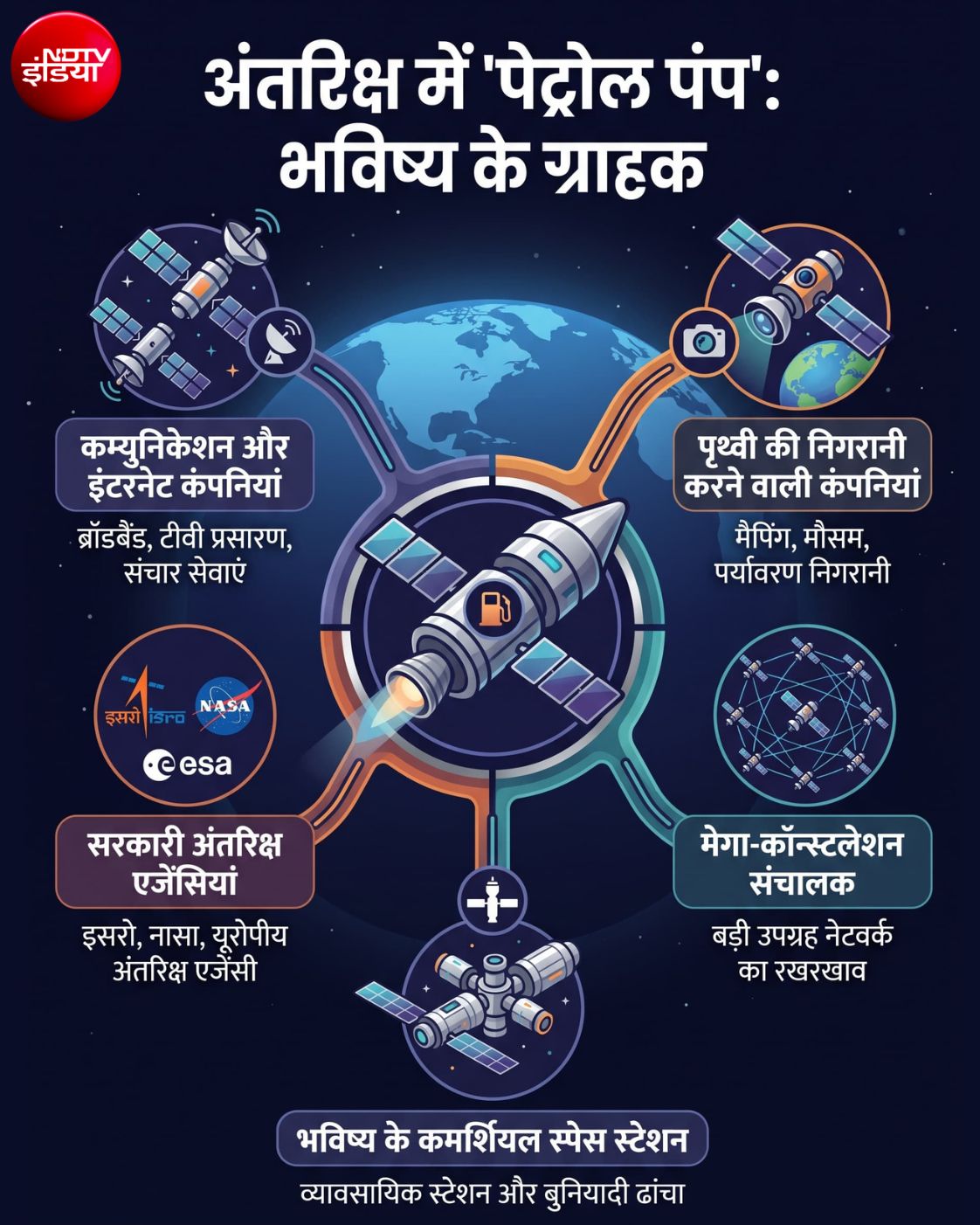
Who will buy fuel from this ‘petrol pump’ in space?
Potential customers for space refueling services could be organizations and companies whose satellites cost a lot and need to be kept in operation for a long time.
- Communication and Internet companies: Companies that operate satellites for broadband Internet, TV broadcasting, and communications services.
- Earth observation companies: Organizations that operate satellites that conduct mapping, weather, environment, and photographs of the Earth.
- Government space agencies: Institutions like ISRO, NASA and European Space Agency, if the service is available as per their needs.
- Mega-constellation operators: Companies that operate networks of large numbers of satellites that may require maintenance over time.
- Commercial Space Stations: Companies developing commercial stations and other infrastructure in space.
How will companies benefit from this technology?
There is huge expenditure on launch, construction and operation of sending satellites into space. If the rest of the equipment of a satellite is working fine, but its operation has to be stopped due to exhaustion of fuel, then the full benefit of the investment is not achieved.
If refueling is successful, there may be an option to keep such satellites in operation for some more time. This could help avoid or in some cases reduce the need to launch new satellites.
Apart from this, in future new business opportunities can also be created for repair, inspection and other servicing services of satellites.
However, its economic benefit will depend on the cost of refueling, the type of satellites that can be fueled and how safe and reliable the service proves to be.
Preparation for more advanced missions in 2027
OrbitAid Aerospace’s plans are not limited to just AyulSat-1A. The company is planning a more advanced mission in the first quarter of 2027.
Two satellites are to be launched in this mission. Of these, one will be ‘chaser’ and the other ‘target’. The chaser satellite will approach the target and technologies related to automatic docking, proximity operations and refueling will be demonstrated between the two.
The company is also working on jet-pack propulsion technology. In the future, such technology can be used to change the direction of satellites, service them and in some cases help in operations related to their orbit.
Technical testing and mission success will be necessary before all these capabilities can be used practically.
One potential benefit of refueling technology could be to extend the operational life of some satellites in space. This may reduce the need to deactivate satellites prematurely due to fuel exhaustion. So space garbage is also expected to reduce to some extent.
Source: ndtv.in