



Since October 1, 2026, MetroENERGÍA, the marketing company controlled by MetroGAS, resumed natural gas export operations through new contracts, in a scenario in which national production reached 155.7 million cubic meters per day during August, with a strong participation from the Neuquén basin.
The company reported this Friday, October 9, that it incorporated new natural gas marketing agreements abroad as part of a strategy aimed at expanding its presence outside the country. The resumption of these operations occurs after the experience developed during the previous season and aims to take advantage of the growth in the supply available in the Argentine market.
The advance of Vaca Muerta appears as one of the main factors behind this expansion. According to data released by the company, of the 155.7 million daily cubic meters of natural gas produced in the country during August, 119.4 million came from the Neuquén basin, whose volume registered a year-on-year increase of 1.7%. This availability allows us to expand marketing possibilities towards external markets.
Vaca Muerta promotes new opportunities to export gas
The Commercial Director of MetroGAS, Rafael Borrego, explained that the recovery of international contracts represents an opportunity to expand the business. “Resuming export contracts allows us to expand commercial opportunities and continue developing a business that requires increasingly sophisticated management,” said the executive.
However, Borrego clarified that the growth of exports also requires coordinating different aspects of the activity. “We have to articulate the available supply with demand, consider the supply and transportation conditions and build operations that are sustainable for all actors involved,” he said. In this way, the company seeks to link greater Argentine production with international marketing opportunities.
The return to the external market has as a precedent the first export of natural gas that MetroENERGÍA made to Brazil during 2025, when it marketed more than 6 million cubic meters. That operation coincided with the 20-year history of the company, created in 2005 as a subsidiary of MetroGAS, and marked the beginning of its participation in the export business.
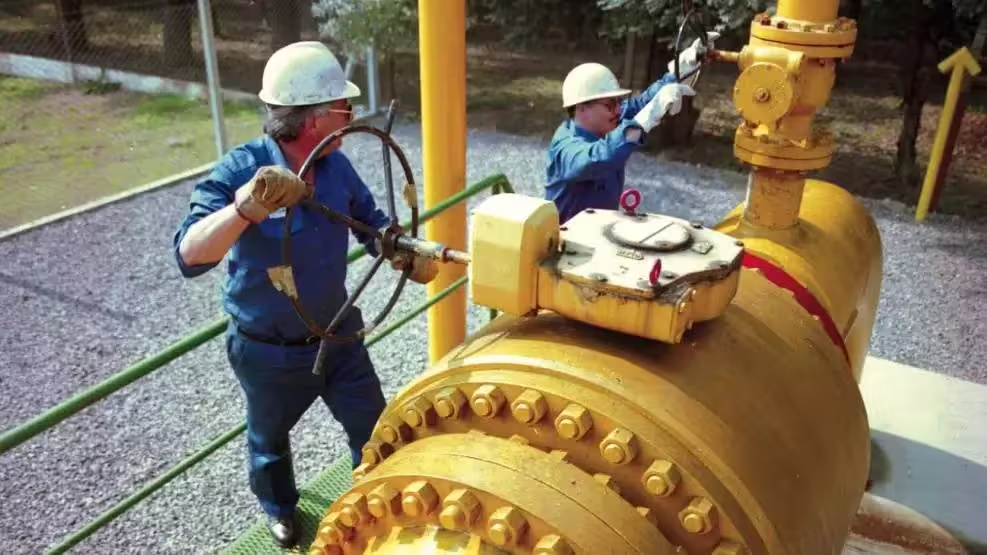
To sustain this activity, MetroENERGÍA has supply agreements with producers and transportation capacity to manage operations destined for different markets. The company highlighted that coordination between supply, transportation and demand is essential to maintain the predictability and continuity of international operations.
MetroENERGÍA seeks to expand its businesses inside and outside Argentina
The expansion of exports is part of a broader commercial strategy, which also includes the development of the domestic market. Currently, the company supplies Compressed Natural Gas (CNG) to almost 300 service stations, participates in gas generation businesses and develops electrical self-generation projects for companies that consume intensive energy.
In addition, during 2025 MetroENERGÍA signed an agreement to supply CNG to the first fleet of urban buses in the country that uses this fuel. To guarantee supply, the company maintains the continuous supply of natural gas to an exclusive charging station located in the Buenos Aires neighborhood of Barracas, from where the units are supplied.
In that sense, Pablo De Cicco, Wholesale Business and Supply Manager at MetroGAS, said that “the development of new businesses allows us to expand MetroENERGÍA’s proposal beyond gas supply.” For his part, Mariano Luzuriaga, head of Natural Gas and Transportation Marketing at MetroENERGÍA, highlighted that the integration of commercial management, demand planning and operational capacity makes it possible to develop solutions for both the domestic market and regional energy integration.
Looking ahead to the coming months, MetroENERGÍA will seek to add new international clients and continue developing its activities in the Argentine market. The company assured that it has access to all productive basins and firm transportation capacity to manage the gas value chain. “The opportunity is to develop markets to channel production growth, leveraged on our experience and ability to manage increasingly complex operations,” concluded Borrego.
Source: Profile
Source: energiaytransporte.com.ar