




Key Takeaways:
- The essay says Houthi pressure on Bab al-Mandeb has turned the Horn into a western edge of a Middle East war: Djibouti hosts U.S., Chinese, French, and Japanese bases; landlocked Ethiopia depends on Djibouti ports and Gulf ties when freight and insurance rise.
- Türkiye’s Somalia role is framed as naval training plus offshore exploration under production-sharing deals, with deepwater wells still a geological bet rather than proven oil.
- A find would not equal prosperity; the author says revenue split, security, and transparent management decide whether Mogadishu gains capacity or long-term dependence.
Geography possesses an undeniably dark sense of humor. For nations situated along the Horn, looking out across the beautiful, sun-dappled waters of the Red Sea and Gulf of Aden means staring directly at one of the world’s most important commercial arteries, and increasingly, one of its most dangerous military fault lines.
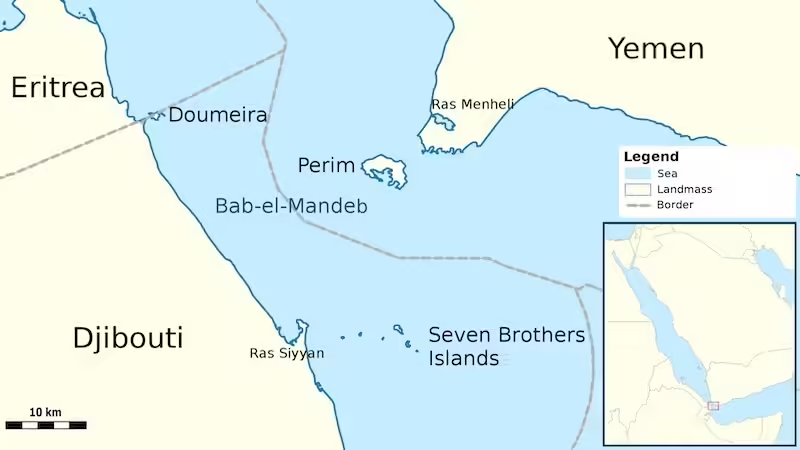
With the Iran-backed Houthi movement projecting military power from Yemen and threatening maritime traffic through the Bab al-Mandeb Strait chokepoint, the Horn shoreline has become the immediate western frontier of a Middle Eastern conflict it never chose to enter.
For the region, neutrality is becoming less a strategic choice than an increasingly expensive luxury. Foreign powers arrive not merely with diplomatic assurances, but with naval deployments, security agreements, investment packages, and demands for strategic access. In this environment, sovereignty is increasingly negotiated through contracts, security guarantees, and competing financial commitments.
The economic importance of the chokepoint explains much of the pressure. Djibouti occupies an especially consequential position. Despite its small size, the country hosts military facilities operated by several major powers, including the United States, China, France, and Japan.
Its strategic geography has transformed it into a heavily militarized diplomatic crossroads, only a short distance across the water from Yemen. Any sustained deterioration in security around the strait, therefore, carries consequences not only for regional governments but also for global shipping, energy markets, insurance costs, and international supply chains.
Ethiopia faces a different form of vulnerability. As a major landlocked economy, it remains heavily dependent on access to ports, mostly in Djibouti, for much of its international commerce. Disruptions to Red Sea shipping consequently create a chain of economic pressures extending deep into the Ethiopian interior.
Higher insurance premiums, freight charges, transit costs, and uncertainty over maritime access can all deepen economic strain. This has pushed Addis Ababa to strengthen ties with Gulf states and other external powers serving as a pressure valve on neighboring coastal countries, underscoring how geography can constrain foreign policy, even when governments seek strategic autonomy.
Somalia occupies an even more complicated position. Mogadishu is attempting to rebuild state institutions, strengthen maritime security, and assert greater control over its territorial lands, waters, and exclusive economic zone.
But instability across the Gulf of Aden cannot easily be separated from Somalia’s own security challenges, which exposes the country to external threats as its maritime space also contains some of its most significant economic opportunities.
This is where Türkiye has emerged as an increasingly important actor. Ankara’s engagement with Somalia has developed beyond conventional military training and diplomatic cooperation toward a broader security and economic partnership.
Under maritime and defence arrangements, Türkiye has taken on a significant role in supporting Somalia’s naval capabilities and helping Mogadishu secure its maritime domain. At the heart of this relationship lies the possibility of offshore hydrocarbons.
For decades, Somalia’s geological potential remained largely theoretical, constrained by political fragmentation, inadequate infrastructure, insecurity, and limited exploration. Offshore seismic surveys by Türkiye have now begun transforming that uncertainty into a more concrete exploration programme.
The deployment of Turkish energy infrastructure illustrates the scale of that ambition. The drilling campaign involves operations in deep waters off the Somali coast, where exploration wells must penetrate thousands of metres beneath the seabed – perhaps the second deepest venture for oil or gas under water!
Such projects require sophisticated drillships, seismic research, dynamic-positioning systems, specialist logging equipment, and extensive logistical support. Reaching a planned geological target, however, is only the beginning.
The financial architecture behind such projects is, therefore, as important as the drilling itself. Production-sharing agreements are designed to allocate exploration risks and future revenues between governments and petroleum companies. In frontier environments such as Somalia, the private or state-backed operator assumes substantial upfront costs and geological risks in exchange for a defined share of any future production.
The precise balance between cost recovery, royalties, profit petroleum, taxation, and government participation consequently becomes a central question of sovereignty as well as economics. What may appear on the surface to be a simple energy contract can determine how much revenue ultimately remains in the producing country, how much flows to the foreign investor, and for how long.
For Somalia, the immediate priority appears to be unlocking the oil and gas resources beneath its seas and territory. While foreign capital, technology, and expertise are essential to this effort, Mogadishu must ultimately ensure that resource development strengthens state capacity rather than deepening long-term dependence on external partners.
A commercially viable discovery could provide Somalia with new state revenue, support infrastructure, and enhance its strategic importance, while encouraging a more sustained naval presence to protect offshore energy infrastructure.
A discovery would not automatically translate into national prosperity. Turning offshore resources into lasting economic gains would require years of investment in infrastructure, security, and regulatory capacity, alongside stable institutions and transparent management of resource revenues. Ultimately, the benefits would depend as much on how Somalia governs and distributes its resource wealth as on the size of the discovery itself.
The scramble for the Somali Basin reflects a broader reality of twenty-first-century geopolitics: strategic geography, military security, energy, and sovereign finance are increasingly intertwined. Somalia’s position beside a vital maritime chokepoint, coupled with its potential offshore resources, makes it both strategically valuable and vulnerable to external pressure.
For Somalia, the opportunity is immense, but so is the dilemma. Offshore hydrocarbons could provide the economic foundation for a stronger state after decades of fragmentation. But turning geological potential into lasting national wealth will require more than drilling.
It will depend on equitable contracts, maritime security, effective regulation, transparent revenue management, and enough strategic autonomy to ensure that Somalia’s resources serve the Somali state rather than great-power interests.
The Somali Basin is becoming more than an energy frontier. It is emerging as a geopolitical arena where chokepoints meet checkbooks, and sovereignty is negotiated through contracts, security guarantees, and control of strategic infrastructure.
For Somalia, the real challenge is turning its expanding foreign partnerships into lasting national capacity rather than another form of dependence. After decades of being defined by what it lacked, Mogadishu now has a different problem: making sure that everyone drilling for its future does not end up owning a piece of it forever!

Source: www.eurasiareview.com