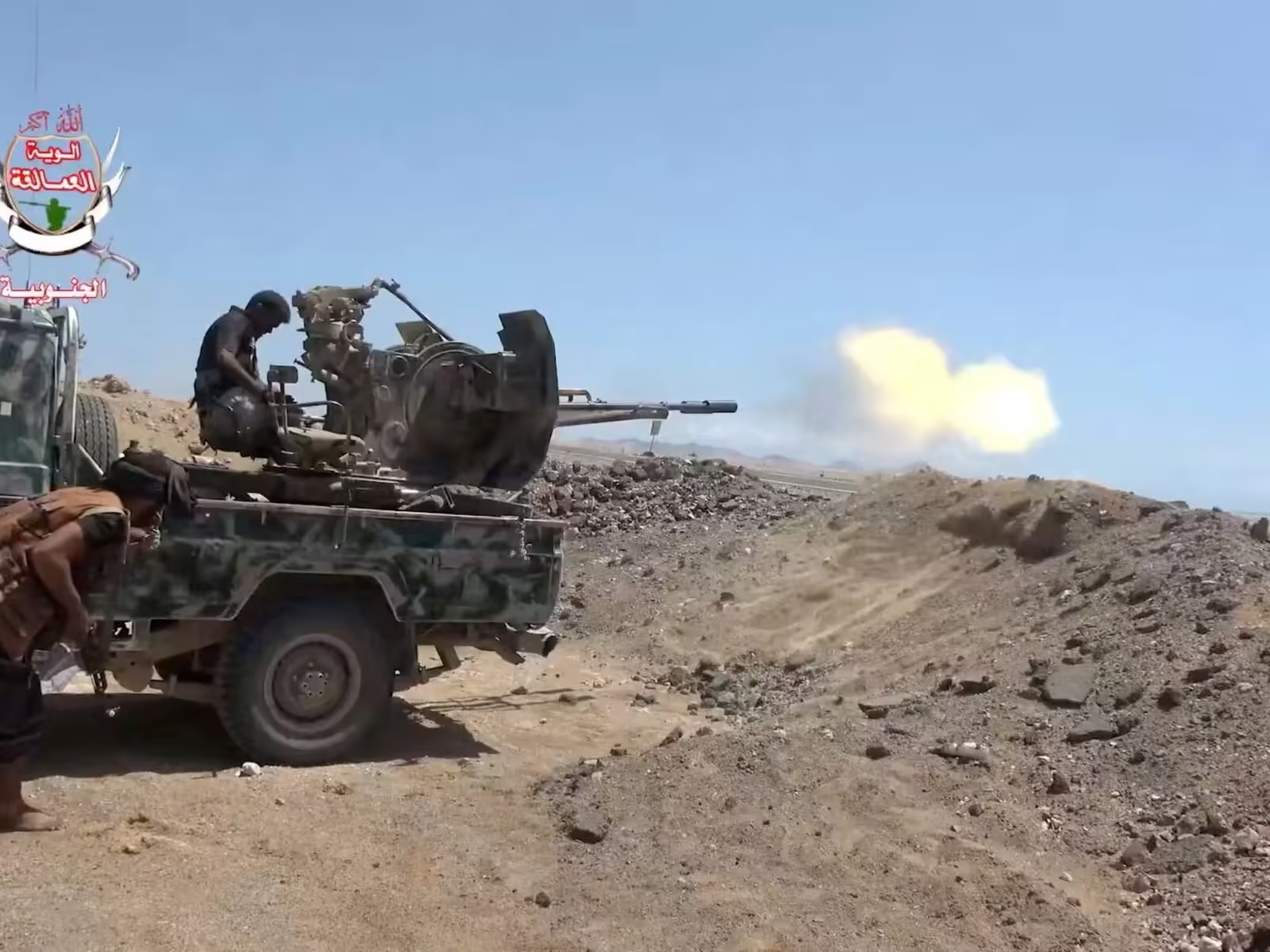

Yemen is witnessing a major military escalation that has once again brought the western coast and the area around the Bab al-Mandeb strait to the forefront of regional developments. Operation Yemen’s Dawn, launched by the forces loyal to the internationally recognised Yemeni government, has produced some results.
Government forces have advanced towards the strait of Bab al-Mandeb and are now fighting against reinforced Houthi positions. Clashes continue in parts of Dhubab District and around Dhubab Airport.
The central question now is whether these military moves can bring about a lasting change in the balance of power and whether they will widen the confrontation or open the way for a new negotiating process.
Control of Bab al-Mandeb
Fighting has concentrated around Bab al-Mandeb because of its strategic position in global trade and energy flows. It is especially significant to the parties to the Yemeni conflict because control of the coastline, islands and surrounding highlands offers varying capabilities for surveillance, military deployment and threats to maritime traffic.
An advance along the coast may enable government forces to retake key positions and restrict the Houthis’ space for manoeuvre. However, it does not, by itself, guarantee the security of the strait or eliminate threats to navigation.
Even if the Houthis lose coastal positions, they could still retain their ability to launch attacks in the Red Sea. Threats to maritime traffic do not necessarily depend on direct control of the strait; they also depend on the availability of missiles, drones, launch platforms, supply networks and the ability to operate from other locations.
As operations move from the coastal strip into the highlands, particularly the Kahbub Mountains in Lahj governorate and the highlands to the west and south-west of Taiz governorate, the challenges posed by the terrain, defence, movement and supply become more severe.
In this context, three distinct levels must be differentiated: retaking coastal positions, consolidating military control over them and establishing a sustainable capacity to secure the strait and its surrounding area. Confusing these levels may lead either to an exaggerated assessment of the operation’s results or to an underestimation of the adversary’s ability to continue fighting.
Unity and cohesion
Recent statements by Dr Rashad Al-Alimi, president of Yemen’s Presidential Leadership Council, signal a shift in objectives: from containing the Houthi threat to restoring state institutions and liberating Sanaa.
This shift gives the ongoing fighting a national dimension that goes beyond limited gains on the ground. Its success, however, remains contingent on the government forces’ ability to unify command, secure supplies and coordinate the various military formations.
Containing divisions within the components of the government—particularly over the southern issue—is essential to preserving gains and preventing the confrontation from turning into an internal conflict.
Success requires coordination among participating formations, avoidance of competition over spheres of influence and the linking of military gains to security and political governance capable of preventing fighting between factions.
This is especially important because the formations playing the most effective role in the coastal battles, the Southern Giants Brigades, originate from the southern governorates.
The regional dimension
The Houthi escalation is difficult to understand in isolation from the Iran war. Iran’s support for the group is well-known, but recent media reports have also revealed the extent of it. The Islamic Revolutionary Guard Corps reportedly has directed Houthi movements along the coast and encouraged escalation against Saudi Arabia, with commitments to provide further support.
Control of Bab al-Mandeb is strategically important to Iran and its allies, as increased pressure there can provide more leverage in the Iran conflict.
For Saudi Arabia, involvement in the Yemen conflict is driven by direct security concerns and a desire to reduce threats to its territory and nearby maritime routes.
Against this backdrop, a Saudi response to the deadly airport attacks appears highly likely. Riyadh may be less inclined to limit itself to familiar exchanges along existing front lines and could instead target sites or capabilities of greater importance within the Houthis’ military structure. What form the response takes may reflect efforts to impose significant costs without immediately widening the confrontation into a broader regional war.
At the Gulf level, collective military participation appears less certain. The attacks could prompt an emergency GCC meeting, stronger political statements, or greater defensive coordination, but reviving a joint military campaign against the Houthis would be more difficult. Gulf states no longer share the same degree of strategic alignment over Yemen, while differences, particularly between Saudi and Emirati priorities, continue to constrain collective action.
Pakistan and Turkiye, for their part, have announced support for Saudi Arabia under the Mecca Pact, although the exact parameters of their participation are yet to be defined. The current escalation may therefore test whether these partnerships remain political and defensive frameworks or translate into practical military support, including stronger air defence deployments.
US involvement also remains possible, but any direct role would likely be limited. Previous US intervention in Yemen has focused more on deterrence, maritime security and containing threats rather than on decisively shifting the battlefield balance in favour of the government forces.
An expanding confrontation does not automatically mean that all parties seek an open war. Some may use escalation to improve their deterrence or negotiating position, although the risk of miscalculation remains.
What happens next
Developments in the Yemen war in the near future depend on the government forces’ ability to hold the positions they have retaken, secure the area around the strait and the connecting roads and remove the Houthi threat from the highlands. If these conditions are met, the balance of military and political pressure could shift, though this would not necessarily end the Houthis’ maritime threat.
However, if the advance stalls at positions that are difficult to overcome and the Houthis are able to continue using missiles and drones to conduct counterattacks, this could create a protracted confrontation. A war of attrition could have a devastating humanitarian and economic impact not just on Yemen, but across the region.
The risk of escalation and region-wide war may still push the parties to seek an understanding or an arrangement to halt the fighting. Turning military advances into a settlement, however, would require addressing broader political and security issues, including power-sharing arrangements, mutual guarantees and the security of maritime routes.
In other words, the ongoing coastal battle could become a gateway to a broader change in the course of Yemen’s crisis rather than another round in a protracted war.
The views expressed in this article are the author’s own and do not necessarily reflect Al Jazeera’s editorial stance.
Source: www.aljazeera.com