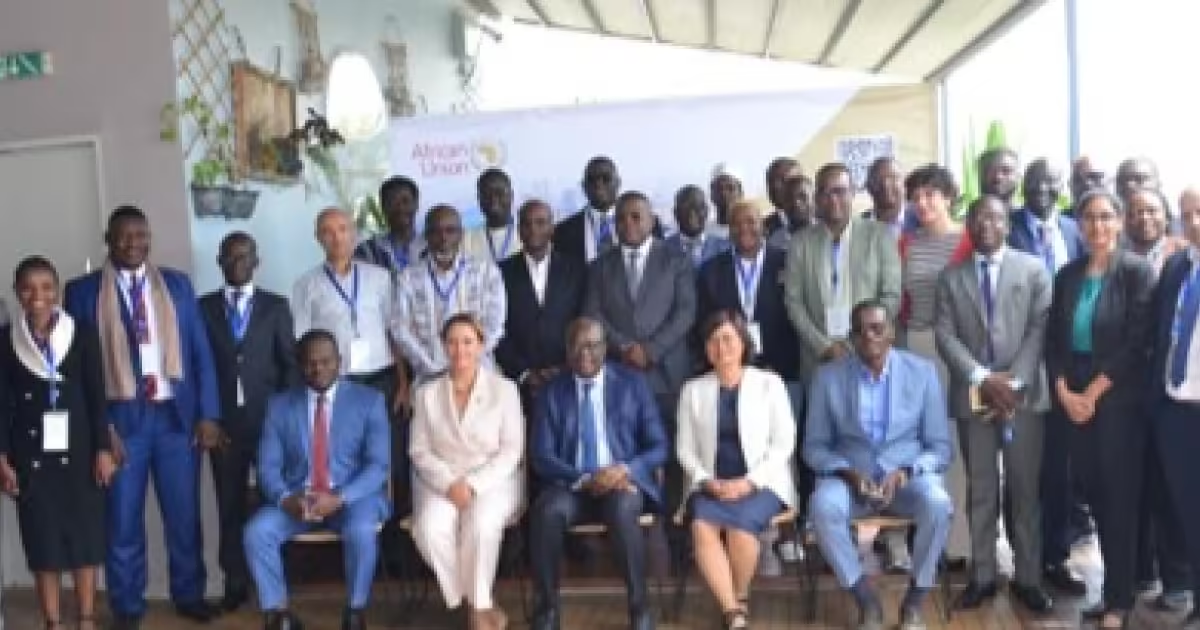

The African Union Commission (AUC) has concluded the second meetings of the Technical Working Group and Steering Committee of the Africa Urban Resilience Programme (AURP), held from 22–24 September 2026 in Lomé, Republic of Togo. The meetings brought together representatives of AU Member States, Regional Economic Communities (RECs), development partners, and other relevant stakeholders supporting urban resilience across the continent.
The back-to-back Technical Working Group and Steering Committee meetings reviewed progress in implementing recommendations from the inaugural meetings held in Cape Town, South Africa, in 2025, and considered strategic updates on the programme. Discussions focused on strengthening the AURP’s operational direction, improving working relationships and engagement among participating institutions, and sustaining efforts to reduce disaster risks and losses in African cities and urban centres.
Participants reviewed the continental report, themed ‘Urban Resilience in Africa: A Continental Review’, and its policy brief, along with the programme’s 2025–2026 activity report and the proposed 2027 workplan. Participants also considered the validated sectoral guidelines on water and housing, the AURP Implementation Plan, and its Monitoring, Evaluation and Learning framework.
While reaffirming their commitment, the meetings underlined the crucial role of coordinated, risk-informed urban development as disaster impacts increasingly affect cities and urban centres across the continent. The Africa Urban Resilience Programme, developed by the AUC and officially launched in 2024 in 2024, seeks to contribute to a sustainable reduction in disaster risks and losses while supporting resilient and sustainable development.
On behalf of the African Union Commission, Dr Jihane El Gaouzi, Head of the Sustainable Environment Division, highlighted the Programme’s main achievements since the AURP inaugural meetings in Cape Town in August 2025. These include the publication of Urban Resilience in Africa: A Continental Review, the development of sectoral resilience guidelines for water and housing, and stronger engagement in continental and global advocacy and fora. “These achievements reinforce our shared commitment to reduce disaster risks in cities, protecting people and assets, and advancing the objectives of Agenda 2063 and the Sustainable Development Goals,” she underlined.
Ms Karin Andersson, Head of Regional Cooperation at the Embassy of Sweden in Addis Ababa, Ethiopia, underscored the importance of risk-informed urban planning, nature-based solutions, and other innovative approaches to protect lives and livelihoods while strengthening the resilience of growing cities and towns. Highlighting the importance of coordinated action at all levels and of the AURP, Ms Andersson reiterated the importance of urban resilience, saying:
“Sweden is proud that our support to the UNDP Sahel Resilience Project has contributed to the African Union’s development of AURP. With Swedish support, UNDP and UN-Habitat have assembled data on infrastructure and services from nearly 500 local government areas across eight Sahel countries. The intersection of settlements, markets, natural resources and risks has then been identified, providing a stronger basis for planning and investment informed by both evidence and local needs.”
Speaking at the meeting, Ria Hidajat, Head of the Resilience Initiative Africa (RIA) Project at the Deutsche Gesellschaft für Internationale Zusammenarbeit (GIZ) GmbH, said that the German Federal Ministry for Economic Cooperation and Development (BMZ), through the RIA Project, supports the African Union Commission’s Africa Urban Resilience Programme (AURP), connecting continental ambitions with regional, national and local implementation.
“We work closely with Regional Economic Communities, AU Member States, local governments, civil society and multilateral organisations across Africa and look forward to continuing and strengthening these partnerships,” she added.
Participants also discussed strengthening collaboration with RECs and strategic partners to advance resource mobilisation and coordinate AURP’s engagements at global, continental and regional levels, including convening and participating in the second Africa Urban Forum, held from 8–10 April 2026 in Kenya, and participating in the 13th World Urban Forum, held from 17–22 May 2026.
The next phase of AURP implementation will focus on producing the State of Disaster Resilient Infrastructure Report. This will be followed by submitting the adopted AURP Sectoral Guidelines on Water and Housing, the AURP Implementation Plan, and the Monitoring and Evaluation (M&E) Framework to AU Member States and Regional Economic Communities.
About Governance and Coordination Mechanisms of the Africa Urban Resilience Programme (AURP)
The Steering Committee of the Africa Urban Resilience Programme (AURP) provides strategic direction and oversight, while the Technical Working Group supports coordination among institutions and partners engaged in resilience building. The African Union Commission serves as the Secretariat of the Steering Committee.
About the Africa Urban Resilience Programme (AURP)
The African Union Commission (AUC) developed the Africa Urban Resilience Programme (AURP), with support from the Government of Sweden and the United Nations Development Programme (UNDP) through the Sahel Resilience Project. The AURP is a continental framework designed to strengthen regional and national urban risk management policies and plans, as well as the institutional capacities of Member States to address urban risks.
Additionally, the European Union, through the 11th European Development Fund (EDF) Intra-ACP Natural Disaster Risk Programme, played a catalytic role in supporting the development of the AURP.
About Resilience Initiative Africa
The ‘Resilience Initiative Africa’ (RIA) is a regional project supported by Germany that aims to increase the capacities of regional, national, local, state, and non-state actors for risk-informed urban development in Africa. One crucial component of RIA is support for the Africa Urban Resilience Programme (AURP). The project is commissioned by the German Federal Ministry for Economic Cooperation and Development (BMZ) and implemented by the Deutsche Gesellschaft für Internationale Zusammenarbeit (GIZ) and its project partners.
About the Aqinile Partnership (AUC-UNDP-UN-Habitat-UNEP)
‘Aqinile’, which means ‘They are strong, they can withstand’ in the Zulu language, reflects the ethos and ambition of building resilience in urban Africa. The AUC, UNDP, UN-Habitat, and the United Nations Environment Programme (UNEP) have joined forces through the Aqinile partnership to deliver risk-reduction and resilience-building efforts and accelerate risk-informed development across the continent. The partnership serves as an implementation mechanism for the Africa Urban Resilience Programme, which promotes intersectoral coordination and advocates for urban resilience among AU Member States and Regional Economic Communities (RECs).
For media inquiries:
Mr. Molalet Tsedeke, Senior Communication Officer, Information and Communication | Information Communication Directorate (ICD) Tel. +251-115182014; WhatsApp+251-911-630631; Email: [email protected]
Ms. Maryanne Muriuki | Communications Analyst – Disaster Risk Reduction | Disaster Risk Reduction Unit | Directorate of Sustainable Environment and Blue Economy | Email: [email protected] | Addis Ababa, Ethiopia
Source: au.int