




A subsidy redesign shaped by US threats has sent more support to Tesla than Honda or Nissan, and the money is nearly gone. By Stewart Burnett
Japan has already near-exhausted its JP¥110bn (US$700m) electric vehicle (EV) subsidy budget just halfway through the fiscal year, with Tesla drawing appreciably more support than either Honda or Nissan. Payouts on eligible EVs sold between April and September would reach JP¥97.4bn, or 89% of the total, according to Nikkei, meaning applications could close as early as December.
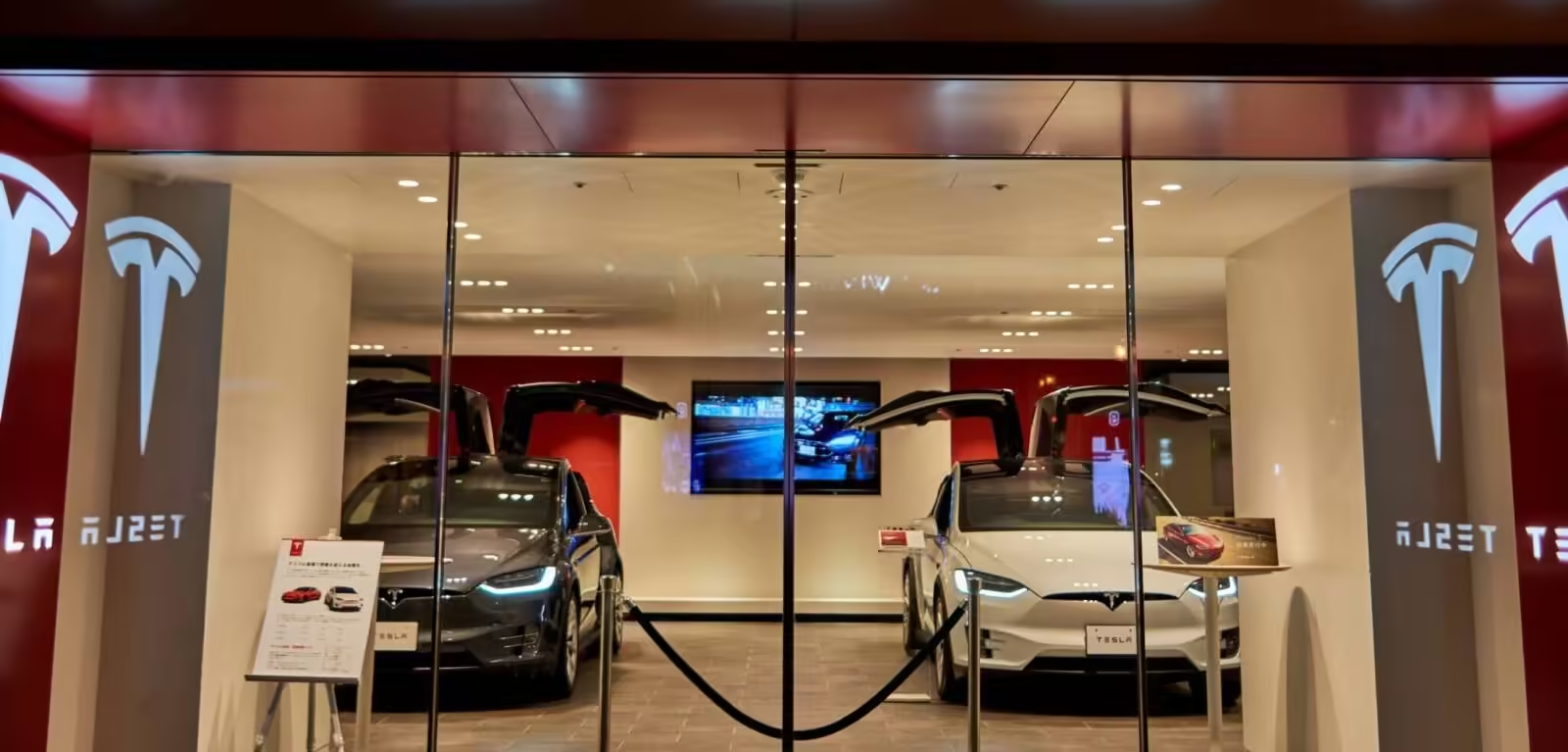
Toyota leads by manufacturer with JP¥34.5bn, 31% of the budget driven by the updated bZ4X, which qualifies for the maximum JP¥400,000 subsidy per vehicle. Tesla’s Model Y accounted for JP¥15.3bn, meaningfully ahead of either Nissan’s Leaf or Honda’s Super-One.
This particular outcome is unlikely to be an accident and can trace its roots directly to the revision of Japan’s Clean Energy Vehicle subsidy scheme back in January. The revision came on the heels of protracted US-Japan trade negotiations, which marginally raised the maximum EV subsidy by JP¥400,000 and cut support for fuel cell vehicles.
It also benefitted US automakers: the Model Y’s payout rose to JP¥1.27m, despite its Supercharger network scoring well under the scheme’s company evaluation criteria. “The change came after the US-Japan tariff negotiations, so it can’t be ruled out that some aspects could be perceived as favourable treatment from the government,” Yoshiaki Kawano of S&P Global Mobility (now Mobility Global) said at the time.
Meanwhile, BYD’s models—including the Japan-exclusive Racco kei EV—remained stuck at JP¥350,000-450,000. Multiple analysts have assumed the reason for this was political in nature, though Japanese regulators have refused to offer public comment. BYD has certainly drawn this conclusion: in March, BYD Japan President Atsuki Tofukuji told Nikkei that his company was at an “overwhelming disadvantage”. He remarked: “If the reason is just because we’re a Chinese manufacturer, then I want them to say so.”
Demand has responded dramatically, with passenger EV sales up 150% year-on-year to a record 70,273 units in the six months to September, lifting EVs to 3.7% of new vehicle sales. The side effects are just as visible: Tesla demand outran supply and caused repeated delivery disruptions, EV sales by other foreign brands fell 26% to around 7,900, and some used EVs now cost more than new ones. “The subsidy per vehicle is too high. We’re grateful for the support, but it has distorted supply and demand,” one Japanese automaker executive told Nikkei.
Japan’s Ministry of Economy, Trade and Industry admitted to the outlet that it may have misjudged the pace. “The budget is being used up about one month faster than we expected,” an official said, adding that subsidies have previously been granted retroactively. Yet the ministry is requesting the same JP¥110bn for fiscal 2027, which against a 150% surge in demand means either lower per-vehicle payouts or an even earlier cliff. Its pledge to review “appropriate levels” suggests the former is a more likely outcome.
Suzuki, for its part, is betting on neither. Its e-Sky kei car, launching in November from JP¥2.12m, will be Japan’s cheapest EV and was priced to compete with ICE-powered kei cars without relying on any subsidies whatsoever. “Subsidies are welcome, but they will end someday,” said President Toshihiro Suzuki. “Is it really the right approach to depend on subsidies to sell vehicles?”
Ultimately Tokyo’s scheme has done what its redesign intended, lifting EV sales from a very low base, while rewarding Toyota and the US automaker whose treatment sat in the background of trade talks. The likely cost, however, is a subsidy cliff that will fall hardest on the brands whose growth it has inflated most, Tesla chief among them. Whenever the money runs out, it will show how much of the 150% surge was bought, and quite possibly surrender the next phase of Japan’s EV transition to cheap kei cars that never needed the money in the first place.
Source: www.automotiveworld.com

